Top Line Thoughts: This movie has been on my radar for a long, long time and I was looking forward to finally seeing it. The only thing that kept me from 100% excitement was the runtime. 3 hours and 26 minutes. Add in 30 minutes of previews and a 45 minute round trip to and from the theater and the whole experience basically took half a day. It’s one of my favorite ways to spend a day, but still I felt like I was prepping for a marathon going in. I had to carefully plan my snack consumption and bathroom schedule so I wouldn’t have to get up during the actual movie. Luckily, it was a success! In more ways than one: I did not have to leave the theater during the film and the experience was worthwhile.
I wanted to start with this because I know the length of this film will deter a lot of viewers. Movies seem like they’re getting longer and longer these days and more and more people are trading in the theater experience to watch new releases from the comfort of their own home. While I personally am a huge fan of going to the movies, I understand and respect that it’s not for everyone. However, I think people need to acknowledge the way that viewing from home can significantly affect your perception and opinion of a film. I noticed this with the films The Batman and Glass Onion: A Knives Out Mystery last year. I saw both in theaters and greatly enjoyed them, as did critics and people on social media, but then when I talked to people I knew who watched the movies at home and saw the reaction online after the home releases, the sentiment was much more negative. I’m honestly not sure what makes the difference, but what I do know is this: if you are interested in watching Killers of the Flower Moon and cannot make it to a theater to see it, you have to commit to the experience when you watch it at home. Turn off the lights, don’t talk to anyone, don’t check your phone, don’t take long breaks – essentially pretend you’re at the theater. I don’t mean to sound preachy about “doing it the right way” (even though I do care about the sanctity of the movie viewing experience), but if you’re going to spend the 3 hours and 26 minutes to watch this movie, don’t you want it to be worthwhile? With a movie like this, you should get everything out of it that you can.
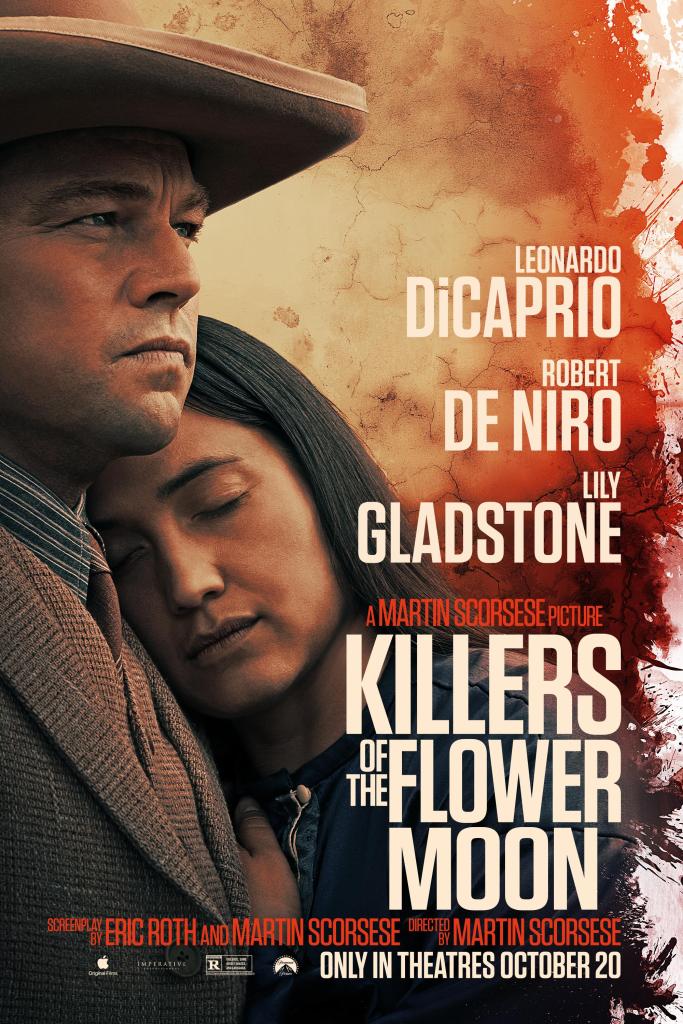
Do I think this movie needed to be 3 hours and 26 minutes? No. But I’m not going to sit here and tell Martin Scorcese how to make a movie. Do I think all 3 hours and 26 minutes of this movie are beautiful and powerful? Absolutely yes. Killers of the Flower Moon is adapted from David Grann’s 2017 non-fiction book “Killers of the Flower Moon: The Osage Murders and the Birth of the FBI”, although the movie focused much more on the former part of the subtitle than the latter. It tells the story of Ernest Burkhart, played by Leonardo DiCaprio, who moves to Oklahoma in the 1920s to work for his uncle William Hale, played by Robert De Niro. The area has a large population of wealthy Osage people due to the abundance of oil on their land and Ernest ends up marrying Mollie Kyle, played by Lily Gladstone, whose family seems to be in the center of a string of murders committed against the Osage.
While the source text is nonfiction and true crime adjacent, the movie tells the story from the perspective of the criminals. This is straight out of the Scorcese playbook. Most of his other films explore an objectively bad person as the protagonist, or at least a good person doing bad things, and even if you don’t feel sympathy or empathy for them, they’re still fun to watch. Scorcese has gotten criticism in the past for glorifying and glamorizing criminals in his films (think Goodfellas, The Wolf of Wall Street, Casino, etc.) because of the upbeat depiction of the crimes, even though if you’re really watching, the criminals all get their karma in the end. Killers of the Flower Moon may be his first movie to stray from that formula. The “bad guys” are so disgusting and perverse, the movie doesn’t let you think for a second that anything about this looks fun. The best way I heard this movie described was that it shows the “mundanity of evil”. How casually people can do despicable things and how no one around bats an eyelash. It’s not brash and flashy like other Scorcese films. It has a quiet dread throughout that adds to the story.
The center of evil in the movie is William Hale. Robert De Niro is one of the most famous and storied actors of our time and, after a 60 year career of smash hits, the caliber of his performance in this movie should not have been shocking to me. But for some reason it was. He was incredibly terrifying and unsettling while keeping an even keel for the majority of the film. He plays evil with a calm smile. Leonardo DiCaprio is kind of just always good at this point. He has consistently set the bar so high for himself that it isn’t even that notable anymore when he continues to reach it. Lily Gladstone was extremely impressive sharing the screen with two powerhouses and not only holding her own, but commanding attention. She also gives a quiet performance, communicating so much while barely saying anything. We usually recognize the larger-than-life performances, but this movie demonstrates a lot of outstanding restraint, which in some cases is even more remarkable. All three actors are receiving praise for their work, but De Niro really stole the show for me.
Killers of the Flower Moon is a challenge in both the runtime and the subject matter. It is dark and devastating but also powerful, moving, and has some of the most achingly beautiful sequences I’ve seen. It’s not a perfect movie. I didn’t always follow all the story beats or agree with every single choice. It is not the kind of movie that will have your jaw on the floor or have one major moment that punches you in the gut, but it will sit on your chest and your shoulders and get heavier and heavier as it goes on. And that won’t end when you walk out of the theater. You bring it home and it stays with you while you wonder how this could have possibly happened. The last 5-10 minutes also took a sharp left turn that really elevated the movie to a whole other level for me. This is an important story (that is unfortunately oddly prescient at this moment in time) told in fascinating fashion and I think everyone should try their best to experience it.
Spoiler Section: I walked away from this movie with so many questions swirling around in my head. On the largest scale, how? How could this have happened? How could so many people have let this happen? How could nobody care? As with any tragedy, historical and current, it is unfathomable to me that people could be so evil.
The smaller scale, though, is what is so interesting about this story. Because, sure, we know William Hale is evil. That’s not really in question. But with Ernest, his motivations are much murkier. He did seem to really love Mollie, but also committed acts of violence against her and her family and lied to her face about it. It seems really difficult to reconcile those two things, but somehow Ernest makes you question if they could both be true at the same time. Could he still really love her while participating in his uncle’s scheme? Is he just a dumb pushover who got in over his head without realizing what he was doing? Or was he smart enough to know but too afraid of his uncle to fight back? Or was he also just evil at his core and out for himself? Ernest seemed to occasionally struggle with the morality of his actions and I kept rooting for him to finally stand up to his uncle or make the right choice and show he actually cared about Mollie, but he never did. Time and time again he chose wrong until things had gone too far to be fixed.
Mollie herself wasn’t so black and white either. From the very beginning, she seemed to have Ernest pegged as being out for her money, but she married him anyway. Did she not care? Did she think he would change? Did she see some good in him, the part that wrestled with every decision but ended up losing in the end? Or did she just get caught up in his charm and distracted from the gut instincts that were flashing red flags? I guess everyone has their blind spots, whether you’re willingly ignorant or forcibly misled.
Mollie’s character is the one that, throughout the film, continues to take a hammer to your heart until it shatters into a million pieces. There are honestly no words to describe watching her deal with everyone she knows dying one by one and then being betrayed by her husband and William Hale, a man she knew from childhood and was always there for her family. She had everyone and everything taken from her and somehow managed to survive it all. Lily Gladstone plays this all with such a perfect mix of unbridled emotion and numb stoicism. You can see the light in her eyes dulling over time, each loss another blow to her spirit.
A scene that stood out to me as particularly painful wasn’t the loss of a person, but the loss of a fight. Mollie gives everything she has, a large sum of money and the last bit of strength in her failing health, to travel to Washington D.C. to appeal to the president to send someone to help solve the Osage murders. She makes her case, only to be brushed off and basically ignored. This is everything to her – her family, her home, her life – and no one else cares. I felt her frustration and dejection in that moment so deeply.
Structurally, Killers of the Flower Moon uses another Scorcese trope of alternating narration from different characters. The film doesn’t rely on the voiceover too often to tell the story, but just occasionally to fill in some plot. But, as I previously mentioned, it was the last 5-10 minutes of the film that stood out for me. Where many movies based on true stories end with a coda that tells you what happened in real life after the events you just watched, they are typically title cards with text that explains the aftermath. But in this movie, when the main action of the film ends, we cut to a live radio broadcast presenting the story and we see the coda in this format, complete with actors playing the voice roles of the characters, foley artists making background noises, and a narrator giving the overview, all on a stage in front of theater audience. This whole scene felt very much like Asteroid City to me with the vibe of the production as well as the story within a story. There is also irony in the fact that the radio show presentation is being put on by the FBI, ostensibly to share a true crime story, but really just to show their triumphs and paint themselves as the good guys in this sanitized version of events. While they did do more to help this case than others had, I don’t know that we’d go so far as to call them heroes.
The real kicker of this sequence was when Mr. Martin Scorcese himself appeared onstage to explain what became of Mollie in the aftermath of these events. Needless to say there was no real justice for Mollie or the Osage community as a whole. He then mentions her obituary in which he says, “There was no mention of the murders.” This is the final line in the film. Having Scorcese as himself deliver these last lines about Mollie breaks the fourth wall in a way that is tantamount to grabbing the audience by the shoulders and shaking them. He is telling us that this is not just a story in a movie. He is a real person and this was a real person and he is telling us her story for a reason. I’ve never seen a coda to a film executed so uniquely, powerfully, or poignantly.
I love risk taking in movies; whether it pays off or not, I always appreciate the attempt to try something different. This entire final sequence took risks in ways I did not think I would see from a movie like this and it more than paid off. I thought it was the perfect way to end this story, to jolt the audience into paying attention and remembering it so we can recognize the darkness of the past in order to prevent it in the future.
2023 Count: 26 seasons, 46 movies, 1 special
 I Think I've Seen This Film Before