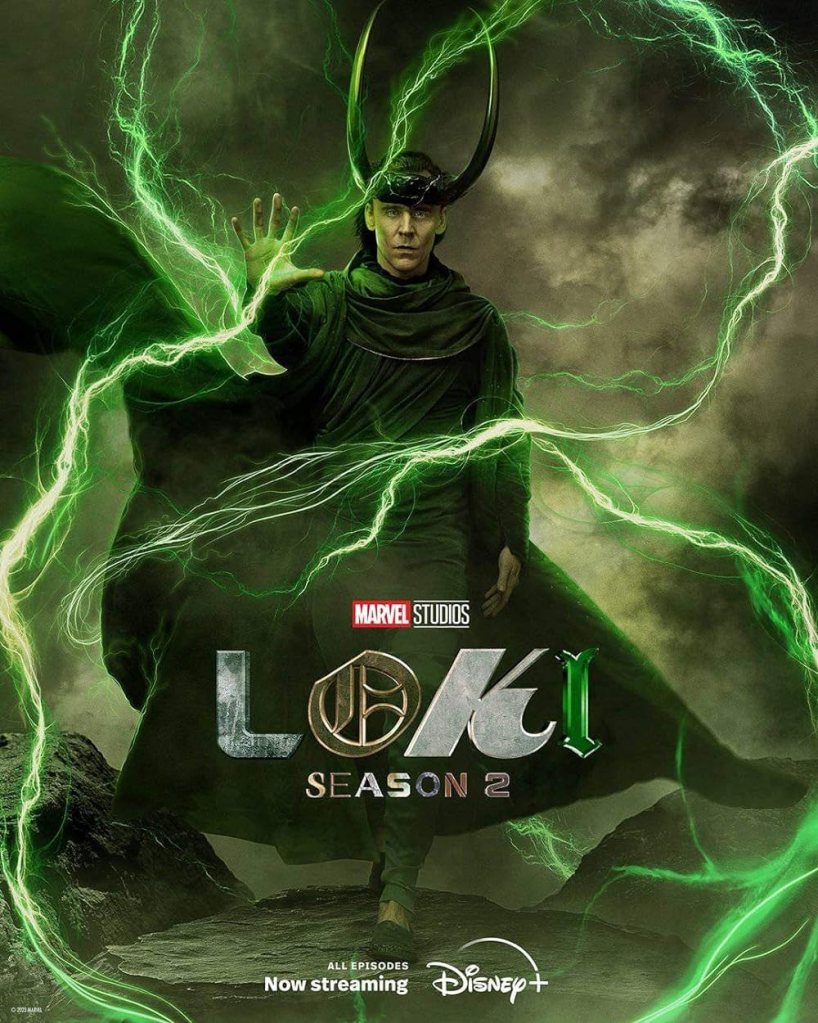
Top Line Thoughts: Season 1 of Loki was my favorite Marvel television show to date, so I was extremely excited for season 2. I had high hopes considering both the precedent set by the first season and also the rocky state of the MCU at the moment. Both Marvel and the fans needed some good content. After finishing the second season, I don’t know if I have ever experienced a season of television quite like this. A season where it seemed like most fans felt pretty iffy about it for the majority of the run and then the final two episodes completely flipped both the narrative inside the show and in the public sentiment around it. Halfway through this season, I could not have imagined myself walking away from it feeling the way I did: happy, sad, heartbroken, proud, emotional, confused, and more. But I can’t say disappointed is one of those feelings.
The season started off underwhelming for me for two reasons: the motivations and the stakes. These are two main pillars of storytelling that need to hold strong for the story to uphold its integrity. When they’re weak, the story starts to collapse. Season 2 of Loki picks up immediately where season 1 left off. While the season 1 finale was super strong and powerful, I felt a little lost in season 2 almost from the jump. I couldn’t figure out what was motivating each character’s actions from moment to moment and what their intended end goals were. This only became increasingly more confusing as the season progressed. I got to a point where I just gave up trying to figure it out because it was hindering my enjoyment of the show. The convoluted plot ends up actually working into the story so it bothers me less now than it did at the time, but I still think it takes a little too long of sitting in the confusion to get to that reveal.
The stakes of the season are reflective of an issue Marvel has been dealing with in content for a while. As these worlds get bigger, the stories do too. It’s not just multiple planets we’re covering but multiple universes and timelines and realms. But where Marvel continues to make a mistake is in understanding how audiences can process a scope that wide. Sure, it can all make sense intellectually (maybe?), but connecting on that scale emotionally is a lot harder. When a character says, “the fate of everybody in the entire universe is at stake” that sounds dramatic, but how much do we care? We can’t visualize that. We don’t know all of those people. But when the fate of a single character that we have grown to know over the course of a few movies or a season of television is at stake, we can feel that. That’s a personal threat. We care about that character and we are invested in their fate. Just because Marvel content now covers a wider scope and scale, doesn’t mean the stories themselves have to become outsized to a point where we can’t connect with them. At the end of the day, we’re here for the characters, not the other planets or timelines or universes. Loki starts the season with the fate of everyone in existence at stake, but over the course of the season manages to narrow its way down to a much more personal story that delivers the emotional connection we need.
The reason we care so much about the characters all comes down to the performances. Loki has always been one of the greatest characters in the entire MCU. He can do it all. A fantastic villain: clever, charming, funny, and backstabbing. But also someone who could show real emotions (mostly “hurt”) while trying to hide them behind his evil. For me, Loki was like Bellatrix Lestrange from Harry Potter. A villain you love to hate. Yeah, they’re obviously terrible people, but I would happily watch them do anything. It was hard to find anyone else on screen more entertaining. That also made Loki’s character arc throughout the run of this television series so fascinating. I won’t spoil it here, but not only did they take the character in a direction I wouldn’t have expected from him, but it was also a direction I wouldn’t have thought I would want or need to see. I would have been happy for Loki to remain a mostly one-dimensional villain because he worked that way. But this show expanded the character into such a fully formed figure that I care about and am invested in ten times more than I was previously.
I can’t imagine anyone other than Tom Hiddleston being able to portray the many facets of Loki throughout this character’s run. He can be so evil and yet Tom is so charming but also broken in the role that you can’t not feel for him. You’re always rooting for him at the end of the day, even if it’s against your better judgment. While Loki’s relationship with Sylvie is important for his character, it is really his friendship with Mobius, played by Owen Wilson, that is the defining relationship of the series. Owen Wilson’s laidback performance complements Tom Hiddleston’s frantic energy, but he is also able to tap into the emotionality when needed.
As for other performances this season, Sophia Di Martino as Sylvie had a lot more to do in the first season and I wish we would’ve gotten more from her here. Jonathan Majors was showstopping in the first season and, while he technically played a different character this season, I was not personally a fan of the strong choices he made in this performance. It is hard to say if we would have gotten more of him in this season had it not been for current complications in his personal life. New additions Ke Huy Quan as Ouroboros and Rafael Casal as X5/Brad Wolfe were both amazing and brought such a fun energy to the show.
While the first few episodes did have their moments, the final two really made the season for me. I feel like some of the enjoyment also came from the surprise of how much of a departure these episodes felt like from the rest of the season. I was also so impressed by the finale because it flipped the entire season without a crazy twist or cliffhanger that didn’t feel earned. Instead, it relied on the power of emotional connection and our accrued relationship to these characters. It broke the story down to its core pieces and spotlighted them.
Something I have liked about this show since season 1 is how, as the audience, you genuinely don’t know what the right decision is in any situation. It’s not black and white or clear cut and all sides make good arguments. Is there really even a villain? Or is everyone just fighting time in their own ways? While this season was a mixed bag, I think the thing that appeals to me most about this show is its non-traditional nature. Especially within the realm of the Marvel Universe, that is not an easy thing to do. And while the choices didn’t always work for me, the payoff in the end was worth it and I’m not sure it would have carried as much weight if the season didn’t play out exactly the way that it did. This is a really tough show to recommend if you are not fully entrenched in the world of Marvel, but I do think it’s really special outside of what it means in that world so it may be worth a shot either way!
Spoiler Section: If you’re reading this, I’m assuming that means you watched this season and you know how bogged down the earlier episodes got by the plot mechanics. I tried not to poke too many holes in the story or ask too many questions because I just ended up confusing myself even further. But here are a few of the major questions that ran through my head for the majority of the season:
- Why do we need to fix the Loom? Do we need it? Didn’t time exist before the TVA? How did it work then? Obviously it operated in some way without a Loom, so why do we need one now?
- On that note, why do we need the TVA now that we’re not maintaining the Sacred Timeline? Wasn’t that the whole purpose of their existence? If everyone is just free to live their lives on the timelines, then what is the TVA even doing anymore? Can’t they all just be free to go and live their own lives on the timeline? If their goal is free will, then there’s no need for a TVA to be in charge of or control anything right?
I guess mainly, like I said earlier, I didn’t really understand anyone’s goals or motivations. Not until episode 5. When Sylvie finally gets Loki to admit that he’s doing all of this because he “wants [his] friends back”, that felt like such an important revelation because it was the answer I had personally been searching for in why any of this mattered. Loki said it bluntly and plainly but so vulnerably, that he really cared for the friendships he had formed at the TVA and, for once in his life, he was not alone. He would do anything not to lose that.
It turns out that none of my questions or the answers to them really mattered in the end. It became kind of a “the real treasure was the friends we made along the way” season. Not in a bad way or even a corny way. But the reveal in the show that the all-important Temporal Loom was just a failsafe worked for the plot and also for the season. The Loom and all the questions surrounding it were not what season was ultimately about. The Loom provided a goal that Loki could work towards in order to maintain his new friends. It provided them a new adventure to go on together to further their relationships. And it provided Loki enough failures to learn how to succeed. I just wish this realization had come a little sooner in the season so we didn’t spend so much time caught up in details that didn’t ultimately matter.
It seemed for a moment like the only solution to the problem at hand was going to be for Loki to kill Sylvie. It was her actions that set this whole thing into motion in the first place. This was obviously an impossible choice for Loki to have to make: let all the timelines disintegrate or kill the woman he loves. The Loki/Sylvie relationship was so important to me in season 1 and I wanted them together so badly which made Sylvie’s “betrayal” of Loki in the season 1 finale hurt that much more. The two were then faced with losing each other twice at the end of season 2 when Loki contemplates having to kill Sylvie and then when he ends up sacrificing himself instead. While these moments did have an emotional impact, I felt like they would have hit much harder had we seen more chemistry between Sylvie and Loki throughout the season. It felt like they didn’t have much time together on screen and the time they did have was not spent exploring their romantic relationship, or really any relationship for that matter. That’s where those early plot mechanics held back some of the season because the characters were forced to discuss how the Loom works and what to do about the timelines and blah blah blah instead of what they mean to each other. Bottom line: this season did not have enough Sylvie and Loki for me and I think seeing more of them together throughout the season would have made their goodbye in the finale much more impactful.
Instead of letting all the timelines or Sylvie die, Loki goes with a third option and makes the ultimate sacrifice: himself. I had learned from a podcast covering the show that, in the comics, Loki is canonically a weaver so it made sense that he was destined to weave the timelines together. But even knowing this theory could not have prepared me for the sacrifice Loki would have to make for that to happen. After over a decade of being defined by his catchphrase “I am Loki of Asgard, and I am burdened with glorious purpose”, Loki is told by Mobius in the finale that, in reality, “most purpose is more burden than glory.” We can see Loki put that into practice as he essentially sacrifices his life to save the timelines. Loki was always more focused on the “glory” than the “purpose”, wanting to rule and feel important. But after finding people he cared about, he now has purpose, and that is to protect those people. To see a character as historically egotistical and out for himself as Loki give up everything to secure happiness for the people he cares about is incredibly moving. Now, he watches them pursue happiness from afar as he makes sure all the timelines run smoothly. On the one hand, he gets to see the payoff of his sacrifice but, on the other, he can no longer physically be a presence in the lives of the people he loves. The weight of his actions and watching them play out across his face absolutely broke me in this finale and still makes me emotional to think about.
Time travel stories are always difficult. They’re confusing and convoluted and hard not to be repetitive when we’ve had so many of them over the years. While Loki doesn’t reinvent the wheel here, I did like some of their specific takes on the ideas of time. When Loki learns how to control his time-slipping and uses it to replay the same moment over and over to get it right, he realizes it’s not working. It becomes apparent that for his plan to work, he’ll need to spend centuries learning science and math and physics and more. I thought in this moment he would try to come up with a different plan. But when the title card “Centuries Later” flashed across the screen, my jaw hit the floor. I couldn’t believe they actually went for it in that way instead of explaining around it or going in a different direction. I also loved O.B./A.D.’s explanation of time travel and other time related phenomena in episode 5. He said that everything Loki was explaining was impossible, but that didn’t mean he didn’t believe it could happen. That’s the basis of science-fiction: “It’s impossible. But don’t let that stop you.” This quote had serious echoes of one of the greatest Dumbledore quotes from Harry Potter: “Of course it is happening inside your head, Harry, but why on earth should that mean that it is not real?” Reality is what you make it and things are only impossible until you do them. The idea that rules are meant to be broken also feels very Loki.
Loki season 2 was beautiful, sad, moving, quirky, crazy (what in the hell was going on with Miss Minutes? That’s an entirely other conversation I don’t feel like getting into), emotional, fun, and more. It remains probably my favorite Marvel show and a special show even outside of the Marvel world. I will for sure miss this show and Loki as a character. Who knows if we’ll be getting more of either?
P.S. Hours after finishing this show, I went to a screening for work and the guy sitting in front of me was wearing a TVA jacket. Is that a sign? What do we think it means???
2023 Count: 28 seasons, 47 movies, 1 special
 I Think I've Seen This Film Before