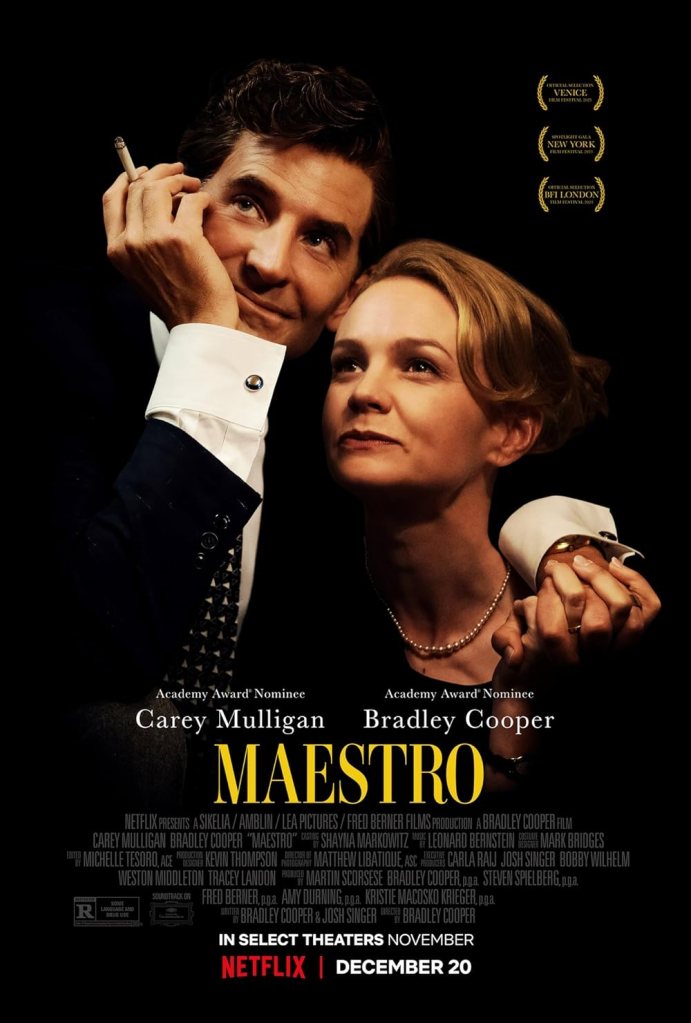
Maestro is not your typical biopic. But whether that is intentional or not, what it wants to be and doesn’t want to be, is not clear. I went into this film thinking it would be about the life and career of composer and conductor Leonard Bernstein who, if I’m being honest, I knew nothing about. I learned from this movie that he composed the music for West Side Story which really feels like something I should have known. But nonetheless, I was excited to learn about this famous figure as I usually am with any biopic (a popular genre as of late). And while I did learn about Leonard Bernstein from this film, it wasn’t in the way I expected.
The movie is way more interested in Leonard’s personal life than his career. It mostly follows his relationship with his wife, Felicia Montealegre. So much so, that I wondered at points if the film is really intended to be a portrait of her. But instead, it sits in a strange middle ground where it doesn’t dive fully enough into either Leonard or Felicia to be wholly about one or the other. So, in a sense, it’s about their relationship. I would say the film sits way more comfortably in the relationship drama genre than the biopic genre. We do see flashes of Leonard’s increasingly flourishing career throughout the movie, but more as a backdrop to the stages of his relationship with Felicia. I can’t really say I learned too much about Leonard’s work and career that I didn’t know previously (which I will remind you was virtually nothing). I would have loved to see even just a brief scene of his work on West Side Story!
This ambiguity left me unsure of how to feel about the film afterwards. Did I not like it because it wasn’t good or because it didn’t meet the expectations I had set for it based on my own parameters? Or did I just not get it? I think the best conclusion I can come to is that it just wasn’t what I wanted it to be. It was enjoyable enough to watch, but felt a little aimless and like I was waiting for information and moments and milestones that wouldn’t come. This type of movie may really benefit from a rewatch where I can go in knowing what to expect and not be faced with disappointment after the fact.
Even though the intention of the movie was not clear, two things were: the vision and the passion. This movie might not know what it wants to say, but it definitely knows how it wants to say it. It starts in black and white and then later shifts into color to depict later decades, all the while looking so crisp and visually stunning. Any shot from this film could easily be a standalone painting. Many of the scenes are also long, static shots which, when paired with lengthy dialogue, feels more like watching a play than a movie. It really gives the actors a chance to shine (and they do – more on that later). The visuals and actors are perfectly complemented by the hair and makeup, which is something I typically don’t comment on (even for movies like Barbie and Poor Things where they are an integral part of the aesthetic), but it stood out for me so much here. I don’t think that I’ve ever seen such seamless, naturalistic old-age makeup in a film before and it is so important in helping viewers remain within the world of the story.
The movie also has a specific vision of how to communicate the story. While it takes place in reality, the entire movie does have a dreamy quality to it. And a few scenes break form into fantasy. There’s a really interesting and creative Broadway ballet sequence that I really enjoyed and a Thanksgiving Day Parade scene that feels like hyper-reality. Both stood out from the rest of the film while still serving to tell the story through plot as well as form. Another distinct choice the movie makes is to use only the music of Leonard Bernstein as the soundtrack. I felt like this really honored him and his work beautifully and also showed the breadth and range of his talent. I will typically always advocate for seeing movies in the theater when you can but, in this instance, I would not have known that it was Leonard Bernstein’s music playing if it wasn’t for Netflix subtitles.
Both the vision and the passion come from the filmmaker. In this case, that is Bradley Cooper. One thing I felt while watching this movie more than anything else was that Bradley Cooper put his heart and soul into this production. You could feel his effort in the acting, in the directing, in the specific visual choices. This can sometimes be a bad thing, obvious effort (some have said you can feel him “delighting in his own genius”), but I didn’t necessarily think so in this case. Knowing how much he cared about this story actually endeared me to the film probably more than I would have felt otherwise. While this movie is wildly different in many ways from his directorial debut, A Star is Born, (likely an intentional choice by him to show his range and not pigeonhole himself) it actually does cover similar themes of the struggles of balancing fame and love. Whether that was intentional or not is debatable. Is that a theme that he is interested in exploring and could become a recurring motif in his work, like Steven Spielberg with childhood and dysfunctional families? Or is he unintentionally letting his own life bleed over into his work, accidentally making semi-autobiographical films? I will be interested to follow his career and see how his future work compares to these first two films.
As for his acting, it’s over-the-top and energetic but feels like it fits the personality of the character. Carey Mulligan plays off of Bradley Cooper perfectly as the other half of this complicated couple. Both make the lengthy dialogue feel lived in and organic as opposed to recited. THE scene of the movie, Bradley’s big showcase, is a scene in which Lenny conducts Mahler’s “Resurrection Symphony” in a performance at Ely Cathedral in England. This is the scene Bradley has talked about having worked on for years. The performance, physically in his conducting and emotionally on his face, is dazzling and thrilling. You can’t take your eyes off him. He is possessed by the spirit of Lenny and moved by the music. This scene, more than any other, conveys the power of music. Why it means so much to people, how it can conjure emotion, why it deserves to be studied and respected and celebrated and enjoyed.
I definitely have mixed feelings about this movie. I respect and appreciate all the efforts that went into making it and did enjoy some aspects and sequences but, overall, feel like it missed the mark for me. I’m glad I watched it but don’t think I would jump to recommend it, especially since it is more on the slow and quiet side which usually needs a little more punch to make it worth the watch for most. However, if you do decide to watch it, there’s definitely a lot to like and even more potential peeking through for Bradley Cooper’s future in filmmaking. He has shown that he has the talent and the vision, it’s just about putting all the pieces together in the most effectual way.
2023 Count: 30 seasons, 56 movies, 1 special
 I Think I've Seen This Film Before