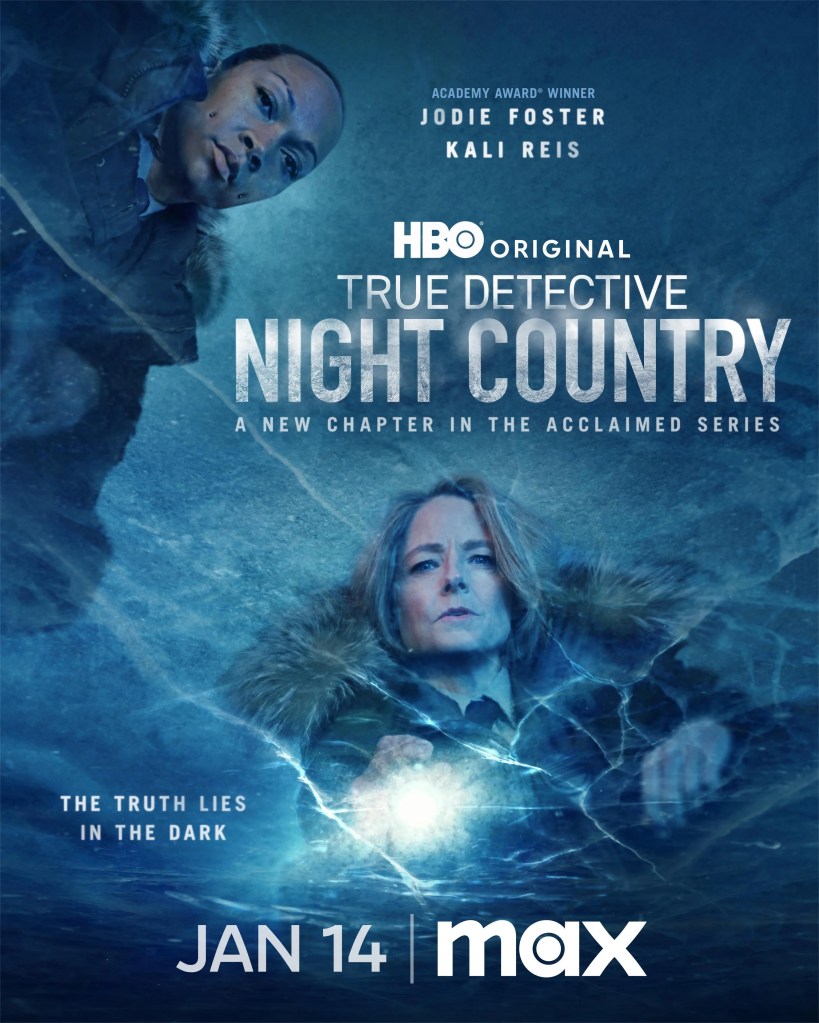
I had almost forgotten about the show True Detective when this new season came around. The first season, considered by many to be one of the all-time great seasons of television, premiered 10 years ago already. Many would like to forget season 2 exists and, while season 3 was better, it never reached the heights of that initial showing. When the show came back into the conversation recently, I decided to rewatch that first season. I barely remembered it having originally seen it so long ago. It was as good as I had thought at the time with compelling characters and a complex mystery, but extremely dark, disturbing, and upsetting. I wondered if despite having a different creator than the first 3 seasons, season 4 would be the same. It both was and it wasn’t. The new season was definitely dark, but more in a horror movie way than the nihilistic manner of season 1. As for the characters and the mystery in season 4, both started out as compelling and complex, but I think ultimately failed to reach a satisfying conclusion.
I thought the setup for the season was really intriguing. The story takes place in the fictional small town of Ennis, Alaska. Ennis is a place that experiences the real world phenomenon of “polar night” which is a period of 24/7 darkness that begins around the winter solstice. Just after the last sunset of the year, eight scientists at a secretive research station seem to vanish into thin air. I think that is such a cool place and time to set a mystery. It is inherently creepy and odd. The dark makes everything scarier and everyone a little crazier. We all know how it feels when daylight savings ends in the fall and the sun sets at 4pm. Seasonal depression skyrockets with that little sunlight. I can’t even imagine what it would be like to have no sunlight at all for weeks on end. You feel disoriented even watching the show. There is never any concept of what day or time it is. Any scene could be at 3am or 3pm. An episode could take place over 5 hours or 5 days. I really like this setting for the show and the way it contributes to the unsettling atmosphere.
The vibe the show sets from the beginning is spot on and feels like it takes inspiration from other iconic entertainment. The idea of the science lab feels like Lost’s Dharma Initiative (in addition to other things that come later), the flickering lights feel like Stranger Things, the potentially supernatural aspects of the case feel like The X Files as well as the dynamic between the main two detectives. A lot of the ice and snow gives off an eerie glow that looks cool and scary (but watching this show does make me super cold). Sometimes the music works (I really like the choice of using Billie Eilish for the theme song), but sometimes it’s a little too corny and on the nose (way too many doomcore covers of pop songs). Overall, the world and ambience of the show feel fully formed and intentional.
Aside from the vibe, the thing that makes True Detective True Detective is the characters, the detectives. Season 1 had the famous duo of Matthew McConaughey and Woody Harrelson while season 2 featured a group of detectives and season 3 focused on just one. This new season brings us back to where we started with a mismatched pairing of detectives, except this time both leads are women. One major criticism the original run of True Detective always received was for misogyny. Women were often undeveloped characters who suffered trauma and violence for reasons that didn’t always serve the story. Under the helm of a female creator, this new season provided an opportunity to bring women to the forefront of a True Detective story. Enter Jodie Foster and Kali Reis as Chief Liz Danvers and Trooper Evangeline Navarro, respectively. The pair bring a great contrasting dynamic in many ways. Danvers is a realist while Navarro believes in spirits and religion. Danvers is white and somewhat of a newcomer to the town while Navarro is part Native and has lived in Ennis most of her life. Also, from a viewing perspective, Jodie Foster is a seasoned veteran in the industry while Kali Reis is a fresh face for most. All of these contradictions make for so much potential interplay in the story, but they are teased and then never fully explored. There are much larger points that could have been made or even questions that could have been asked about Danvers and Navarro as cops with different approaches and who is doing the policing and who is being policed in a place like Ennis with a large indigenous population, but the show just barely skims the surface.
Jodie Foster and Kali Reis are both great in their performances. Jodie said she wanted Danvers to be unlikeable and she definitely achieves that, but still manages to make us care about her and see the good intentions hidden under her harsh words and actions. This character is another entry into a newly forming trope in modern television of “the hardened female cop in a blue-collar community”. It reminded me most closely of Kate Winslet in Mare of Easttown, a show that actually feels more like the first season of True Detective than this fourth season. Another parallel to Mare is the character of Peter Prior, played brilliantly by Finn Bennett (who I just learned is Irish-British and was doing an American accent which is just always a crazy realization). Peter is a young cop who looks up to Danvers and wants nothing more than to learn from her. He mirrors Evan Peters’ young detective character from Mare which, if you’ve seen that show, made me extremely worried for him throughout the entire run of the season. I also think he looks just like Dean from Gilmore Girls which also influenced the way I thought about his character (a well-meaning dope). Peter’s storyline finds him pulled in all directions by family: his father who is also a cop in town but not a great one (or a great person), his wife who resents him for never being home for her and their son, and Danvers, his surrogate mother who cares for him deeply but pushes him maybe too hard. He is eventually forced to literally choose in one of the more shocking scenes of the season. I really liked a lot of the Peter stuff but sometimes it did feel like it was taking place in a different show from the rest of the story.
Ultimately, I think one of the biggest issues this season suffered from was time. Most of the pieces seemed great but they weren’t given enough room to breathe. It felt like too many threads were started and not enough of them were wrapped up, let alone even explored. The creator of this season, Issa Lopez, claims HBO asked her to do more episodes in the season but she felt like 6 was the right amount for this story. I’m not sure how true that is but I personally don’t feel like it was the right decision for all the elements this story tried to include. Aside from being overcrowded, many mystery shows suffer from intriguing setups with unsatisfying conclusions. The questions are more interesting than the answers. The season started out strong but I didn’t feel like the ending gave me the resolution I wanted from the majority of the storylines and character arcs.
Another staple of a season of True Detective is the balance between reality and the supernatural. The show has traditionally taken a path of having aspects that feel supernatural but always have a real world explanation. This season felt more supernatural than most and really pushed the boundaries of what people may consider plausible. Spirituality is a big theme throughout the season as it connects to Ennis itself and the indigenous communities. It’s made out to seem like a common thing that people in town see ghosts, especially during the polar night. “It’s a long night. Even the dead get bored,” one character says in the first episode. I don’t mind the spooky elements tying into the story. But where it gets complicated is how these elements become incorporated into conversations about mental health. The season creators said they tried to be careful about separating these two worlds, but I don’t think they did a good job at this. There are Native characters in this story who are in touch with traditions and connected to spirit worlds and there are also characters who suffer from severe mental health issues and see things that are not there. But we never really know which is which. Navarro’s sister, Julia, suffers from some kind of mental health issues that are never clearly defined. Their mother also had the same issues. Julia has visions and hallucinations that often upset and agitate her. She is eventually placed in a psychiatric hospital. There has been some discussion that possibly a point of the story is to show how Western medicine does not understand cultural traditions and has misdiagnosed Julia’s connection to the spirit world as a mental health disorder. I think that’s an interesting theory but, again, the show doesn’t do enough to try to argue or explore that. The confusion of these concepts is then further compounded when Navarro herself begins having the same kind of visions and is forced to grapple with what they mean for her and her life. The ending of Navarro’s arc is left a little bit ambiguous but, if it means what I think it does, I really do not like the message the show is sending about mental health. It’s confusing and honestly dangerous. To not totally criticize, the one idea born out of the spirit world aspect of the story that I do really like is that there is a fate worse than death and it is being haunted. For those who are not dealing with mental illness, living a haunted life, a life right on the edge of the spirit world, is not really a life at all.
True Detective is an anthology series, meaning each season is a completely new, unrelated story. However, season 4 did draw some intentional parallels to season 1. At first, the connections were small, like the ghost of a character being revealed to be Rust Cohle’s (Matthew McConaughey’s season 1 character) father, Travis Cohle (it was already established in the first season that Rust was from Alaska so this made sense). Or the source of the money behind the mysterious science lab and the town’s mining company being Tuttle United, a link to the corrupt Tuttle family who play a major role in the season 1 case (large political cover ups and conspiracies are also a mainstay of all the seasons of this series). I liked how these details established that all of the stories from different seasons took place in the same universe without having to interconnect the cases. These small connections were also mentioned without explicitly referencing Rust Cohle or any specific details from season 1. It was the kind of thing where if you got it, you got it and if you didn’t, it didn’t take away anything from your understanding of the story. But as the season went on, the connections became much more overt than I was expecting, culminating in a character in the final episode repeating a full line of dialogue pulled from season 1: “Time is a flat circle” (Honestly, that’s kind of meta in how that sentence also relates to the way these stories recycle that line and those themes). This blatant callback to season 1 (probably one of the most famous lines from the series) was a little bit too on the nose for me. I preferred the subtler references. That being said, I am not one of those psychos who thinks that including allusions to previous seasons somehow ruins those seasons. I have always said that I don’t understand when people think that sequels or prequels or remakes or reboots or any of that can “ruin” the source material. All of these things can exist on their own and be appreciated on their own merits. Nothing that comes before or after has to diminish that in any way unless you let it. Anything that happens in season 4 of True Detective does not change anything that already happened in season 1. People on the internet (mostly men) are way too sensitive about this stuff and can’t let themselves just enjoy a new entry into this story without getting up in arms about “the sanctity of season 1”. Since when did this show and that season become so precious that the new season has so many people so mad? I personally think a lot of it is misogyny because season 1 was extremely male-oriented, created by a man, starring two men, featuring a very stereotypical male perspective, and season 4 is created by a woman and starring two women. Also, the creator of the first three seasons, Nic Pizzolatto, is no longer associated with the show, had nothing to do with season 4, and has spent a lot of time publicly criticizing the new season which is just adding fuel to the fire. I just think that’s disgusting and unnecessary behavior and he should get over himself. This is the most relevant he has been in years and it’s because of a show he had nothing to do with. Did he forget he made season 2, objectively the worst season of the series?
Pulling back from that mini rant, this season did have a lot of issues. But I never had a bad time watching it. I am always down for a good murder mystery. Sometimes the endings aren’t as satisfying as you hope for but it’s still fun to play along for a while. This is the kind of show that I love to listen to a companion podcast with where they talk about details you may have missed and theories and everything else. You get to play detective along with the characters. There’s so many more specific things I could say about this season so if anyone wants to have a spoiler-FILLED conversation let me know! But if you haven’t watched and are considering it, it’s not the best season of television I’ve seen, it’s not the best murder mystery crime show, but it has its moments of being creepy and interesting and entertaining and it’s only 6 episodes so not a huge time commitment. The show has been renewed for a season 5 with the same creator and I will definitely be back to see what the new season will have in store!
2024 Count: 7 seasons, 10 movies
 I Think I've Seen This Film Before