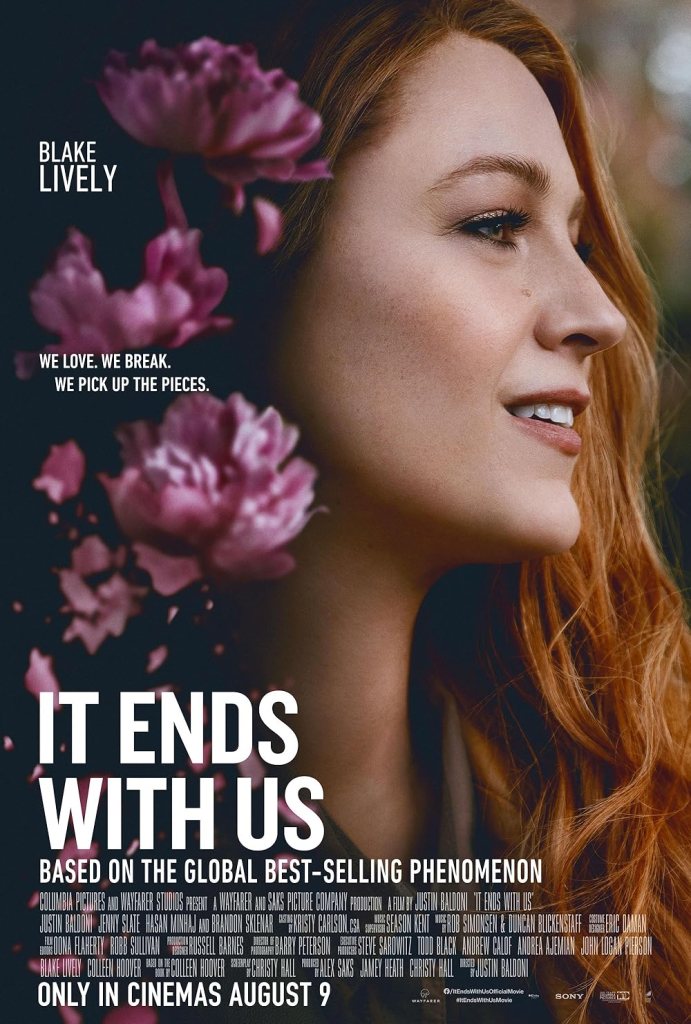
A movie should really be just about the movie. But I’m sure we all know it is almost impossible not to let outside forces influence our thoughts and feelings. Do we like or dislike the main actors as people? Did we already hear it got negative reviews? Are we in a bad mood when we watch it? Was the woman sitting next us in the theater talking to her friend the whole time? There are so many factors that go into our experience of watching a movie that are not just what we see on the screen. Sometimes I wish I could be impervious to the outside noise so my opinions of films are clear and objective. But that’s probably impossible.
It Ends With Us has had an inordinate amount of outside noise. The film is an adaptation of an enormously popular book. It spent more than two years at the top of the The New York Times best-seller list and is one of the biggest books on BookTok (for the chronically offline, that is the side of TikTok where people review, recommend, and discuss books). I read the book a few years ago and liked it at the time, so I was looking forward to seeing this adaptation. But boy it’s been a journey. The worry started with the casting of Blake Lively. She was not at all what readers had imagined for the protagonist, Lily Bloom. Mainly because Lily is supposed to be 23 and a redhead and Blake Lively is 37 and blonde. The team then announced they would be aging up the characters in the story. Despite my immediate negative reaction to the casting, I do really like Blake and thought the story worked perfectly fine with older characters. Then, during filming, the first set photos hit the internet. Blake Lively’s outfits were shocking and atrocious. I was majorly concerned. I do have to say, though, while the outfits were definitely still questionable on screen, they did not look nearly as bad as the set photos. Probably because Blake Lively is supremely cool and can kind of make anything work. The next strike was the first trailer. The outfits already had me worried, but the first trailer pushed me over the edge. I can’t pinpoint exactly what it was, but it just looked bad. As in, the trailer made the movie seem like it was going to be bad. The acting and the music and everything felt so corny and cringey. I wondered if I would even want to go see the film if this is what it was going to be. But then, a shift in momentum, the initial wave of critic reviews hit the internet. And they were mildly positive! I was shocked. But also relieved and excited to see the film once again.
That’s where the story ends, right? A happy ending? Not so much. Right before release day, chatter started online when fans noticed that Justin Baldoni, the director of the film who also plays one of the lead characters, Ryle, had been doing press separately from the rest of the cast. Not only that, but it seemed like the rest of the cast also all unfollowed him on social media. What started as niche internet buzz quickly exploded into national news with rumors flying of onset feuds and struggles for power. What really happened? We’ll probably never know for sure. Some people are on Justin Baldoni’s side and some people are on Blake Lively’s side. No one asked but I’m in the middle; I’m sure they both just rubbed each other the wrong way and this all got blown out of proportion. The story drew a lot of comparisons to the 2022 press tour for Don’t Worry Darling which, for those who don’t recall, was fueled by gossip and drama from start to finish. I don’t know if this can be definitively proven, but I think the real-life drama that surrounded Don’t Worry Darling led to a much greater public awareness of the film and a greater interest in it, resulting in a better box office performance. I think It Ends With Us benefited very similarly. But, for me, the key difference is this: the main Don’t Worry Darling feud was between director Olivia Wilde and star Florence Pugh. While Olivia did play a small role in the film as well, Olivia and Florence maybe had one or two scenes together. For most of the discord, we had to use our imaginations. With It Ends With Us, the conflict was between Justin Baldoni and Blake Lively who spend most of the film in a romantic relationship. I had a much harder time blocking out the reality of what I knew while watching them on screen together. With every flirtation and profession of love and intimate moment, all I could think was, “these people hate each other.” It made it difficult to fully buy into the love story and buying into the love story is the crux of the film.
Outside chatter aside, I did mostly like this movie. I wanted to love it. Or even really like it. But I just couldn’t fully get there. From anecdotal evidence, it seems like people who have read the book liked the movie and people who haven’t read the book loved the movie. I feel like it is typically the case that people who have read the book enjoy an adaptation less than others because they are hyper-aware of any differences and changes, especially if they have an emotional connection to the book. While I did read this book, it was a few years ago, so I remember the major points but not all the details. I didn’t think it would impact my viewing because I wouldn’t notice every little change the way I did for something like Where the Crawdads Sing which I re-read right before seeing the movie. But in this case, the difference that separates book readers and non-book readers is the structure of the film. [Spoilers to follow.]
The biggest reveal of the story is that Ryle, Justin Baldoni’s character, is abusive to Lily, Blake Lively’s character. Physically abusive. In the book, this becomes clear pretty quickly and we see Lily deal with it as it escalates in both frequency and harm. The movie handles this slightly differently, choosing to make a more intentional storytelling choice. All of the instances of physically abusive behavior we see in the film (save for the final one) are shot and cut in ways that make them seem accidental, because that is how Lily sees them. To Lily and the audience, the situations look bad from the outside, but we saw what happened and it was all an accident. A misunderstanding. Until a final reveal forces Lily to look back over these events with fresh eyes and see the truth. We then see a montage of these scenes, recut to show Ryle in full rage, intentionally causing harm to Lily. Very clear. No accidents or misunderstandings. Lily was just seeing what she wanted to see and believing what she wanted to believe, that the man she loved would never, could never, hurt her.
As a storytelling choice, I actually like this decision. It makes sense for the story and the characters as well as any message the movie might be trying to communicate. But as a book reader, knowing where the story was going, I felt frustrated. It took way too long to even get to the first incident. The early sections of the movie felt like waiting for the other shoe to drop, to get to the real meat of the story. But when it finally did, it was played in a wishy-washy way that almost made it seem like the movie wasn’t going to actually commit to telling a story about abuse because it could all be explained away as accidents. For non-book readers who didn’t know what was coming, this all plays so much better because it actually is a reveal. They don’t know what is coming so they aren’t waiting for or expecting the plot to be presented in a certain way.
The movie needed less but it also needed more. It seems silly to say that a 2+ hour movie didn’t feel like enough. It felt too long but filled with mostly fluff. It needed more of the drama, more of the emotional beats, more plot as opposed to many scenes that felt like filler. We have multiple extended montages of Lily and Ryle’s romance, but a scene where Lily and her mother discuss their individual experiences with abusive partners can barely be classified as a discussion. The balance was almost ⅔ romcom and ⅓ overcoming an abusive relationship when really those should have been flipped. Or at least been 50/50. The romcom section starts to feel aimless because there is no narrative tension, no conflict. And then when the first physical incident happens, you think the story is really about to start and then it is just brushed over. The film is more light and thin where the book is darker and heavier. Light and thin is probably more commercially viable, but for a story about such serious themes, the film needed more weight.
Aside from some missed opportunities and structural issues, the movie isn’t bad by any means. It just happens to be a situation where the less you know beforehand, the better, but that does it make it difficult for the millions of fans who read the book. Blake Lively was great and so charming. Jenny Slate and Hasan Minaj are funny and spirited as another couple in the story. Isabela Ferrer who plays the young version of Lily is literally Blake Lively’s clone. It was shocking to see everything from her face to her voice to her mannerisms match Blake so perfectly. A+ casting there. Obviously I couldn’t escape the movie without crying, but the scene that got me did surprise me (actually, one of the scenes did. The other one was when they played “my tears ricochet” by Taylor Swift and crying then could not have been less surprising). I don’t know, I have a lot of mixed feelings about this one. I think I ultimately feel disappointed because I wanted to like it more than I did, but I also don’t think it’s totally bad. Maybe just done in a way that didn’t personally give me what I wanted out of the film. But I’m glad others were able to enjoy it, I’m glad to see Blake Lively back on the screen, and I’m glad that women-written and women-led stories are making over $300 million at the box office!
2024 Count: 25 seasons/specials, 47 movies
 I Think I've Seen This Film Before