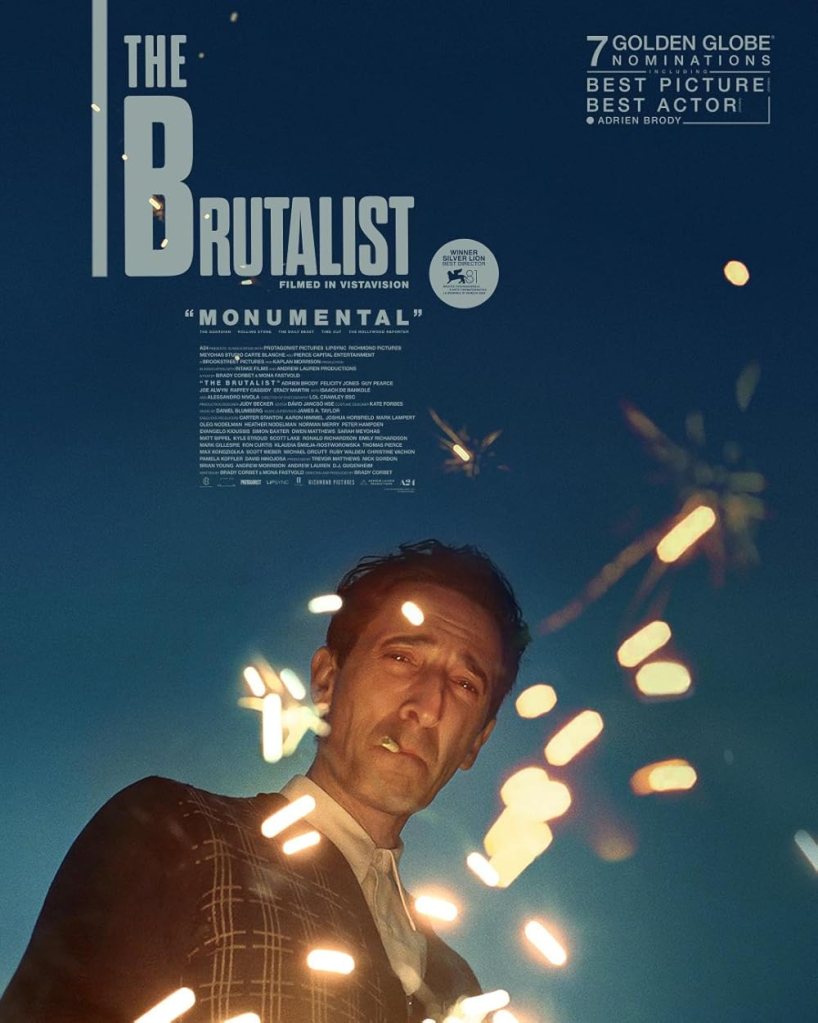
If you’ve heard of The Brutalist, it is probably more about the lore around the film than it is about the story. It’s a 3 hour and 35 minute epic that includes a 15 minute intermission, shot on 70mm film in VistaVision, reportedly the first American film to fully do this since One-Eyed Jacks in 1961 (no, I have never heard of this movie before but I did do my research). Film bros on the internet are obsessed with everything about this, like how this format reportedly required the filmmakers to transport 26 reels of film, weighing some 300 pounds, to Italy for the film’s world premiere at the Venice Film Festival. True cinema! The movie also took 7 years for director Brady Corbet to make alongside his wife and co-writer, Mona Fastvold, and was somehow shot on a budget of less than $8 million. That’s a lot of lore. If you haven’t heard of The Brutalist, it’s likely because it does occupy somewhat of an artsy, pretentious, Oscar-baity zone that isn’t front and center for most of the general public. I was really excited to see The Brutalist for the experience. After all of that to-do, I was interested to see what the end result actually was. And a film with an intermission? That was new for me. A chance to check my phone and go to the bathroom? Invaluable. But, seriously, while I did actually enjoy the movie, the plot is outshadowed by the monumental mythology of the film itself. Everything is big, the scope, the scale, the score, in a way that can’t help but be impressive. It’s bold and ambitious and sprawling and really feels old-fashioned. We don’t see movies like this anymore. But the story and the message(s) at the heart of everything are not new or innovative or particularly affecting. I appreciated the artistic endeavor more than I felt emotionally moved by the film.
The Brutalist is an American epic about the American Dream. It tells the story of László Tóth (Adrien Brody), a Hungarian-born Jewish architect who emigrates from Budapest to America in 1947 after World War II to experience the “American dream”. A gifted and celebrated brutalist designer back in Hungary, László is initially forced into poverty before falling in with a wealthy tycoon named Harrison Lee Van Buren (Guy Pearce). Van Buren is a fan of László’s work and eagerly decides to bankroll a project for him: a combination auditorium, gymnasium, library and chapel, made of concrete and Italian marble, near Van Buren’s estate in Pennsylvania. While the project is underway, Van Buren allows László to live in his guest house and helps him to bring over his wife Erzsébet (Felicity Jones), from whom he was separated during internment. The association between these two men will change the course of both of their lives. (Side note for a brief history lesson! Actually it’s not really history but just some context, I guess. The title comes from the style of architecture László specializes in: brutalism. Brutalist architecture is a style that emerged during the 1950s in the UK and is characterised by minimalist constructions that showcase the bare building materials and structural elements over decorative design. Key characteristics of brutalist architecture include blocky, heavy appearance, simple, graphic lines, lack of ornamentation, utilitarian feel, monochromatic palette, use of raw, exposed concrete (and sometimes brick) exteriors, and rough, unfinished surfaces. How relevant is all of that to the movie? Probably minimally, but I feel like I understand László’s designs more after knowing that and isn’t it just fun to learn something new?)
László’s story is told with such precision and detail it plays more like a biopic of a real person than a fictional story. It’s a story we’ve seen before: a person who aspires to the American Dream, only to discover that America is not what was promised. The narrative and cinematography and old-fashioned feel of the film have strong undertones of the young Vito Corleone plotline in The Godfather Part II (a movie near and dear to my heart). And in some ways, the structure of The Brutalist mirrors The Godfather Part II as well. Where The Godfather Part II shows the rise of The Corleone family and the American Dream with Vito’s storyline and the fall with Michael’s storyline, The Brutalist shows the rise of László Tóth and the American Dream in the first half (before the intermission) and the fall in the second half (after the intermission). The first half of the film ends on such an optimistic note, you just know the other shoe is going to drop eventually. Many have expressed that they greatly preferred the first half because, when that other shoe drops, it all goes off the rails a little bit. There’s an unexpected twist in the final stretch that feels like it comes out of nowhere and then the main section of the film ends ambiguously. In addition to having an intermission, the film is divided into chapters with titles like “The Enigma of Arrival” but also has an epilogue. Instead of just being a tacked on conclusion to tie off any loose ends, the epilogue turns out to be somewhat of a skeleton key to understanding the entire film. For a story that is told in rigid, chaptered structure, The Brutalist still finds ways to be unconventional in that space.
Through this narrative, the film attempts to tackle many well-worn but weighty themes. The American Dream, privilege and wealth, the immigrant experience, artistic integrity, just to name a few, are among those explored. Ultimately The Brutalist tells us that America is rotten to the core, and the closer you get to the center, the more corrupted by it you become. László starts as an outsider. He’s new to the country, idealistic, and naive. When Van Buren first takes László under his wing, it’s like he’s a shiny new toy for the area’s elite. They’re fascinated by him, drawing entertainment from his stories of horror and tragedy from life in war-torn Europe, receiving gratification from their “charity” of offering him help. A white savior narrative. But as soon as the novelty of László’s gift and presence wears off and the more he tries to ingratiate himself in the inner circle of America’s moneyed and privileged class, he is quickly and viciously cut down. Reminded that he is not one of them and will never be. The rich take what they need from immigrants and then cast them out. A means to an end. The second-half twist (which I won’t spoil here) seems slightly confounding if you think about the characters as people but it is almost obviously literal if you think about them as representations of American and immigrant experiences (this is not a subtle movie). America’s corrosive power also manifests in László’s drug addiction that gets increasingly more debilitating as the film goes on. He is literally becoming filled with a poison that is breaking him down the longer he stays in the country and the harder he tries to be “American”.
While directly about an architect whose dream is to design buildings that define the future, The Brutalist is highly allegorical for the director’s experience. Is it art imitating life or life imitating art for Brady Corbet? László’s building for Van Buren has many setbacks and takes years and years to get off the ground, similar to Corbet’s experience trying to make this film. Ideologically, the film also argues for art over commerce. A secondary architect is brought in to “supervise” László and help cut costs, but László constantly fights for the sanctity of his vision. This other architect’s claim to fame is that he worked on a bowling alley, the equivalent of a Marvel film or big-budget blockbuster as opposed to László’s design standing in for what Brady sees as true art (films like this one). László is drawn to architecture because his blocky, concrete buildings were built to last. His legacy will outlive him through his work. László’s genius becomes strikingly apparent through the epilogue where it is revealed that (spoiler alert!) his explanations to Van Buren for the inspiration behind his plans for the community center were fake. The design was actually supposed to reflect his encampment at Buchenwald during the Holocaust. It is explained by László’s niece Zsofia, “For this project, he re-imagined the camp’s claustrophobic interior cells with precisely the same dimensions as his own place of imprisonment, save for one electrifying exception; when visitors looked 20 meters upwards, the dramatic heights of the glass above them invited free thought; freedom of identity. He further re-imagined Buchenwald and his wife’s venue of imprisonment in Dachau on the same grounds, connected by a myriad of secret corridors re-writing their history and transcending space and time so that he and Erzsébet would never be apart again.” Right under the noses of the callous, privileged elite, and on their dime, László built a monument, a permanent reminder, of the horrors endured by millions and the strength of many immigrants to carry on. While not always taken seriously in the moment or seen for what it is, art outlasts and holds meaning for anyone willing to look.
Adrien Brody plays László in a performance that very well may win him the Oscar. He’s emotional and fragile but also has a strong sense of pride and gravitas. Despite his brilliance, László can’t help but be self-destructive. His experience in America constantly chips away at his ego, his control, and his sense of self, causing him to double down on his narcissism. The kind of narcissism that usually accompanies a genius. And playing a misunderstood genius is almost a surefire way to win an Oscar. Cillian Murphy won for Oppenheimer just last year and Adrien Brody’s stiffest competition right now is Timothée Chalamet, playing the misunderstood genius Bob Dylan.
László’s foil in the film is Guy Pearce’s Harrison Lee Van Buren in a captivating performance. The relationship between László and Van Buren is complex and always at an imbalance. They are artist and patron, immigrant Jew and American blue blood, underprivileged and enormously wealthy. Van Buren boasts his encouragement and cultivation of the arts, preaching about the responsibility of the rich in this area, but he benefits more from gatekeeping artists like László for his own personal wants and feeling a sense of ownership over them. “I find our conversations intellectually stimulating,” Van Buren repeatedly tells László. It’s ostensibly a compliment but, not only is it patronizing that Van Buren is impressed that a poor immigrant is able to have an intelligent conversation, but it is also ominous. Van Buren sees László as less of a human and more of plaything. Something to keep around to satisfy his own needs and entertainment. This relationship only turns more and more toxic and volatile as the story progresses.
Joe Alwyn plays Van Buren’s son, Harry. Joe Alwyn is in this movie. If that doesn’t mean anything to you, then you must not be a Swiftie (and if you’re not, the context is that Joe was Taylor’s boyfriend of six years. The one she broke up with before she started dating Travis… with some other stuff in between that we, as a community, don’t like to acknowledge). I knew he was in this movie but seeing him was still a jumpscare. I never hated him after his breakup with Taylor because I’m normal but, after seeing him in this movie, I think I may hate him now. He’s just really good at playing smarmy, and with the Van Buren family as representatives of the moral corruption bred by wealth and power, Harry is the perfect poster boy of entitled and evil.
Most misunderstood genius characters are saddled with a wife who has the thankless role of being either an unwavering support or causing friction for also not being able to understand. Either way, she typically has very little agency. Felicity Jones as Erzsébet is a slightly different take. She is educated and smart and understands much more of what is going on around them than László is able to see. She is not blinded by the wealth the Van Burens dangle just out of reach. She’s eternally supportive of László but not governed by him. Erzsébet does understand him, stating, “László worships only at the altar of himself,” but that doesn’t scare her away. Personally, I didn’t love this performance or the character. Something about the energy of it didn’t feel congruent with the rest of the film. But her injection into the film in the second half does serve a function to show us László’s shifting identity. After pining for her for many years, their reunion brings a reminder of home, of their past, that he no longer wishes to associate with. She’s a part of his old life and not the high-brow American he’s now trying to pass for. Through their interaction, we can really see how László starts to forget himself.
In trying to be a grandiose experience, The Brutalist is going for a lot visually. Aside from the structure markers like chapter titles and the intermission, the film also incorporates archival material like news report footage and audio over montages for historical context. The opening credits are arranged in a unique sideways scroll as opposed to the usual top down view. Many of the shots in the film are from low and sideways angles, most notably the opening shot of the Statue of Liberty as László arrives at Ellis Island. He sees the statue and then the frame slowly rotates 180 degrees until it is upside down. Again, this movie is not subtle in its symbolism. Along those lines, there are many shots meant to highlight the wealth surrounding Van Buren, like close-ups of people just touching their jewelry. I might be the only person to ever mention these 2 films in the same context, but the framing of the Van Buren mansion reminded me of Saltburn. Obviously that is an extremely flawed movie but it does reckon with ideas of wealth and power and has some beautiful images of a mansion on a large piece of property. The editing of The Brutalist is also versatile. Some scenes linger, like many extended monologues from different characters, and some cut off abruptly. I don’t know much about cameras or film stock but the 70mm VistaVision film here is noticeable. The cinematography is gorgeous throughout but feels really apparent in landscapes and the especially spectacular setting of the marble town of Carrara, Italy. But the old-fashioned vibe is meant to feel of the era it is portraying. When the epilogue jumps forward to the 80s, the aesthetic shifts completely to suit that time. The Brutalist is extremely purposeful in its visual choices.
The Brutalist is a lot. And that’s intentional. It is overflowing with themes and messages and symbolism and visual elements and runtime and mythos. Brady Corbet set out to make an epic. And there is no doubt what he accomplished is impressive. But does all of that also make it a little bit too self-indulgent and pretentious? Kind of, yeah. That’s not to say that I didn’t like it. I think I did. But it felt like the film was trying harder to be monumental than it was trying to be resonant. Sure, there are moments throughout that are affecting, but the only one that really penetrated my core was the reveal in the epilogue and the power of the idea that art outlasts. But, mostly, I enjoyed the experience of seeing something so different more than I enjoyed the film itself. The Brutalist is an incredible work of art. It leaves you with a lot to think about. It will definitely be nominated for Academy Awards. I think it’s a worthwhile watch just for the spectacle of it all but I also understand this film is divisive and takes some commitment to get through. So, after all that, I guess the takeaway is… more movies should have intermissions? Oh, and I guess that I want to see more movies taking big swings. It keeps it exciting.
2024 Count: 70 movies, 36 seasons
(technically I saw this movie in 2024 so this is my 2024 count!)
 I Think I've Seen This Film Before