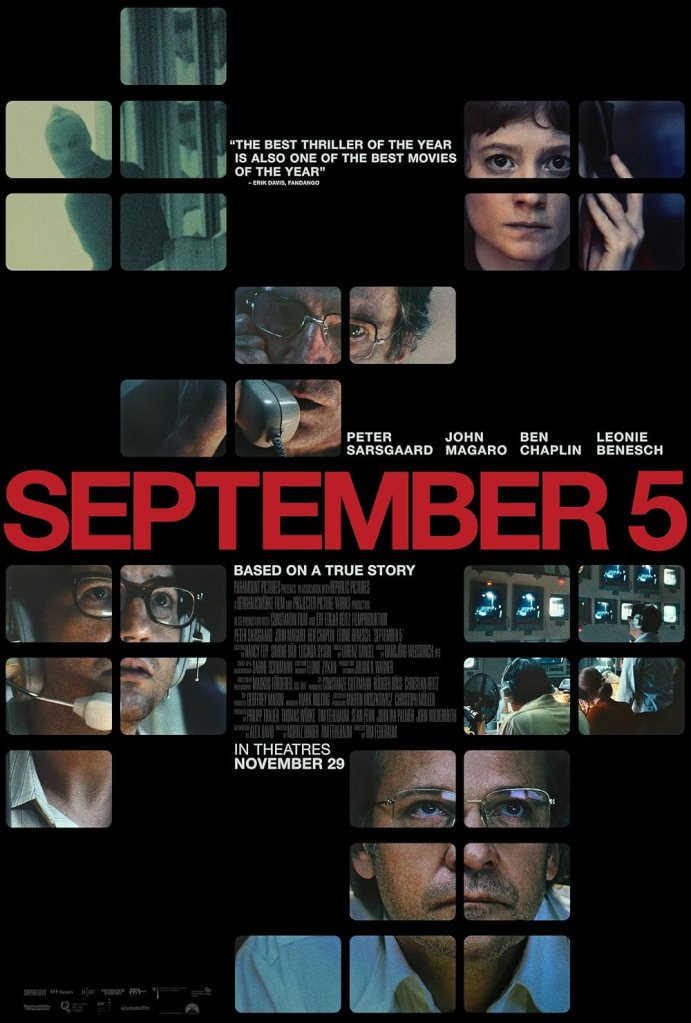
On September 5, 1972, a Palestinian group called “Black September” infiltrated the Olympic Village at the Munich Summer Olympics and held the members of the Israeli team hostage. Through brand-new satellite technology at the time, millions watched as the ABC Sports team broadcasted these events live with minute-to-minute updates. The team was there in Munich, stationed right across from the Olympic Village, to report on the games, but because of their proximity to the sudden crisis, they quickly pivoted their broadcast, operating outside of their typical comfort and professions.The coverage was so thorough that both the terrorists and the hostages’ families were able to follow along in real time, learning what the authorities were doing via the broadcast. ABC became the first network to broadcast an act of terrorism on live TV and later won 29 Emmys (a mix of sports and news trophies) for its coverage in Munich. This story was monumental. The coverage made history. September 5 tells the story of the sports crew of an American TV network figuring out on the fly how to report on this life-or-death situation and whether or not they should. The docu-drama details the 22 hours spent in the ABC control room. I had vaguely heard of the events of the 1972 Munich Summer Olympics but definitely did not know all the details. Even if you are familiar with this story, I still think the movie will be powerful and suspenseful, like trying to prevent a car crash that has already happened.
While the action of the real-life story takes place in the Olympic Village, September 5 is told completely from the ABC control room through the perspective of the broadcast team. You still get the tension of a thriller as the events unfold mixed with the confusion and frustration of not being able to fully see or understand them as soon as they happen. The team is so close to the action but they have no influence or control over it. They’re not the police, just journalists. They just have to watch it all play out and put together the bits and pieces of information they’re able to obtain. The perspective of the newsroom also removes a lot of the political and emotional factors and focuses mostly on an analytical approach, as would (or at least should) a reporter. The team we follow includes Roone Arledge (Peter Sarsgaard), the president of ABC Sports, Marvin Bader (Ben Chaplin), the head of operations, Marianne Gebhardt (Leonie Benesch), a German translator for the crew, and Geoffrey Mason (John Magaro), a young producer who was left in charge to cover what was supposed to be an uneventful day of sporting events. The studio is in constant, claustrophobic chaos as the team scrambles to provide current and accurate content. The filmmakers employed period-accurate broadcast equipment and filming techniques to support the documentary feel. For the scenes of the broadcast itself, actual archival footage was used of the Olympics and the crisis so we only see what was really shot by the ABC Sports crew instead of recreations of those images. Additionally, director Tim Fehlbaum felt that no actor would be able to replicate Jim McKay’s infamous work at the anchor desk that day. The film had to secure rights and permissions from ABC to use the McKay ‘72 Olympics tapes. September 5 went to real lengths to present this version of the story in painstaking, authentic detail.
The ABC Sports broadcast of this international hostage situation was the first of its kind in many ways. It was innovative and a paradigm of providing truth directly to an audience, but it also set a precedent for the sensationalized, voyeuristic, bloodthirsty media landscape we find ourselves in today. The film tries to address the modern issues of morality and ethics in broadcasting through the lens of this event. But mostly it asks questions instead of providing answers (are there even answers? At least right ones?). Primarily, the team can’t seem to agree on or even understand themselves why they are covering this story. Is it for the ratings? For the spectacle? To help one side or the other? Or for some sense of “journalistic duty” to report the facts, whatever that may mean. Where is the line between reporting and exploiting? It also alludes to our current idea of “fake news” (a phrase that makes me nauseous to even think). The reporters are very cautious of what they say, using a lot of qualifying language or hedging. “There is some evidence to suggest that…” “It is possible that…” “We believe that this may indicate…” “We are hearing unconfirmed reports that…” “Authorities have not yet confirmed…” “At this time, we believe…” “What we know so far is…” All of that basically means “we don’t know anything but we’re going to say it anyway”. And once it is said, true or not, it officially becomes reported as news. But what’s more important, being the first to report something or being the most accurate? The journalists will tell you it’s being first. Unlike the Olympics, no one remembers second and third place. But this sets a really dangerous standard for the way we consume information. Is it real? Is it true? Who cares? We just want the details and we want them now. Maybe the ABC Sports team in 1972 did have real journalistic integrity in their broadcast. The movie does paint them in a favorable light, depicting them as even having these debates and asking these questions about morals and ethics. Weighing the potential harm of their decisions and oftentimes knowing more and knowing better than the law enforcement on the case. But, either way, they unintentionally helped to shape the modern media landscape in alarming and damaging ways.
I have to be honest, this movie was a tough watch. It was really well-made with great acting performances and a compelling perspective. As an exploration of journalistic ethics and a thriller about broadcasting, I really enjoyed it. But the true story at the heart of it all put me in a dark, somber mood for the rest of the night. It’s a horror that stays with you. And especially right now. It is strangely, unbelievably, uncomfortably timely to be reminded of a crisis about Palestinians taking Israelis hostages. It feels surreal to watch a historical drama about events from 50 years ago when those exact same events are taking place as I sit in the theater. Chilling, really. I had actual chills as the movie wound down to its tragic conclusion. And a pit in my stomach ruminating on the state of the world. While the story isn’t told from a melodramatic viewpoint, it is impossible not to feel emotional. The journalists in the room are there to do their jobs. They have to keep it together and only when the broadcast is over and they leave the studio can they let the weight of the reality of what just unfolded hit them and let themselves fall apart. September 5 is a high-tension thriller that cuts way deeper in 2025 than I’m sure was intended or expected when the film was first made. It’s an interesting and important story but a dark and heavy one that not everyone will be in the mood for right now.
2025 Count: 4 movies, 5 seasons of television, 1 special
 I Think I've Seen This Film Before