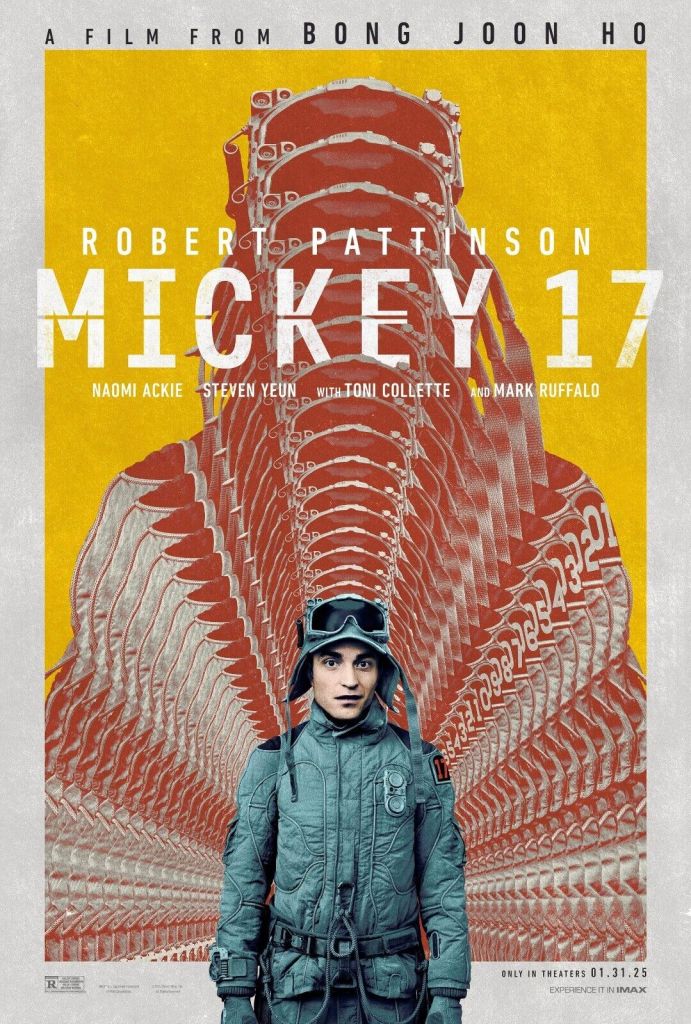
Mickey 17 is the long-awaited follow-up from director Bong Joon Ho after his previous film, Parasite, won the Academy Award for Best Picture in 2020. The next project after an Oscar win is always a big question for actors and filmmakers alike. Curiosity around Mickey 17 only increased when the film faced multiple date changes. Postproduction delays pushed the film from a March 2024 release into April 2025, and then it was later moved up to March 2025. While Parasite was a biting black comedy tackling greed and class discrimination through the lens of a South Korean family, Mickey 17 is a dystopian sci-fi satire that skews much sillier than its predecessor. I can’t claim to be an expert of the films of Bong Joon Ho, but what I understand is that there seems to be a clear difference between his Korean movies vs. his American movies. The Korean films (like Parasite) tend to have much more nuanced complexity than the American ones (like Mickey 17), although they do cover similar themes. Mickey 17 was entertaining and fun enough, but did not have nearly the same impact as Parasite.
That being said, it isn’t exactly fair to compare the two films. They are distinctly different. Mickey 17 is adapted from Edward Ashton’s 2022 sci-fi novel “Mickey 7” and stars Robert Pattinson as Mickey Barnes, a man in a near-future who signs up for a job as an “expendable” on a space expedition to the distant planet Niflheim. An expendable is a disposable employee sent on dangerous jobs who is reprinted via cloning technology whenever he dies. Mickey is killed and reborn many times (hence the Mickey we meet at the start of the film being the 17th version) but dying never gets easier. The new space colony is led by Kenneth Marshall (Mark Ruffalo), a failed politician turned dictator, and his controlling wife Ylfa (Toni Collette) who treat the society like a religious sect. Mickey’s only solace is his love for his girlfriend Nasha (Naomi Ackie), a security agent on the mission. Things go off the rails when Mickey 17 is presumed dead and a new Mickey is printed. But 17 comes back alive and has to face off with the new version of himself in a world where “multiples” are illegal. Niflheim also turns out to be the home of mysterious creatures dubbed “creepers” that look kind of like a cross between a rhino and an armadillo with some insect-like qualities. The film then devolves into a battle between the colonists and the creepers. That is where my biggest issue with the film comes in. I wanted it to stay focused on the two Mickeys plot line instead of becoming about these new creatures. Maybe that’s more of just a personal preference issue but, in my opinion, there was much more to explore regarding the multiples.
Multiples, clones, doppelgangers, duplicates. It has become an increasingly hot topic as of late. Even just sitting in the theater to watch this film in which Robert Pattinson plays multiple, but mostly two, versions of the same character, there were two previews for movies in which the lead actor plays multiple parts. One being Robert De Niro in The Alto Knights (review coming soon) playing two different characters and the other being Michael B. Jordan in the upcoming movie Sinners playing twins. The Oscar-nominated film The Substance also centered around this topic as does the show Severance which was airing concurrently with this film’s release. So why is this concept suddenly so popular? Why is it, as this tweet calls it, the year of the doppelganger? There are many intelligent articles on this subject and many interpretations of “doubling”. Creating a better, more perfect version of yourself, literalizing an inner conflict, dissecting all the different facets that live within you. Mickey 17 hones in on that last one. Nasha tells Mickey that all of the reprints have had slightly different personalities. We see this in action with Mickey 17 and 18. 17 is passive and bashful while 18 is direct and aggressive. How does this happen when all of the Mickeys are reprinted with the same materials and memories? And what does their instinct to fight and kill each other say about the overarching psyche of Mickey himself? These are fascinating questions I would have loved to see the film interrogate. Instead, it briefly skims the surface before pivoting towards other ideas. Lots of other ideas.
Mickey 17 has so much on its mind. Colonization. Religion. Politics. Class disparity. Bodily autonomy. All of that fun stuff! So let’s go through them one at a time. Colonization: the driving force of the plot is the idea that this group of people has left Earth to colonize a new planet. This comes to a head when the humans battle the creepers, the natural inhabitants of the land. This invasion becomes very heavy-handed and even has characters saying lines like, “they lived here first!” Religion/Politics: obviously these go hand in hand. Mark Ruffalo’s buffoonish leader has inspired a cult of zealots who mix religious ideals with their political views. Those in charge use their power to control those beneath them. In comes the class disparity (a tried and true Bong Joon Ho theme). The Marshalls are living large while the rest of the colony rations their food and lives in barracks. And finally, bodily autonomy: not only is Mickey forced to put his body through extreme circumstances, but sex is also outlawed during the 4 year travel to Niflheim as the members can only expend a certain amount of calories to conserve food. Mickey and Nasha break this rule, their own tiny form of rebellion, by doing what they want with their own bodies. These are all themes that are endlessly relevant and can be interesting, but only when they are given the time and space to be explored further and pose new ideas rather than glossing over commentary that is well-worn.
Robert Pattinson does a great job of anchoring the film and being the emotional center while also providing comedic relief. It’s become a joke that he loves to do a weird little voice in a movie and that holds true here. He also plays Mickey 17 and Mickey 18 as two distinct characters with their own voices and mannerisms. Enough that audiences are pretty much able to tell the two identical beings apart. My first thought when I saw Mark Ruffalo’s Kenneth Marshall was that he was doing Trump. He has a dark spray tan and these oversized, glowing white veneers and speaks in a Trump impression. His followers also wear red hats. While mocking this type of leader is almost old news at this point, I do have to give the film the credit that it was written and filmed and planned to be released before the 2024 election so it was not intended to be a commentary on the 2025 politics of America. However, director Bong Joon Ho claims the character was not modeled after Trump, saying, “Some of the people I took as a reference were some of Korea’s bad leaders of the past, or dictators from elsewhere, but I didn’t use any actual politicians from today. I created this character in a comical way by drawing inspiration from past figures, but since history always repeats itself, it might seem like I’m referring to someone in the present.” Some of that might be true but this performance rings so clearly as Trump to me in a way I found uninteresting. Especially these days I’ve seen enough of that. I feel like I’ve only seen Naomi Ackie in smaller parts before but I thought she was great as Nasha. I also liked Anamaria Vartolomei (who I have never seen before) as Kai but I was distracted by how much she looked like Ana de Armas (I have since Googled her and she does not in real life but I guess just in this movie).
Mickey 17 wasn’t everything that I wanted it to be but it was still entertaining. The crowd in my theater seemed really into it, laughing often. It is a comedy, albeit a very dark one. I was on board for some of the weirdness (the clones and human recycling) but not all of it (the creepers and Ylfa Marshall’s bizarre obsession with sauce?). Overall, I think the film opted for falling back on been-there-done-that themes rather than exploring something different and potentially more challenging. Mickey 17 doesn’t posit anything new. That doesn’t mean it’s not worth watching and not still entertaining. But that did, however, make it less interesting to me.
2025 Count: 20 movies, 12 seasons of television, 3 specials
 I Think I've Seen This Film Before