**This review contains spoilers**
To be honest, I was never interested in watching The Last of Us. I always said I could only get invested in so much nerd content. But that wasn’t really true. The show just had so much working against it for me. I don’t really like zombie stories or apocalypse stories and video games (which the show is based on) are one of my biggest blind spots. I know nothing about them. But, somehow, season 1 got me (shoutout to Hillary for convincing me to take the leap and to my immune system for contracting the flu and giving me ample free time to binge watch). I guess it’s not really a surprise when you look at it. The show isn’t about zombies or the apocalypse or video games. I mean it has all that if you want it. But it’s really about human emotion and relationships. Particularly the relationship between Joel and Ellie that transforms from begrudging to devoted over the course of a journey across the country. Maybe it was naive of me, but I never knew that video games had so much in-depth storytelling. So many scenes from the show are pulled exactly from the game. Scenes with such emotionality and weighty ideas. I still can’t believe they came from a world I had wrongfully assumed to be just about clicking buttons to punch and shoot or whatever. I also can’t believe how deeply this show has burrowed into my heart and soul and how important it has become to me in such a short amount of time.
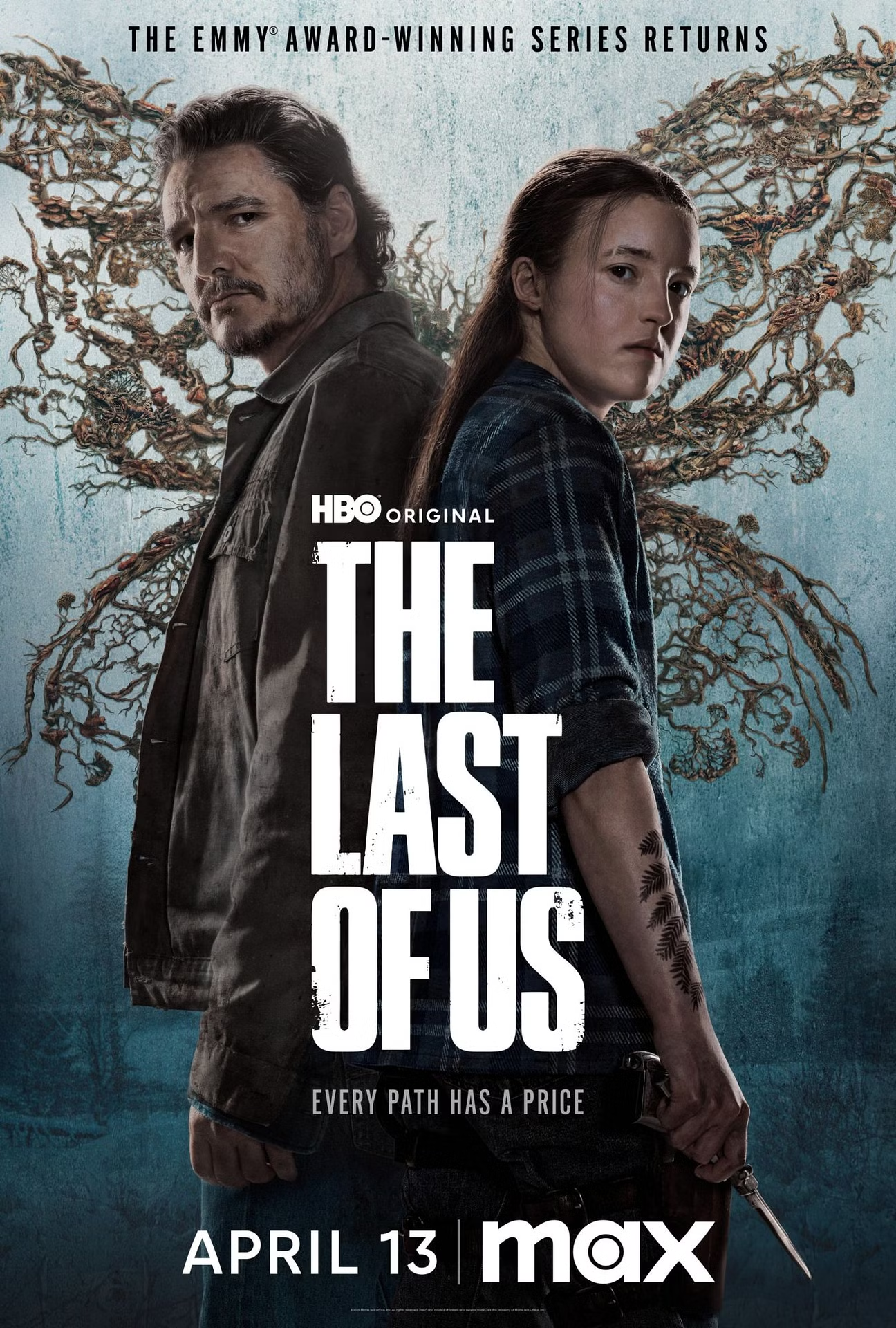
Season 1 of The Last of Us ended with Joel killing an entire hospital full of Fireflies to stop them from subjecting Ellie to a fatal operation that could help create a cure for the cordyceps infection. He would rather murder 20 people than lose her. Ellie, who wanted to sacrifice herself for the cause, asks Joel what happened and he lies. And then swears to her he’s telling the truth. Season 2 picks up 5 years later with the pair living a relatively domestic life in Jackson. Until the bubble of that utopic town explodes, in more ways than one. In lieu of walking through all the plot details of the season, I want to focus on two specific episodes. The ones that affected me the most. The first is episode 2, technically titled “Through the Valley” but will forever be known as “the one where Joel dies” (that’s like a bad Friends episode title). I knew we were losing a major character this season. I knew the introduction of Kaitlyn Dever as Abby meant Joel’s life would be in danger. But I didn’t really think we would actually lose him. And definitely not this soon into the season. Like Succession killing off Logan Roy in the third episode of the season and Severance having Mark start the reintegration process also in the third episode of the season, shows are making bolder choices earlier on and shirking the traditional format that spends all season building to a big climax. It works to successfully shock the audience, make anything seem possible at any time, and generate more interest in how the show will move forward.
Abby is a surviving Firefly member from the hospital in Salt Lake City. Her father was the doctor Joel killed and she is hellbent on revenge. Once the pieces of the episode fall into place, you realize there is no way out of this. For Joel or for us. Joel’s death scene absolutely destroyed me. I sobbed until I felt physically ill. Every aspect of it was heartbreaking. Ellie screaming for Joel to get up. Joel slightly moving his hand in an attempt to do that for her. Ellie crawling across the floor, injured, to curl up next to him in his final moments. Even showrunner Craig Mazin got emotional just talking about the scene. In an interview he said, “He hears her, and he’s aware of her. He wants to, he just can’t. If there’s one person in the world that could make him do the impossible, it would be Ellie telling him to get up. It also tells us that he knows that she was there, and he got to see her. [Mazin starts to cry] And I’m going to get a little emotional. Talking about this, I’m just thinking, “Oh man, I want him to get up.” Even as writers, we want Joel to get up. We love this character. Her face is the last thing he sees.” This felt personal. But it’s a testament to these characters and how real they feel to the audience.
The other standout episode of season 2 for me was episode 6, titled “The Price”, but better known as “the flashback episode”. Four episodes after Joel’s death, we flash back to a ~better time~ when Joel and Ellie were still living in Jackson and check in on them and their relationship on Ellie’s 15th, 16th, 17th, and 19th birthdays. Early on in the episode, Joel calls her “baby girl” and I immediately started sobbing. I missed him and I missed them together. What the episode really shows us is Joel’s immense and all-consuming love for Ellie. He puts together such elaborate gifts for her each year and the joy that radiates off her face reflects back on his just seeing how happy she is. The scene in the spaceship is sweet enough to make my heart explode. But there’s also the downside of that much love. A theme of season 1 that carries over to season 2 is how dangerous love is. Joel is a protector by nature and has a savior complex. He fights to the death for what he loves. At the end of the episode, we finally see the scene on the porch where Ellie confronts Joel about what really happened in Salt Lake City. She never fully believed his version of events, but after seeing him break his promise to her about Eugene, she realizes how easy it is for him to lie. It is important for me to put the entire of context of this scene here:
“I’m going to give you one last chance,” Ellie says. “If you lie to me again, we’re done.”
“Making a cure would have killed you,” he says in tears.
“Then I was supposed to die!” Ellie says, crying too. “That was my purpose! My life would have fucking mattered, but you took that from me!”
Joel is sobbing now. “If somehow I had a second chance at that moment, I would do it all over again,” he says. “Because I love you. In a way you can’t understand.”
There’s a long silence. “I don’t think I can forgive you for this,” Ellie says. “But I would like to try.”
Ellie wanted purpose. She wanted her life to matter. And she was willing to sacrifice herself for the greater good. Ellie’s thinking about Riley, Tess, Henry, Sam, all of the people who died along the way so that she could keep moving forward and help find a cure. It feels to her like that was all for nothing. And Joel took that from her. Because, selfishly, he loved her too much to lose her. He loved her so much he was willing to murder 20 people for her. He loved her so much he unwittingly signed his own death warrant. Love is dangerous. Loving someone that much is dangerous for you and everyone around you. The biggest gut punch of this moment is that it takes place the night before his death and is the last conversation they have. We are teased with the slightest hope of reconciliation between the two after months of hostility but know that they never did and never will get the opportunity to restore their formerly beautiful relationship.
The Last of Us is teeming with ideas. I think showrunner Craig Mazin along with co-showrunner and game creator Neil Druckmann and game and show co-writer Halley Gross are absolute geniuses. Everything they say about their intentions for the show’s themes and questions they’re asking is so unbelievably interesting and insightful. One of these major themes is heroes and villains. Craig said, “the story is about perspective. Who the heroes and villains are is based on where you’re standing.” Ellie and Abby are mirrors of the same story. Joel killed Abby’s dad so Abby killed Ellie’s dad and now Ellie wants to kill Abby. We’re rooting for Ellie because we’ve been living in Ellie and Joel’s perspective. We have a relationship with them. Abby is an outsider who comes in and kills someone we love so we want revenge the same as Ellie. She’s the villain in our story. But from Abby’s perspective, an outsider came in and killed someone she loved. If we had been in Abby’s story the whole time, we’d be on her side, encouraging her revenge mission against Joel. Craig said, it’s the “idea of ‘when we do it it’s justified. When you do it it’s evil’”. Is anyone really good or bad? Or is everyone just dealing with their own struggles? Halley Gross said, “Ellie and Abby [look] at each other and [recognize] the pain and rage of ‘you took someone I loved’”. They’re not diametrically opposed. They’re mirror images. Their one-on-one battle is reflected on a larger scale in the war we see playing out in Seattle between the WLF and the Seraphites. In an exchange between Jeffrey Wright’s WLF leader, Isaac, and a Seraphite he is torturing, the two debate the impetus of their conflict.
- Malcom: You kill our children.
- Isaac: Never by choice. You trained them to shoot at us.
- Malcom: Because your Wolves kill them.
- Isaac: Because you trained them to shoot at us.
- Malcom: Because you broke the truce.
- Isaac: Because *you* broke the truce. Because you broke it because we broke it. I’m not playing your little chicken-and-egg games today, Scar.
The back and forth is reminiscent of the line from season 2 of House of the Dragon about the centuries-long dispute between the Brackens and the Blackwoods. Daemon asks why they’re fighting each other and Ser Simon responds, “The answer to that is lost in time. Sin begets sin begets sin.” No one even knows why they are fighting or who started it. Reason has gone out the window. All they know is who their side is and who the enemies are.
Which brings us to another Craig Mazin banger: “Everyone is infected with cordyceps or tribalism.” Community, your tribe, was another huge theme this season. The idea is built right into the title of the show. “The Last of Us”. How do you define “us”? There’s us and there’s them. In the finale episode, Ellie and Jesse fight over what community means to them. For Jesse, it’s the town of Jackson. He feels responsible for the entire population and the city itself. For Ellie, she says, it was Joel. He was her whole world. Her whole community. And now he’s gone and she feels utterly alone. That’s what drives her. It comes across as selfish because she’s the only one left in her circle. When Jesse acts, he’s thinking about what’s best for everyone. When Ellie acts, she’s thinking about what’s best for her and Joel. We’re always putting up these boundaries and dividing lines. Identifying our communities, who is on the inside and who is on the outside. And, in this world, very much like our own, there’s a strong “if you’re not with us, then you’re against us” mentality. But the problem is, these factions are spending so much time and resources fighting each other, that they’ve lost sight of the real threat: the infected. Who, by the way, while the humans are embroiled in their petty wars, are evolving and getting stronger and smarter. But does anyone seem to care? Does anyone really even notice? Everyone is so distracted by creating battle lines and enemies instead of banding together to defeat the real issues that affect us all. (Sound familiar?)
The creators said that “this season is about consequences of violence. How far will you go when you feel righteous and just?” Everyone believes that the side they are on is the right one and therefore feel justified in their increasingly violent and depraved actions. Ellie grows darker and more vicious throughout the season. Bella Ramsey says of their character, “Joel says ‘I hope you do a little better than me’ and she doesn’t. She does worse.” Vengeance was the buzzword of the season. Everyone revolved around the axis of this impulse. People are no longer just trying to survive. They’re weaponizing their grief in a cycle of violence. The world as we know it may have ended. Everyone has had to scramble to figure out their place in this new society. The Washington Liberation Front (WLF) organizes around a militia. The Seraphites, or the Scars, dedicate themselves to faith. The community of Jackson attempts to ignore present circumstances and live a sheltered life that’s a muted reflection of the world that was left behind. But humanity lives on in the form of love and rage. The zombies are not the villains in The Last of Us, the people are.
A genre show about zombies and the apocalypse is typically very plot heavy. While there is obviously plot in The Last of Us, it’s the characters that draw us in, not the action set pieces. Every single actor in The Last of Us is firing on all cylinders. It is truly an incredible acting showcase. Isabela Merced as Dina, Young Mazino as Jesse, and Catherine O’Hara as Gail were all new players this season as different Jackson residents and were all fantastic. Isabela Merced as Dina, Ellie’s best friend and romantic interest, is immediately captivating and magnetic and we would follow her anywhere. Catherine O’Hara plays Gail, the only therapist in town who also may have a drinking problem. She is just the icon of all icons and, even in a role and a show that is not comedic, she’s such a singular and special performer. The other new addition this season was Kaitlyn Dever as Abby. I have always been a Kaitlyn Dever fan, but her performance (mostly in the Joel’s death episode because that’s really the bulk of her screen time) is genuinely some of the best acting I’ve ever seen in my life. She’s just seething with venom and rage and it explodes out of her, but she somehow looks worn out and vulnerable at the same time. Dever said of her character, “When she walks into a room, she comes through with this intense strength. It’s what makes her scary and intimidating. But it’s all because of how much pain she’s gone through.” Kaitlyn also lost her mom very shortly before the start of shooting and was clearly able to channel those emotions into her powerhouse performance. I know people have mixed feelings about this but I, personally, am excited to get to spend a majority of next season with her.
Our two stars, Pedro Pascal as Joel and Bella Ramsey as Ellie, continue to be as outstanding as they were in season 1 but, this time, showing entirely new shades of their characters and acting chops. Season 1 Joel was extremely guarded and gruff, occasionally showing glimmers of heart but only really beginning to open up towards the end of the season. In season 2, he truly wears his heart on his sleeve. He has such emotion in his eyes every time he looks at Ellie. The love he has for her is so overwhelming it radiates off of him in both joy and pain. In the porch scene between the two when he admits to his lie, Pedro plays it mostly silent. He has almost no dialogue. Instead, we see his internal struggle, fighting between whether to be honest with Ellie or shield her from the truth. This manifests externally in tearful nods and quivering restraint. Season 2 Joel is such an open wound all of the time it physically hurts me to watch. With Joel mostly gone after episode 2, Bella has to take the lead for the remainder of the season. They’re no longer playing the spunky sidekick but, instead, have to portray a descent into grief and fury that comes out in an escalation in temper and violence. I loved the performance and thought that it felt authentic that we could still sometimes see the scared little girl underneath the harsh exterior Ellie feels forced to adopt. She’s no longer the silly 14-year-old girl cracking dumb jokes, eager to connect with other people. She’s a 19-year-old girl, hardened by life experience, on a single-minded mission for revenge.
It is kind of unfathomable to me that a season of television that I found so brilliant and moving has received such a negative response online. It really shouldn’t be so surprising considering that’s what the internet does, bashes anything and everything. I can understand when people have legitimate reasons for their unfavorable opinions. Like a performance didn’t work for them or a storyline felt rushed. You can choose to agree or disagree with those notes. But it’s the bad-faith criticisms from people who just want to hate that really make me angry. Yeah, watch out I’m about to rant for a second (or more). A very large contingent of the show’s audience have claimed to no longer like the show without Joel. They can give whatever reasons they want for that but I refuse to believe it’s anything other than misogyny. If you can only enjoy a show where a man is the lead and not a woman, then you’re the problem. Some have said the show becoming centered on the Dina and Ellie storyline has made it feel too YA (Young Adult. Defined as a category of literature targeted at readers aged 12-18. Although not a single genre, YA books typically encompass genres like fantasy, romance, and contemporary fiction, as well as more niche categories like dystopian, historical, and magical realism). Once again, this comes from men immediately writing off anything to do with women, particularly young women, as childish. It reminds me of criticisms of the Barbie movie and the Eras Tour except that the only aspect of The Last of Us that even could feel YA to me is the age of the characters. Then there are those who have issues with Ellie. I really don’t even want to get into the disgusting hate aimed at Bella Ramsey over their non-binary identity and physical appearance because that doesn’t even deserve my breath or anyone else’s. But I’m talking about the people who don’t like the character of Ellie because they think she is “unlikable”. Since when has a character’s likeability been an issue? Every single character on Succession is a terrible person. Most of the characters on Yellowjackets are unlikable. But they’re all always entertaining to watch. And Ellie’s unlikability is earned. We see the horrors she has lived through that have made her this person. It doesn’t come out of nowhere. It’s part of her arc as a character. It’s interesting to see her take a dark turn. As a viewer, it’s not what I want for her. I want her to be happy and to make good decisions, but that wouldn’t be good television, would it? Why does she have to be likable? Because she’s a young girl? These critics also can’t seem to agree on exactly what they don’t like about her anyway. Some say she’s become too violent and cold while others think she’s not violent enough and seems incompetent on her mission. Basically, as always in the life of a woman, you can’t win. I also don’t understand how game players are so upset with differences between the game and the show when the creator of the game is one of the showrunners and is deeply involved with all aspects of the show. If anyone has a right to make changes, it’s him. I’m sorry you are all so miserable and couldn’t allow yourselves to enjoy and appreciate this season as much as I did.
Sorry, that got very hostile but I’m also not sorry. I stand by it all. I really think this show is an incredible achievement. And it should not have been so surprising to me that I would like it. As a video game, I’m sure it has its own influences, but the show clearly pulls from other popular genre series of the modern era. The wall around Jackson is reminiscent of The Wall from Game of Thrones, complete with the Night’s Watch on the lookout. “The Battle of Jackson”, as it is now referred to as when the infected breached the town, also drew comparisons to battle episodes of Game of Thrones like “Hardhome”. When Ellie follows Nora into the basement of the hospital in episode 5, we see that the virus is now airborne. This is visually represented with particles in the air and fungus growing all over the walls. I was immediately reminded of The Upside Down in Stranger Things, especially when the lighting in the scene turned red. All of these elements help to create a vibe that’s right up my alley. I love this show, I loved this season. It broke me and put me back together and then broke me again. I can’t believe we’ll have to wait (who knows how long) to see what happens next. But I am more than intrigued. Craig Mazin told press that season 3 will answer many unresolved questions, including but not limited to: “How did that war [between the WLF and the Seraphites] start? Why? How did the Seraphites start? Who is [their] prophet? What happened to her? What does Isaac want? What’s happening at the end of Episode 7? What is this explosion? All of it will become clear.” Whatever the answers, I’m thrilled to be along for the ride. I could not recommend this show highly enough.
2025 Count: 35 movies, 24 seasons of television, 3 specials
 I Think I've Seen This Film Before
One thought on “The Last of Us – Season 2 (TV)”