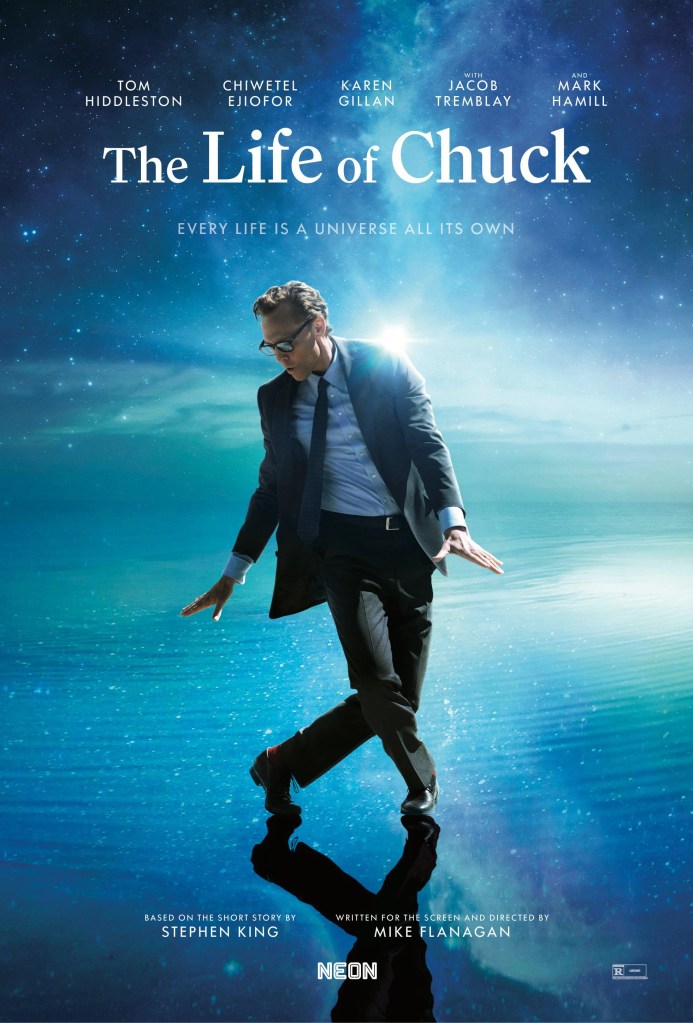
I first heard of this film coming out of the Toronto International Film Festival (TIFF) last fall where it won the People’s Choice Award. This honor is notable because it has historically been a big indicator in the Oscars race. In past years, winners of the award such as Green Book and Nomadland went on to win Best Picture at the Academy Awards. Last year’s Audience Award went to American Fiction while 2022’s award was given to Steven Spielberg’s The Fabelmans, both of which were best picture nominees and major forces during awards season (and both of which I worked on the social campaigns for!). The winner of the TIFF People’s Choice Award is clearly a film worth keeping an eye on. That being said, I don’t know that The Life of Chuck will have much of an impact come award season. Not that it’s not good, I just think it’s gotten lost in the cultural conversation somehow. And while some have found the film incredibly impactful, I feel like it never quite reached its full potential.
The plot of The Life of Chuck is complicated to describe. And to experience. It’s adapted from a novella by Stephen King from his 2020 story collection “If It Bleeds”. While King is best known for his success in horror, The Life of Chuck has been compared to adaptations of his work like Shawshank Redemption and Stand By Me rather than It or Pet Sematary. Although some spookier elements can’t help but creep in. It is Stephen King after all. A story described as “genre-bending” and “life-affirming”, even King himself had reportedly called it “unfilmable”. Writer/Director Mike Flanagan (also best known for horror, particularly his Netflix series like The Haunting of Hill House, The Haunting of Bly Manor, Midnight Mass, and more) gives it a fair shot. The film is divided into three acts and is told in reverse chronological order. All three acts are narrated by Nick Offerman. The opening act (Act Three) starts with the world falling apart. We experience it from the perspective of schoolteacher Marty (Chiwetel Ejiofor) and his ex-wife, doctor Felicia (Karen Gillan), in a small American town. The internet is down as is TV and cell service, California has fallen into the Pacific, Ohio wildfires, flooding in Europe, a volcano in Germany, skyrocketing suicide rates. Marty and Felicia are doing their best to cope and make sense of the end of the world. At the same time, mysterious billboards, signs, and TV ads begin popping up more and more frequently to congratulate Charles Krantz on 39 great years (“Thanks Chuck!”). No one seems to know who “Chuck” actually is. In Act Two, we meet him. Charles Krantz (Tom Hiddleston) is an ordinary man. An accountant. While walking down the street one day, he stops in front of a busker playing the drums and spontaneously breaks into dance, later inviting a woman from the crowd that gathers (Annalise Basso) to join him and the two put on a show. This section is almost entirely composed of this dance sequence, choreographed by Taylor Swift’s Eras Tour choreographer, Mandy Moore. In the final chapter (Act One), we follow Chuck’s childhood after he loses his parents at a young age and is raised by his grandparents (played by Mia Sara and Mark Hamill). Young Chuck learns about art and math, life and death, and past and present. He also becomes fixated on the cupola of his grandparents’ home that has a lock on the door and hides a mysterious secret.
When the movie begins in Act Three, the audience is immediately thrown into the middle (or the end, I guess) of a story we know nothing about. I was waiting and waiting for the events that were unfolding to begin to make sense, but they only got stranger and creepier. I was definitely intrigued, on the edge of my seat, in suspense of where this was all going. When it became clear we were watching a story in reverse, I was able to settle into the movie but also slightly spooked because I had just watched Memento two nights before (another film told entirely in reverse). Coincidence? The Life of Chuck would tell you there is no such thing. The film’s structure, in both the chapters and narration, make it instantly clear this was a short story. If I didn’t know this was based on a short story beforehand, I would have bet money on it after watching the movie. There was so much narration it almost felt like someone was just reading a book to you. Nick Offerman did a great job with it (and has a great voice for it) and the writing from Stephen King is obviously top tier, but this structure made the experience of watching it completely unique while also hampering my connection to the story.
I understand why this movie won the Audience Award. It is beautifully sentimental, no cynicism at all, and has an uplifting message. Even reading Letterboxd reviews, I could see how much it affected people. “Life affirming.” “Pure magic.” “Felt like a hug.” I love that people were so touched by the movie, but it didn’t get all the way there for me. There were moments that were super sweet and made me smile. Like Chuck dancing, both as a child and an adult. And moments that were beautiful. Like Chuck’s relationship with his grandmother. But nothing really pierced me. There was still some distance between myself and the characters. I think the narration format is to blame. It made it feel like someone was telling you about something instead of allowing you to be fully inside the moment with the characters. Which is unfortunate because I do think the movie has some emotionally resonant and heartfelt ideas.
It starts on a real downer note with the world ending (some of which felt a little too real). But then ends with the message that you should live life to the fullest. Even though you know you’ll die someday, everyone will, you have to keep living until that moment comes. Whether you know when that moment will be or you don’t. Keep living until the world ends (or “keep on dancin’ ’til the world ends” like the prophet Britney Spears once said and also feels appropriate for Chuck, the dance pro he is). I also really loved the Walt Whitman quote the concept of the story is essentially built around. “I am large, I contain multitudes.” This comes from Walt Whitman’s 1855 poem, “Song of Myself”. Chuck learns the poem in school and questions the meaning of this one line. His teacher explains how we each create universes inside our heads, filled with everyone we’ve ever met, everything we’ve ever learned and experienced. These universes grow larger and larger and larger. When you die, so does that universe, as exemplified by Act Three which we come to understand takes place inside of Chuck’s head as he succumbs to cancer. We’re seeing the universe Chuck has created, populated by a collection of people he’s met over his lifetime and who we meet in the real world throughout the rest of the film. Stephen King began his short story with an old proverb that Mike Flanagan then repeated when introducing the film at the world premiere: “When an old man dies, a library burns down.” When you die, an entire universe dies. It’s cosmic.
The Life of Chuck isn’t really so much about the titular Chuck at all. We spend just as much time with him as the rest of our ensemble cast of characters full of “that guys”, to borrow from “The Rewatchables” (bonus points if you can remember where you’ve seen all these faces before!). But maybe that’s because the movie is trying to tell us that our lives aren’t just about us. Everything we do impacts other lives as well. We’re all cosmically connected. The movie often falls back on this motif of outer space. We see starry nights and celestial metaphors to help us understand our place in the world. But with the science, we also get the surreal. Ghostly premonitions and ripples between past and present. The same way the movie mixes morbid tragedy with bursts of dark humor and shining glimpses of wonder and resilience. It’s the accounting and the dance that both exist within Chuck. Math, science, dance, art, the supernatural, past, present, space, time, life, death, sadness, joy. All of these things can exist together within us. We contain multitudes. The Life of Chuck has a little bit of everything. A complexly told story about a simple truth: life should be lived to the fullest no matter what. That’s something all audiences can get behind. Do I think there were more poignant and affecting ways to tell this particular story? Yes. Is it really even a movie? I’m not so sure. But I do think it’s worth checking out for an experience unlike any other. And we could all use all the uplifting stories we can get these days.
2025 Count: 44 movies, 33 seasons of television, 3 specials
 I Think I've Seen This Film Before