**This review contains spoilers**
For some, The Fantastic Four: First Steps was just another Marvel movie. But, for others, it carried some serious implications. The state of the superhero film has been in a downfall since it peaked in 2018 with Avengers: Endgame and both Marvel and DC have been scrambling to recapture their former glory. In a time when audiences are experiencing “superhero fatigue”, both companies are making major pushes this summer with Fantastic Four and Superman coming out in the same month. In some ways, it’s a competition between the two films as the studios are historic competitors. But at this juncture in culture, the success of one could be equally beneficial to the other. A rising tide (aka interest in superheroes) lifts all boats. Superman, which came out on July 11, was a win. But even though Fantastic Four was getting great first reactions, it felt like the world was still stuck on Superman by the time Fantastic Four’s July 25 release came around. While both movies ultimately wanted to bring back the hype for superheroes, some argued that they had slightly different tasks. Superman is James Gunn’s first film as co-chairman and co-CEO of DC Studios and the first film to kick off his DCU, DC Universe (no longer the DCEU, DC Extended Universe). There was a lot riding on that. But for the fans, it was to pitch something entirely new. Fantastic Four, on the other hand, was pitching a return to form for Marvel after many felt they have lost their way over the past few years. In theory, that’s true. But after seeing the film, The Fantastic Four: First Steps feels more like something new for Marvel than like some of the older films in the canon. I think that’s a good thing, and I hope they continue to follow this new path they’re forging.
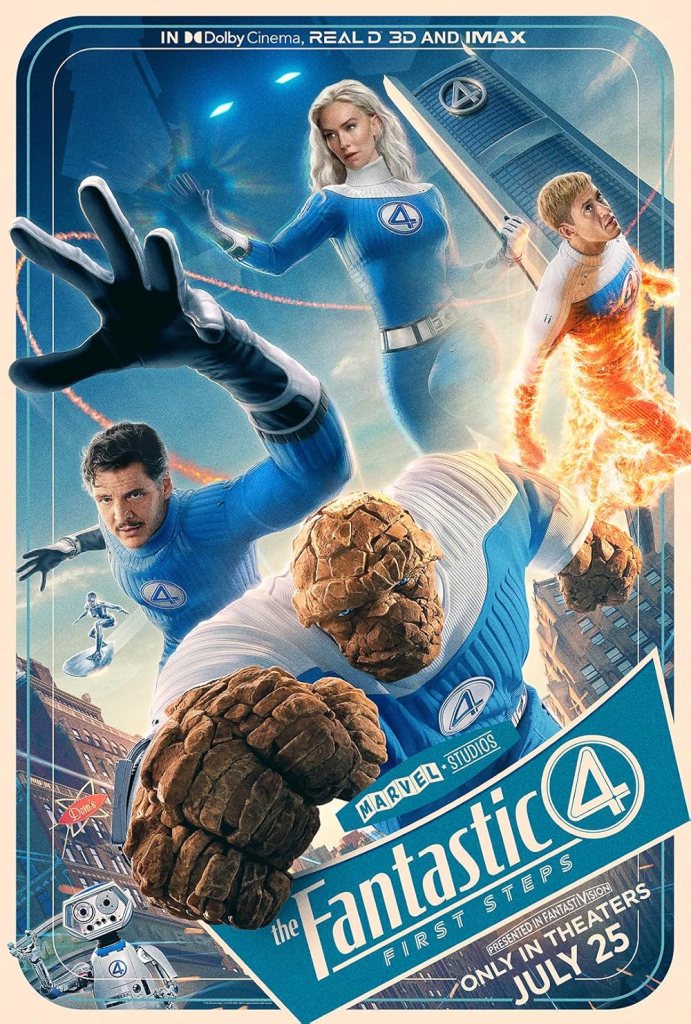
The Fantastic Four were actually Stan Lee and Jack Kirby’s first creation for Marvel Comics back in 1961. They launched the entire interconnected universe we’ve come to know. But, once again, because of rights issues, the team wasn’t allowed to join the Marvel Cinematic Universe until 2019 when Disney acquired Fox. Previous to First Steps, though, there were other attempts to bring “Marvel’s First Family” to the big screen: 2005’s Fantastic Four starring Ioan Gruffudd, Jessica Alba, Chris Evans, and Michael Chiklis and the 2007 sequel Fantastic Four: Rise of the Silver Surfer as well as the 2015 franchise reboot Fantastic Four starring Miles Teller, Michael B. Jordan, Kate Mara, and Jamie Bell. All of these films are widely considered as subpar as well as box office failures. The only one I think I’ve actually seen is the 2007 Rise of the Silver Surfer which I’m pretty sure I saw for someone’s birthday party when I was 10 or 11 so I have very little memory of it, if any. And, I actually did not go back and “do the homework” this time (clap for me for being normal for once!) because I really don’t think it matters in this case. I’m pretty sure Marvel wants to stay as far away from those films as possible. Further proving this is that First Steps is not an origin story, like the previous versions. Some people love skipping the origin story, especially for classic characters where it’s been done multiple times before. As a non-comic book reader, I don’t really mind it, but luckily First Steps shoehorns in a quick retelling to catch up anyone unaware. We learn that scientific genius Reed Richards (Pedro Pascal) led a space expedition with his wife, Sue Storm (Vanessa Kirby), her brother Johnny Storm (Joseph Quinn), and their good friend Ben Grimm (Ebon Moss-Bachrach). When their rocket ship encountered a cosmic storm, it altered their DNA, returning them to Earth with superpowers. Reed, now Mr. Fantastic, has elastic limbs and can stretch like a rubber band; Sue, the Invisible Woman, is able to become invisible and can generate powerful force fields and blasts; Johnny, the Human Torch, can engulf himself in flames and fly; and Ben, the Thing, is a massive, boulder-like hulk with superhuman strength. It’s 1964 on Earth-828 and the Fantastic Four have been saving the world for four years. Being the only superheroes in their world (that we know of), they are famous and adored. The family is celebrating the news that Sue is pregnant when the Silver Surfer (Julia Garner) arrives to herald the news that their planet is about to be destroyed by a cosmic entity named Galactus. The team decides to seek out Galactus before he arrives on Earth to try to dissuade or defeat him, but his only offer is to spare Earth in exchange for the child Sue is carrying.
Another story where Pedro Pascal has to choose between saving his child or saving the world. But, seriously, the so-called “trolley problem” is a classic plot device. The trolley problem is a thought experiment that presents a scenario where a runaway trolley is headed towards multiple people on the tracks. You can pull a lever to divert it to a different track where only one person will be hit. This dilemma forces us to consider the ethical implications of our choices and the value of human life. Is one person’s life worth more than a group of people’s? If you’re looking at only the numbers then maybe, but when it is human lives at stake, it isn’t so simple. And for the Fantastic Four, it’s not just one person, it’s their family. In Thunderbolts*, the real enemy of the story wasn’t some alien magical creature who just wanted to destroy the Earth; it was mental health and the dark, negative thoughts we have inside our own heads. Similarly here, while technically the villain is actually some alien magical creature who just wants to destroy the Earth, there’s more to it. It goes deeper than the abstract of saving the world. The emotional hook comes from having to save their son. That makes it more personal, more relatable. It’s almost too obvious to say that the key theme of the movie is family. The Fantastic Four is a family and has always been about family. Director Matt Shakman told Variety of the superteam, “They are parents first. They are scientists and explorers second. And they’re superheroes only when they have to be.” Family is both their weakness and their strength. It’s a blindspot, it’s their achilles heel. But it also gives them hope, something to fight for, people to fight with, and the power that can only come from shared blood. It is literally a mother’s strength that saves the day in the end. I loved the family dynamic of the film and, while many of these superhero team-up movies play on the idea of “found families”, I felt like The Fantastic Four: First Steps did differentiate itself in the way the true family was portrayed. It’s fairly common knowledge that The Incredibles writer/director Brad Bird had the Fantastic Four in mind when he created the Pixar film. It resonated with audiences because it found humor in the everyday life of a super-powered family. I had The Incredibles in mind when watching The Fantastic Four: First Steps, which is a compliment to First Steps. While I still think The Incredibles is a better movie, First Steps has shades of what works in the cartoon: people dealing with both extraordinary and ordinary problems, families who bicker and hug, and a baby with mysterious powers. Oh, and both films share a composer, the prolific Michael Giacchino.
In First Steps, the Fantastic Four aren’t just special because of their powers, they are also celebrities. Of course most of the Marvel superheroes are famous within their world. But First Steps actually reckons with what that means for these heroes. At first, it’s just a part of the job: giving press conferences, posing for pictures, making television appearances. But the first time they don’t actually accomplish their goal and microphones are shoved in their faces, it’s an entirely new situation. Common sense would say to just lie about what happened with Galactus. Say, “no comment”. But they’ve never had to deal with this before. They have always operated with transparency. The entire world being in on the plans of superheroes was a new dynamic I hadn’t seen before. It’s a tenuous relationship they have with the public, the same as any celebrity. The more closed off you are, the more untouchable you seem. There is a distance between you and the public. Fans put you on a pedestal, but you don’t seem real. The more open you are, the more people feel like they actually know you. You become relatable, just like them, but they also then feel like you owe them everything because you have built this mutual relationship. Most superheroes in our stories fall into the former, but the Fantastic Four are in the latter. At first, this hurts them. The public is angry they would choose their son over the fate of the Earth (can’t say I blame them). But then, because they had previously developed an open, honest relationship with the people of the world, they are able to earn back their trust and mobilize everyone to help with their new plan. “Never doubt that a small group of thoughtful, committed citizens can change the world. Indeed, it is the only thing that ever has,” a character says. A poignant sentiment. The idealism is nice but, in reality, it just made me kind of sad because I know that nothing, not even an Earth-ending threat, could bring the entire world together like that. In the film, everyone on Earth has to turn off their power every night at a certain time to help the Fantastic Four build technology to fight Galactus. When our world was threatened by COVID, for example, everyone refused to agree on practices meant for our safety and openly defied them. It’s sad that in a film about super-powered people and planet-devouring space gods, the most unrealistic part was people working together towards a common goal.
While The Fantastic Four: First Steps cast has some major talent, the majority of the leads are TV stars, not movie stars. Pedro Pascal from Game of Thrones, Narcos, The Mandalorian, The Last of Us; Joseph Quinn from Stranger Things; Ebon Moss-Bachrach from The Bear; Vanessa Kirby from The Crown; Julia Garner from Ozark. These actors made their names on TV, but can they also be movie stars? That’s the question that has been hanging over Pedro Pascal’s head all summer. He’s beloved as a TV star, but after a Pedro-filled summer at the movies with Materials, Eddington, and First Steps all coming out within two months (and Gladiator II only a few months before that), people want to see if he’ll be able to explode into superstardom. The answer is complicated. I personally liked Pedro’s portrayal of Reed Richards. He plays being the smartest man in the world as a burden. He’s so smart but he still can’t fix everything. That’s understandably incredibly frustrating. He’s tortured, not cocky or confident. But, from my understanding, these are choices that the movie is making about the character. Comics fans seem to be unhappy with Pedro’s depiction because it is different from the comics where Reed is the arrogant leader of many iterations of superhero teams. I really don’t mind the change. Pedro’s Reed is a scientist, not a leader. He’s almost too smart to have the social skills to lead a team. Also, we’ve already seen the arrogant smart guy thing in this world with Robert Downey Jr.’s Iron Man. We don’t need to see that same thing from someone else. Especially when Robert Downey Jr. is coming back to the MCU. He’s playing a different character this time but he really only has one mode. I like that Pedro is bringing a different energy here. Sure, it’s less fun to have a somewhat depressed Reed, but other characters are there to bring the fun. The interesting part is that Pedro Pascal in real life is incredibly charming and charismatic. But of his multiple recent film roles, he’s never shown that side of himself. So does Pedro have “it”? For sure. But does he bring it to the movie screen? That remains to be seen (but 0/4 on charisma so far isn’t a great stat).
Joseph Quinn impressed me the most out of anyone in the cast. He has an easier job as comic relief in the movie, but he also goes deeper than just being the butt of the joke. He’s playful and immature but that also feeds his need to prove himself useful in the family. He’s the typical younger brother. Ebon Moss-Bachrach is given much less to work with here than his fantastic job as Richie on The Bear, but he still manages to put heart and feeling into a CGI rock creature. It is also obvious that there was a lengthier romance between his character and a teacher named Rachel, played by Natasha Lyonne (I did not know she was in this) that was cut out of the film and we only see glimpses of. I’m sure that would’ve given his character much more dimension and I’m sorry we don’t get to see it. Vanessa Kirby has the tough task of being the only woman on the team and the glue that has to hold it together. I thought she was great and grounded and played everything with sincerity. I was also kind of surprised how far some of the content and innuendo surrounding her pregnancy went for a Marvel movie. Like there was a full birth scene (obviously minus any graphic content, but still)… is that a first for Marvel? Vanessa herself told Variety of that scene, “It was so cool to see that a superhero was doing something so primal and so utterly human.” Julia Garner was the powerhouse that fueled Ozark. Not every role is going to be Ruth Langmore, but I just don’t think First Steps gave her the opportunity to shine (no pun intended… because her character is physically shiny… you get it).
From the minute the movie started, I was immediately enamored with the aesthetic. The 1960s setting lends itself to a retro-futurism that is captivating. The décor is kitschy and cool but the movie itself is also super stylized with split screens, mirroring across multiple panels, and aspect ratio changes. Director Matt Shakman previously directed all nine episodes of WandaVision, so some of the artistry is familiar. He’s good at it. The tone of the film also feels strangely quiet. It’s not as quippy as other Marvel entries and people feel very serious a lot of the time. It’s an interesting contrast to the majority of other superhero movies that are big and loud and chaotic. First Steps never gets to that point. It has a stillness that somehow doesn’t work against it. I love choices like this that show us that superhero movies don’t always have to be more of the same.
With each new Marvel movie these days everyone is asking, “What does this mean for the state of the MCU?” Not the world inside the story, but the business that is Marvel and the wider superhero-industrial complex. The Fantastic Four: First Steps, in particular, seemed to be an important inflection point. On its surface, First Steps seemed like an easy sell. It’s a self-contained story: there are no characters we’ve seen before and it has no direct effect on our existing Marvel timeline. Translation: you can know nothing about Marvel or the MCU and see this movie with no questions asked. That is huge considering how much homework has gone into many of the other recent entries, tiring both casual and die-hard fans alike. First Steps shows how multiversal storytelling can be beneficial instead of overcomplicated, allowing one-off stories like this to exist. But the audience response to the film has been surprisingly divisive. People seem to either love it or hate it and I definitely did not expect that at all. It didn’t seem like the kind of movie to me that would warrant such an extreme response either way. At the box office, the film grossed more on its opening day than 2015’s Fantastic Four grossed in its entire domestic theatrical run. But in its second weekend, it dropped a whopping 80%. The movie is expected to pass $450 million globally by the end of its run, which would be an impressive achievement, but maybe less so when you consider that Marvel movies used to earn upwards of $1 billion at their peak. Avengers: Endgame made almost $2.8 billion. So where does that leave us now? I don’t think the superhero movie is over. But it does seem clear that the era of superhero domination in mainstream media might be. The fans will always be there, but the rest of the world has lost interest. Nothing lasts forever. Marvel was bound to fall eventually. The superhero bubble was bound to burst. But they haven’t crashed and burned. They’ve just landed on a slightly lower ledge. And that’s okay. We don’t all need to be running around screaming that the sky is falling. Not every movie is going to make or break Marvel. This is just the reality now, the new normal, and we all have to adjust our box office expectations. And, who knows, maybe losing their place at the top will light a fire under Marvel? Sometimes the best work comes when you’re operating from an underdog position.
A lot of people really wanted this movie to be good. I was one of them. For myself I wanted to be excited about Marvel again. I hate feeling like getting through this stuff is a chore. So when the first reactions were positive, I could’ve cried. No, it doesn’t compare to peak Marvel. And, no, it didn’t feel like a “return to form”. But I was pleasantly surprised to see some bold choices across the board in character portrayal, aesthetic, tone, story, and more. No one would blame Marvel for playing it safe here. The Fantastic Four is an important story for them to get right. I guess opinions vary widely on whether or not they did get it right, but, regardless, I applaud the risk-taking and I would love to see more of it. Show me something I haven’t seen before in the countless other superhero films that have flooded the landscape. The Fantastic Four: First Steps did that. And, for what it’s worth, all the risks worked for me.
The movie also did its job in getting me interested and excited about where we’re going next. Speaking of defying expectations, when the Thunderbolts* mid-credits scene teased the arrival of the Fantastic Four’s ship, everyone expected the team to make the transition from Earth-828 to Earth-616 at some point in First Steps, but it never comes. We know for a fact, though, that our superfamily will be starring characters in 2026’s Avengers: Doomsday, alongside a whole slate of existing MCU characters. They will all be teaming up to fight the Fantastic Four’s greatest nemesis, Doctor Doom (as played by Robert Downey Jr.), who appears in the First Steps mid-credits scene with the now four-year-old Franklin Richards, son of Reed and Sue. Franklin holds many mysteries himself. The phrase “the power cosmic” has come up a lot with comics fans. The power cosmic is essentially the power of a god with the ability to manipulate anything at will, including time. Who has the power cosmic? Maybe the being who brought his mother back from death as an infant. What will Franklin be able to do as a toddler or a teenager? What does Doom want with him? How do the characters from Earth-828 and Earth-616 connect (aka how do we combine multiple timelines)? Has Marvel pulled me back in? I guess technically I never left. But, yes, I can admit I am now more excited and optimistic about the future. So let’s all take the win there.
2025 Count: 52 movies, 36 seasons of television, 3 specials
 I Think I've Seen This Film Before