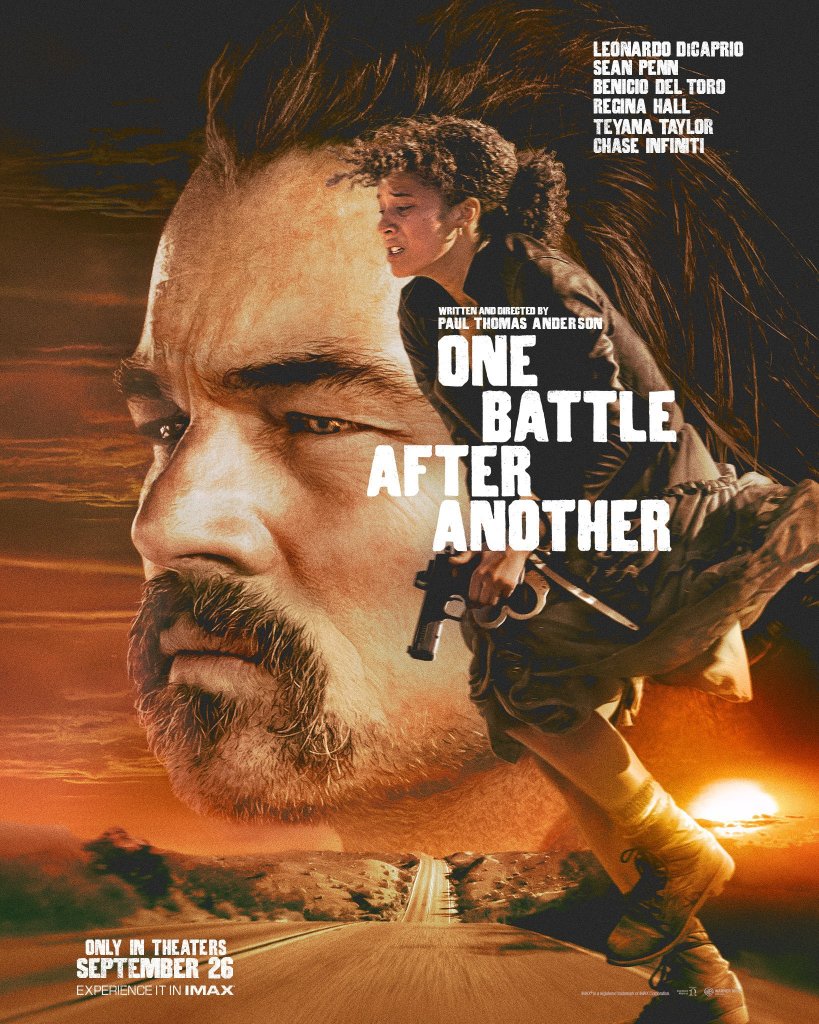
I was already looking forward to seeing Paul Thomas Anderson’s One Battle After Another, but when word started coming out of early screenings calling the film “the best movie of the year, and maybe the decade”, my excitement level went through the roof. This was a stark contrast from the social media chatter prior to this, decrying the film’s marketing campaign as “the worst of all time”. Bad marketing wouldn’t deter me from seeing the film, but I’m sure it did for many. Even in my own life, I spoke to people who were at the very least confused by the trailers and promotion and unsure about the film. But the movie itself here happened to be the saving grace, with positive word of mouth giving the campaign a total 180. In the few weeks between the beginning of early screenings and the film’s actual release, social media was flooded with review after review saying nothing but incredible, laudatory things about the film. While the endless praise did excite me, it also made me nervous that the movie was getting overhyped. Was it now held up to such a level it couldn’t possibly reach and I could only end up disappointed? I worried I would become the only person to not like the film. Well, that was not the case. I really enjoyed the movie. And while I think it deserves all the praise and hype, I’m not totally on the same level as the early critics. But I can see where they’re coming from and think their reactions are actually more nuanced than just how “good” the movie is.
Written and directed by Paul Thomas Anderson (PTA) (Boogie Nights, Magnolia, There Will Be Blood) and loosely inspired by Thomas Pynchon’s 1990 novel “Vineland”, One Battle After Another is a sort of social-political thriller/comedy/drama. It’s operating on many levels. And has some big ideas. The beginning of the movie is essentially a prequel to our story. It plays out like a propulsive, non-stop montage where we meet Leonardo DiCaprio as “Ghetto” Pat Calhoun and Teyana Taylor as Perfidia Beverly Hills. The two meet and fall in love through a revolutionary group known as the French 75 who bomb buildings, rob banks, and stage rescue raids on deportation camps. Perfidia Beverly Hills is the group’s passionate but reckless leader. She’s so magnetic that even an adversary like Col. Steven Lockjaw (Sean Penn), a man she dominates and humiliates during a raid on a deportation camp, is continuously drawn to her. It’s this fatal attraction that sets One Battle After Another on its years-spanning collision course. Pat and Perfidia have a baby, but Perfidia doesn’t want to be a mother, she wants to be a revolutionary. She leaves the family and ends up getting caught and ratting out the rest of the resistance crew to save herself. Pat escapes with their child to start a new life and Perfidia runs away from witness protection, where Col. Lockjaw was keeping a special eye on her. That’s all within the first 40 minutes of the movie. We then pick up 16 years later where Pat, now Bob Ferguson, is living off the grid with his teenage daughter, Willa (Chase Infiniti). Col. Lockjaw has become a prominent figure in the U.S. security agencies and gets invited to join the Christmas Adventurers Club, a secret society of wealthy far-right white supremacists, played by actors like Tony Goldwyn and James Downey. It’s a “great privilege” to be a member, but they demand (among other things) racial purity. Worried that Willa may actually be his child with Perfidia, Lockjaw plots a way to track her down and get rid of any evidence that might bar his acceptance to the club. And the chase is on!
Seeing the film made me realize that when people were saying that this is “the movie of the decade”, some might mean it’s the best, but they also mean that it is representative of this moment in history. The movie is set in an America that’s become a fascist police state: a place where immigrants are detained in massive camps, where the military and police operate as one oppressive force, where a secret society plans the future, and where revolutionaries attempt to fight back through random bombings and bank robberies. One Battle After Another is overflowing with ideas about the downfall and possible salvation of the country. Power is the common theme when it comes to the movie’s main forces. Perfidia. Lockjaw. The military. The Christmas Adventurers. They’re all jockeying for it and the sense of superiority that comes with it. While Perfidia in some ways uses her power for good, it’s not entirely selfless. She likes to be in charge. She dominates Lockjaw and she dominates Pat the same way she tries to impose her will on the causes she fights for. But everyone else wields their power entirely like a weapon. The military and government use their force and influence for personal reasons and vendettas. Lockjaw deploys an entire military operation into a small town just to try to seek out Willa because he wants to join a club. And we see the military assert that force in terrifying ways. One moment that really haunted me was when the troops are faced with a large group of protestors in the street and they send in an officer undercover as a protestor to incite violence so the troops have an excuse to retaliate. I wish I could be naive enough to believe that something that dark and twisted only exists in this fiction. When it comes to Lockjaw and the Christmas Adventurers, race obviously plays a large role. The Christmas Adventurers Club treat their mission of racial purity like it’s both as cavalier after-school hangout and as important as discussing nuclear codes. They sit around in a bunker under a member’s mother’s home dressed like they’re going to play golf while plotting murder and other disgusting things. Lockjaw is both a racist and works for a system motivated by racism, but also fetishes black women, particularly Perfidia. The racial politics definitely get thorny and Anderson’s depiction has already become a matter of debate. I’m not the right person to comment on the intricacies, but a film like this should inspire a dialogue. I found it interesting to think about One Battle in conversation with Eddington. They both examine the current state of American politics and society with simultaneous scathing and comedic tones. Some people will be upset that these topics aren’t addressed “with care”. And I can understand that. But mostly, I think the humor makes the ideas more accessible, a kind of Trojan horse that draws in a wider audience who might have resisted a more self-serious or preachy approach. And it can ultimately be more cutting. I also don’t think the comedy comes from making light of the issues. It comes from laughing so we don’t cry at the absurdity that this is our reality.
In his career, Paul Thomas Anderson has only made four films set in the present day, typically opting for a period piece. The fact that this was a story he wanted to tell in this way underlines its importance. The timeliness of the movie is part of what makes it so remarkable. From the opening sequence depicting a French 75 raid on a detention center at the Mexican border where they free immigrants, I understood the film’s place in our current times. The film is even more prescient now than it could have even known it would be at the time of writing and filming, as the country presently deals with outcry against ICE and anti-immigrant propaganda in tandem with the film’s release. Richard Newby wrote in an article for The Hollywood Reporter, “This is a film that has its finger on the pulse of America and shines a light on unspoken truths about our desire for change and the costs to get us there.” The clash comes from the film’s portrayal of trying to fight today’s modern issues with revolutionary practices that feel more like they’re from the 60s and 70s. Maybe that’s the point. We can’t rely on old techniques to win current battles. And that’s why Bob feels defeated. He’s older, set in his ways, he didn’t actually change the world, and he feels hopeless. So do we a lot of the time. But, unlike Eddington, the movie does leave us with a glimmer of hope. Younger generations are still willing to fight. “One battle after another” can be a discouraging thought, but it’s also the only way to win a war.
One Battle is PTA’s first action movie. But you would never know from the skill he shows in shooting these sequences. The camera movement is shaky and visceral. The gunshots and explosions are loud. The score is urgent, sometimes sounding like the way a car beeps when you leave the keys in it, a constant alarm chirping in the background. There are multiple high-tension chase scenes. One, in particular, the ending car chase, has gotten tons of hype online. And it lived up to the expectation. It’s so immersive I felt myself getting car sick (which, honestly, if you know me, doesn’t take much). The cars go up and down over these big hills on desert roads like waves in the ocean. It’s rhythmic. But it also creates a tension in audience expectation. The valleys obscure the drivers and when and who rises to the top is always a surprise. I genuinely saw people leaning forward in their seats in suspense, the sign of an expertly executed chase sequence. The movie also looks incredible. Anderson worked with cinematographer Michael Bauman to create a visual style with a dark ’70s grunge feel. There are some gorgeous shots of landscapes in the vast desert and silhouettes of people running through the smoke-filled night following the protests. It feels strange to find beauty in these moments where the story is dark or distressing. But the movie points you there. It quiets down ever so slightly in these flashes. It wants you to take a minute to breathe and relax and appreciate the small things where you can. Even when the world is falling apart around you. And the film isn’t all action-chaos. It’s surprisingly very funny. The audience I saw it with was laughing and cheering the whole time which elevated my viewing experience. We also get some extreme close-up shots of characters’ faces, reminding us of the human stakes underneath the large scale battles. I didn’t find this to be a particularly emotional movie until the very last moments where you find you have formed an intimacy with these characters.
Leonardo DiCaprio shot up to Best Actor favorite as soon as the film came out, as he should. I’m a long-time Leo lover but I really did think he was amazing in the movie. He is so funny, almost in his own stoner comedy film. It got me thinking, how has he not done more comedies in his career? His timing is spot-on! Teyana Taylor is only in the first 40 minutes of the movie but she leaves a large impact. The entire story revolves around her and you absolutely get why. She is so incredibly striking in both her face and personality. It makes total sense why everyone in her orbit would be drawn to her. As one of those people in question, Sean Penn is so good at making his character completely dumb and repulsive. He’s almost cartoonishly evil in a way that’s both non-threatening and also scarily real. Tony Goldwyn seems to be popping up everywhere these days, but I did laugh at the irony of him playing someone who was so vehemently against interracial relationships after he was famously half of one on Scandal. Benicio del Toro is a total delight, playing into his understated, relaxed humor. Regina Hall is great in a supporting role but isn’t given a ton to work with. Newcomer Chase Infiniti holds her own on screen with multiple acting legends and will definitely be someone we see more from in the future. With a name like that, how could she not be a star? Leo isn’t the only one getting Oscar buzz for this movie. I’m sure we’ll see most of this cast nominated. PTA is definitely a strong contender for a directing award as well. He’s been nominated 11 times but never won before. Will this be his year?
So is One Battle After Another the best movie of the year? It might be, objectively. But it’s not my favorite. In the top 5, sure. But not #1. Personal preference. That doesn’t diminish the importance of the movie and the legacy it will have. Not only does it operate inside the very real world of today’s nightmare politics, but it is also a really fun watch full of exciting action and laugh-out-loud humor. Political extremism, dark comedy, division, violence, urgency, relevance, acting for the ages… and a movie about girl dads! There is so much here, all good, and I never knew what was going to happen next. Which made the experience of watching it all the more thrilling. I would highly recommend everyone see this movie. I think you will be hard pressed not to find at least one aspect you find enjoyable or impactful.
2025 Count: 65 movies, 40 seasons of television, 4 specials
 I Think I've Seen This Film Before
One thought on “One Battle After Another”