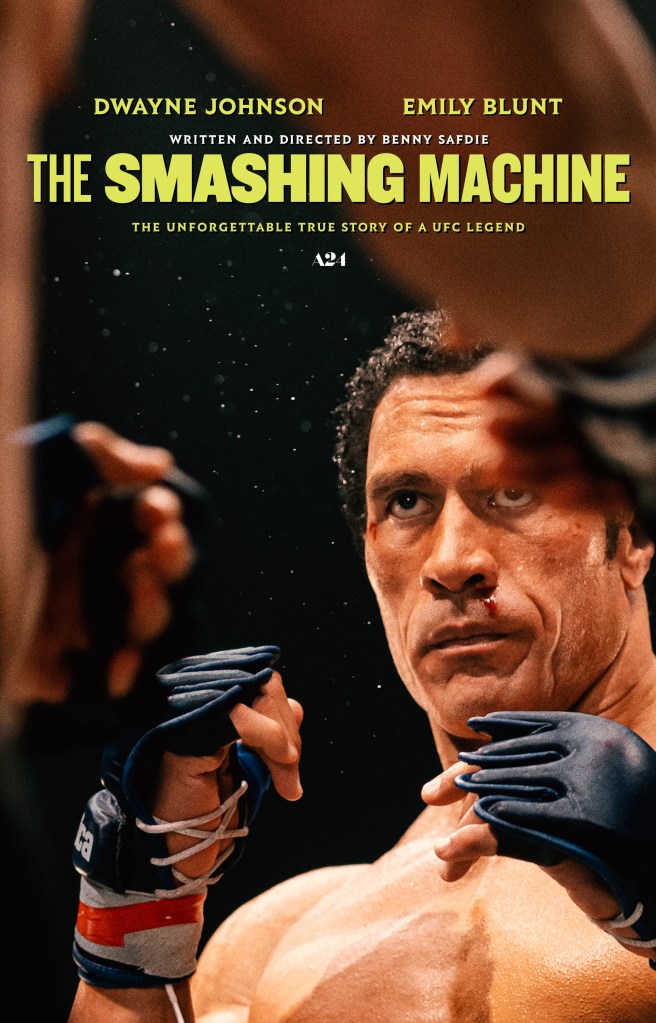
I have been interested in The Smashing Machine since I first heard about The Rock’s dramatic turn. But after the film had its world premiere at the Venice Film Festival, it came away with glowing reviews and director Benny Safdie won the Silver Lion for best directing achievements in a feature film, moving it all the way to the top of my hype list. I think The Smashing Machine turned out to be more of an artistic achievement than an entertaining movie. It goes for style over substance and subverts the audience expectation of a sports movie. There are definitely elements of the movie worth appreciating, but I can’t say that, overall, it lived up to the hype.
The Smashing Machine was written and directed by Benny Safdie and based on the 2002 HBO documentary The Smashing Machine: The Life and Times of Extreme Fighter Mark Kerr. This is Benny Safdie’s first solo feature as he usually directs as a pair with his older brother, Josh Safdie, creating movies like Good Time and Uncut Gems. (Josh actually also has a solo directing effort coming later this year, Marty Supreme, which is already being hailed as an awards contender. Will we see the two brothers face off at the Oscars? Something to look out for…) The Smashing Machine tells the story of two-time UFC heavyweight champion and MMA icon, Mark Kerr (Dwayne Johnson). From 1997 to 2000, we follow Kerr on his ascent in the MMA, his struggle with an addiction to painkillers, his tumultuous relationship with girlfriend Dawn (Emily Blunt), and his pursuit of redemption. But The Smashing Machine isn’t your typical rise to glory sports story. It’s not even really a story about fighting, despite taking place in the world of UFC. It’s the story of a man, who by profession happens to be a fighter, but is struggling with personal demons, just like anyone else.
Kerr is a fighter whose greatest opponent is himself. You could be the world’s strongest man and still have weaknesses. And those weaknesses, especially if they’re mental or emotional, can be stronger than any physical force. Johnson told Variety, “it’s not about the wins or the losses … it’s also a film about what happens when winning becomes the enemy. And I think we can all relate to that pressure.” That’s especially relevant in a film in which fights, both in the ring and outside it, are lost more often than they’re won. The movie is more about human vulnerability than it is about athletic achievement. Benny Safdie said he’s long been fascinated by the world of professional fighting, but was actually more interested in the emotional side of the sport over the physical when making the movie. That really comes through in the character of Mark Kerr. “The Smashing Machine” is almost an ironic title because Kerr couldn’t be anything further from the violent, unrelenting robot the moniker evokes. Despite his career in an organization powered by violence, Kerr is strangely soft spoken and sensitive. He speaks in a tempered, intentional manner, like he’s had intense media training or a psychology background, even when in the comfort of his own home. He’s open with his emotions, not afraid to express them. It’s a jarring juxtaposition to see a man with such a tough exterior, who we know could be lethal if he chose to, but oftentimes opts for passivity. Except in rare moments when pushed past his limits and he has brief, but chilling, outbursts.
No one could push Mark’s buttons better than his girlfriend, Dawn. Kerr’s gentle nature makes it easy for Dawn to walk all over him. It’s clear the relationship is toxic, but what’s less obvious is who is the victim and who is the aggressor? At first, in the height of Mark’s addiction issues, we’re inclined to side with Dawn. He’s a big star, he’s high on drugs, struggling with his mental health, and Dawn is just trying to help him while he mistreats her. But after his recovery, the dynamic shifts. Suddenly Dawn is constantly antagonizing Mark, taking issue with his behavior and his program and begins to get increasingly emotional and violent. They’re both narcissists and they’re both dysfunctional and, of course, they can’t stay away from each to save themselves. But neither is a totally one-dimensional good or bad person. Mark and his training and fighting regimen can be a lot to deal with. Plus helping someone through addiction recovery is an added burden Dawn didn’t necessarily sign up for. She likes the lifestyle being with Mark affords her, but her deepest attraction was to being his caretaker when he was down and the power that came from feeling in control of this massive man and to the danger, the thrill of being with a fighter. A scene where the two go to a fair outlines the chasm that has formed between them. Dawn wants to go on most extreme rides. Mark refuses. He’s no longer helpless, having overcome his addiction, and no longer provides any risk, trying to stay level-headed to get back in shape for his UFC return. So Dawn creates the danger herself, landing more punches (psychologically, of course) than we see in the ring. The movie contrasts these two types of head-to-head clashes: professional matches between fighters who respect each other and joke around like friends but who pound each other in the ring and the knockdown, dragout fights between Mark and Dawn at home that leave much more lasting damage. The film’s most shocking, extreme turn comes during one of these constantly escalating battles. Despite the anguish, Johnson claims The Smashing Machine is not ultimately about fighting, but, instead, the opposite. “It’s a love story about Mark and Dawn in this relationship, and it’s a love story about Mark and the love that he had for the thing that he did — his struggle with trying to deliver [in the ring], his challenges and his overcoming.” Dawn is Mark’s biggest supporter and grounding force while also being his Achilles’ heel. The people you love are the ones who can inflict the most pain.
The most stunning aspect of The Smashing Machine is Dwayne “The Rock” Johnson’s dramatic acting chops. The Rock is one of the biggest, most recognizable stars in Hollywood, but he’s mostly known for his work in action and comedy movies. Never anything that’s been taken too seriously. Even as a persona outside of his movies, The Rock presents as this upbeat, inspirational, jovial character. This movie is a total departure from everything we’ve seen from him and redefines his career now and moving forward. I, personally, never would have guessed he had this kind of emotionally raw performance in him. It’s the most he’s transformed both physically and emotionally. There’s a strange uncanniness to his look in the film. Under tons of prosthetics, he sometimes still looks like The Rock, and other times completely disappears into the role. Johnson credits Emily Blunt (who looks amazing as Dawn???) with helping to get the film made. Blunt is close friends with Johnson, having worked together before in Disney’s Jungle Cruise, and also connected with Benny Safdie on Oppenheimer, which he acted in with her. Reportedly, she brought the men together to kick off the project. Blunt and Johnson’s offscreen closeness translates into chemistry on-screen. Underneath all their toxicity and narcissism and ire for each other, you can really feel that their characters do care deeply about one another. Johnson and Blunt have both also said they got to know their real-life counterparts during filming, which helped their performances. Another real-world facet of the film is the character of Mark Coleman, Mark Kerr’s best friend and fellow MMA fighter, who is played by former UFC fighter Ryan Bader. This is Bader’s first ever acting job and he gives a grounded performance. UFC legend Bas Rutten also plays himself while professional boxer Oleksandr Usyk plays one of Kerr’s competitors, Igor Vovchanchyn. Having real fighters in the film adds to its authenticity, but also underlines the title’s irony and misconceptions about this world. The men fight like brutes in the ring, but, outside it, they’re gentle giants who share a camaraderie that few others could understand.
While The Smashing Machine is Benny Safdie’s first feature venture out on his own, the film is stylistically in keeping with the oeuvre he’s created with his brother. The Hollywood Reporter described their signature best in their review: “a stylized moody realism; a cast mixing trained actors with regular people; a downbeat vibe enlivened by flashes of raw humor and kinetic energy; and stories carried by protagonists often addicted to something, whether it’s theft (The Pleasure of Being Robbed, Good Time), drugs (Heaven Knows What) or gambling (Uncut Gems)… [The Smashing Machine] falls in line with other Safdie bros flicks about likable losers getting hammered by everything life tosses at them.” Realism is the most prominent feature of the aesthetic here. DP Maceo Bishop creates a grungy, grainy look that feels vintage and unvarnished. The camera movements are often shaky and handheld, evoking a home video or documentary. This is even more pronounced in scenes that take place in Mark and Dawn’s home. There’s almost a fly on the wall effect that the audience is made to feel. Johnson told Variety, “The house we were in was built from scratch. Real water. Real lighting. Benny made it just so we could hide the cameras — so we never saw the camera during those scenes. We’d go into these emotionally violent places, and Benny made it feel like we were just there. Just living it. Maseo Bishop, our DP and operator — he’s hidden, behind walls. You don’t even see him. There were no lighting setups. Just life. That’s why you feel like you’re sneaking into our house while watching it. Christopher Nolan saw it and said, ‘I feel like I shouldn’t be watching this.’ What a compliment.” I couldn’t have said it better than Christopher Nolan. The ending of the film just doubles down on the realism by having a meta moment in which the real Mark Kerr appears as himself in present day. It’s a strange choice, but meant to hammer home the message that this is a real person, one who has come a long way from the famous fighter of the late 90s and now shops like any regular guy at the grocery store.
This movie is not a crowd pleaser. It’s not the cliche fighting movie audiences may expect it to be. Aside from a training montage set to Elvis’ version of “My Way” (likely an intentional nod to other movies in the genre), The Smashing Machine doesn’t hit any of the typical beats of a fighting film. We don’t get to see Mark at his glory, just his downfall and [spoiler alert] failed attempt at a comeback. We don’t know anything about him or his life. Early in the film, Mark makes an analogy to a reporter about his focus when in the ring: “… it’s like the difference between a flashlight and a laser beam. I have to make sure that I’m 100% concentrated on what I have to do. Because if not, then my emotions will be running around everywhere, like a flashlight.” That’s what this movie is. It’s a laser beam, laser focused on this three-year period of Mark’s life. Nothing else is relevant. That’s the story it chooses to tell. And that story is less about fighting and more a character study of a man dealing with addiction, recovery, and love, told with unflinching honesty. Is it the most captivating story in the world? No. But I do think the film presented it in an interesting enough way to get me thinking. I’m glad I saw it, and there are filmmaking elements to be admired, but it was really just fine as a movie. If anything, I think The Smashing Machine will be remembered most as the film that pushed The Rock to his dramatic side. I’m super curious to see where his career goes from here.
P.S. I’ve previously stated that all movies should have end-credit bloopers, but I will now add to that and say all movies about real people should include their pictures in the credits so I don’t have to Google it myself. The Smashing Machine does deliver on that front.
2025 Count: 67 movies, 42 seasons of television, 4 specials
 I Think I've Seen This Film Before
One thought on “The Smashing Machine”