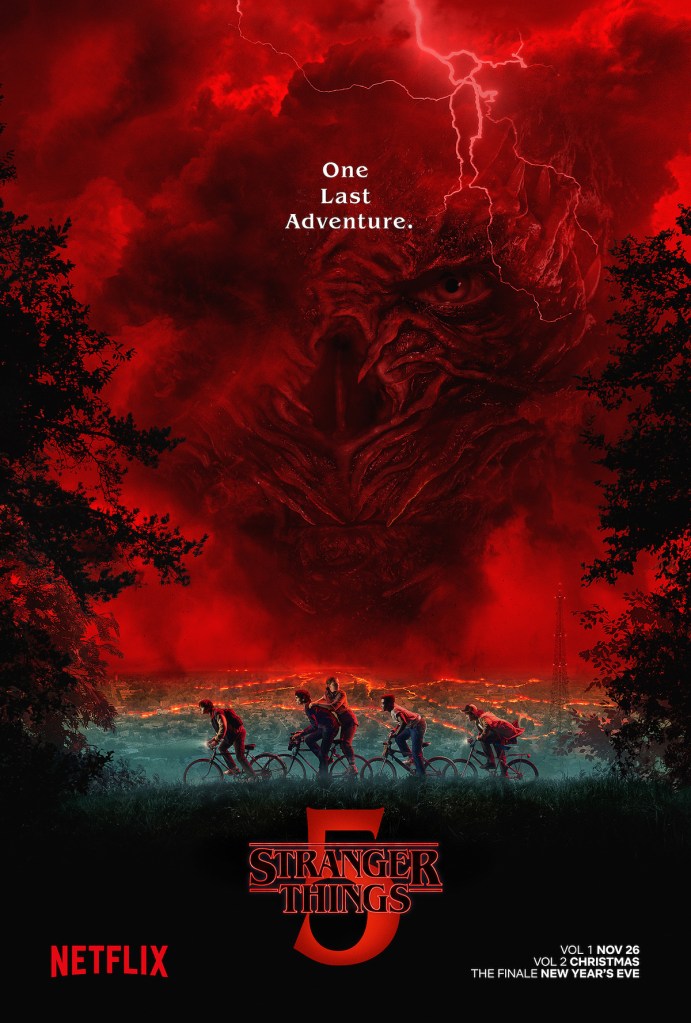
*This review contains spoilers… like massive spoilers… like I talk about everything.
This is one of the most daunting reviews I’ve ever had to sit down and write. Every single thing about Stranger Things has become massive. 10 years to create 5 seasons of television that include supersized episodes upwards of 2 hours long. A season 5 budget of reportedly $50 million to $60 million per episode. Multiple crashes of the Netflix platform when new episodes dropped. Shattered viewership records for the streamer. A limited theatrical release of the finale episode that played in 500 theaters over 2 days and made an estimated $20-$25 million at the box office. A marketing campaign that started months in advance with endless, inescapable content. No wonder I have 11 (coincidence???) pages of notes on this (I think that’s my record)! Because Stranger Things 5 has become more than just a season of television. It is a behemoth of a property that grew too big for its own good. So please bear with me as I attempt to wrap my hands around it and organize my thoughts into something coherent (buckle up, it’s gonna be a long, messy ride).
It’s been three and a half years since season 4 of Stranger Things came out in May 2022. This show has been gone for so long I’ve never covered it in the blog before (the audacity of anything to come out before my blog existed!). Over the years, I had rewatched the first 3 seasons a handful of times, but only saw season 4 once when it first dropped. Naturally, I remembered nothing other than the fact that I didn’t think back upon season 4 too fondly. Everyone knows the first season of the show is undoubtedly the best and mileage varies on the rest. But I needed to go back and refresh my memory before diving right back in with season 5. I had two main takeaways from the experience. 1) I was struck by how incredibly dark and sad it was. Max’s storyline in particular is just gut-wrenching. 2) I liked it much more than I remembered the first time around. Some parts still didn’t work for me, but I was definitely very affected by the season as a whole and it made me much, much more excited going into season 5.
Season 5 picks up in the fall of 1987. It’s 18 months after the ending of season 4 and 4 years (almost to the day) after our inciting incident on November 6, 1983, the vanishing of Will Byers. Unlike the previous seasons, we immediately dive right into the action. The entire team is on a mission to take down Vecna (revealed last season to be the big bad behind everything) once and for all while the military, led by Linda Hamilton’s Dr. Kay, complicates their plans. Stranger Things has always employed this dual threat plot structure with a supernatural enemy and a military/government one. The latter often plays to varying degrees of success and, in my opinion, has not worked really at all in the past 2 seasons. I think if I tried to outline the full plot of this season, you’d be reading this for the next few days. So I just want to hit some major points. Overall, this season had some high highs and some low lows. Oftentimes it did feel like a series that ran out of steam. Having exhausted the limits of the world it created, it was forced to turn inwards, either recycling its greatest hits or mining deeper into complex lore. A bunch of plot points became repetitive over the 8 episode run of the season: Dustin and Steve fighting, Hopper not trusting Eleven, playing “Running Up That Hill”. At the same time, the Duffer Brothers (creators, showrunners, and executive producers of the show) expressed their goal of answering every single question and tying up every loose end in concluding the show. They answered questions that no one even cared about, like “who built the tunnels in season 2?” This desire feels like a direct response to the backlash a show like Lost received with its conclusion because it didn’t really answer any questions at all. Personally, I don’t think giving the audience answers is the only way to conclude a story, especially when communicating those answers feels so forced that it sacrifices the storytelling. It becomes more like someone just reciting facts at you instead of inviting you into the world to experience it yourself.
Yet while trying to close every loop seamlessly, they also opened plenty of other plot holes. I know people out there have made lists of all of the “plot holes” in the season and I think most of those are pointless. Like I don’t actually think knowing what happened between Dustin and Suzie or with Derek’s family adds anything to our understanding of this universe or story. I don’t consider those plot holes. What bothered me most was how fast and loose they played it with ages and timelines this season. Someone said for a show with a clock-obsessed villain, you would think they would have a better handle on that stuff. Holly Wheeler somehow aging at least 6 years in the 4 year span of the show. Or Henry Creel being in high school with Joyce and Hopper and a bunch of other parents in the 1950s flashback when none of those characters should really be the same age. That fudging of the details concerns me more than finding out “what the Upside Down really is”. I can live with some mystery and ambiguity, but it’s harder to accept sloppy writing. This season both felt like too little time to meaningfully resolve its loose ends, yet too much time spent treading water in certain stretches.
Another product of bumping against its own walls meant much of this season was spent banking on nostalgia. Nostalgia is a powerful drug and is quite literally the foundation of the show. Stranger Things made its bones on references just short of straight rip offs of classic tales. Or, to put a more positive spin on it, loving homages. The Duffer Brothers were inspired by Stephen King novels, Steven Spielberg films, and video, arcade, and board games (graduating from influence to reality when they got Frank Darabont, director of films like The Shawshank Redemption, The Green Mile, The Mist, episodes of The Walking Dead, The Shield, Tales from the Crypt and more, to direct 2 episodes of the show for season 5). The 1980s nostalgia well was constantly returned to throughout the entire series. But this season added another layer: creating nostalgia for the show itself. Flashbacks to earlier seasons are peppered throughout, sometimes endearing us to the journey we’ve been on and sometimes reminding us just how much things have changed. Specific plot points also seem like a rehash of past ideas. Eleven’s final sacrifice and enigmatic ending directly mirrors her season 1 fate while Will’s psychic connection to the Mind Flayer is a copy of season 2. Ross Duffer even said as much to The Hollywood Reporter stating, “If you’re going to rewatch anything, I would definitely rewatch those early seasons because it really is about tying [everything] back to seasons one and two. [Those] are the seasons we referenced the most, because we really wanted this to be circular and to come full circle.” I appreciate a full circle story and a closed loop as much as the next person, but it can get to a point where it feels more like spinning your tires or running in circles than it does a satisfying end to an arcing journey.
It made sense to me to break the rest of the season down by character, so let’s start with Will who became kind of the center. And let’s also start with the positives because I feel like I’ve been a little negative so far. The ending scene of episode 4, titled “Sorcerer”, where it is first revealed that Will has powers, was probably the moment of the season for me. I thought it was just exhilarating and thrilling to watch unfold. Maybe because it hit on a more modern reference that struck close to home for me (intentionally or not). The first thing that came to mind upon seeing this Will/Vecna connection was Harry Potter. The allusions to Will as Harry have been there from the beginning. Will is “Zombie Boy”, Harry was “The Boy Who Lived”. Will felt it in the back of his neck when something was wrong, Harry felt it in his scar. Will seeing through the eyes of the Demogorgons when they’re about to attack specifically reminded me of Harry seeing through Nagini’s eyes when she attacks Arthur Weasley in The Order of the Phoenix. Will channels happy memories of himself as a child and first meeting Mike to harness the powers to fight off evil the same way Harry would channel happy memories to cast a Patronus. And Vecna choosing to kidnap Will that day back in 1983 inadvertently made him The Chosen One in this story, just like Voldemort did with Harry. And that’s where the powers come from in both cases. It seemed like there was some confusion about this with viewers. No, Will is not just like Eleven. His powers are different. They don’t come from inside him but instead from Vecna and the tether that was created between the two of them. It helped me to think about it through the lens of Harry. The connection between Harry and Voldemort, the ability for them to see into each other’s minds, comes from the small piece of Voldemort’s soul that unintentionally attached itself to Harry when Voldemort tried to kill him as a baby and failed. It’s because of that piece that Harry is able to speak Parseltongue like Voldemort can. But when that piece is killed off, Harry no longer has that ability. Will can tap into Vecna’s powers and siphon them for his own use, but without Vecna, he is just a mere mortal. Will is a horcrux! So what I’m trying to say is, Stranger Things 5 is for the lifelong Harry Potter fans! And this climax to end the Volume 1 drop of the season was more exciting and rewarding to me than the finale. It was a cool turn in the story that felt earned, with seeds planted going back seasons, and a great moment for a character who hasn’t much of a chance to be a hero.
Unfortunately, Will’s powers also have a downside. His connection to Vecna also connects him to the hive mind. And it’s been long established that when one link feels something, the entire chain feels it. So why didn’t Will die when Vecna and the Mind Flayer were killed in the end? And if just the small piece inside of him was killed or expelled, like Voldemort’s soul fragment in Harry, why didn’t we see or acknowledge it? It’s a small detail that has much larger consequences in our understanding of this world. Will’s powers are also very intertwined with his sexuality. This is another plotline that has been subtly developing over the series, growing in overtness until finally being directly said this season. The slow evolution of this always made sense to me, and I really liked in the climax of episode 4 how he needed to accept himself to be able to unleash his power, to finally project strength and confidence instead of fear. But that really should’ve been the end of it. It was a powerful statement! To continue to come back to Will’s sexuality as a major plot point leading to the much-discussed coming out scene just felt like overkill and watering down the previous achievement. I know it’s a tricky subject and I don’t actually think the coming out scene was as bad as everyone has made it out to be, but I just don’t think it was needed. Not because I don’t think queer stories are necessary or important, but because I think they previously made their point in a much stronger way and harping on it just dragged everything down. Relatedly, I also don’t think Noah Schnapp’s performance as Will this season was as terrible as everyone has made it out to be, but it definitely wasn’t the strongest. Especially for a character who carries much of the emotional heft of the season. It’s a shame because I still think about Noah Schnapp’s performance in season 2. He was absolutely incredible at only 12 years old.
The counterpart to Will is Vecna (/Henry/One). To me, Henry’s story is the biggest casualty of the “too much yet not enough” problem of this season. We spend so much time sifting through Henry’s memories, half the season literally takes place inside his mind. But yet I still don’t feel like enough time was spent exploring his origins with the Mind Flayer. It’s kind of like his story was told in reverse. We got part of his childhood in season 4 along with his young adulthood, but now much of season 5 was spent building to the reveal of what happened before any of that, when Henry first became connected to the Mind Flayer. An odd wrinkle in all of this is the existence of the stage show “Stranger Things: The First Shadow”. The show had its first performance in 2023 (between seasons 4 and 5 of the television series) and is still running on Broadway. What’s odd about it is that the play specifically dives into Henry Creel’s back story in ways that were likely spoilers for season 5 of the show. Also, from what I’ve heard, it fills in those blanks with much more color and context than the TV show gives us. Matt Duffer told Variety, “…you absolutely do not have to have seen the play to understand [the show]. They’re Easter eggs more than anything.” But it’s totally bizarre to me to have a play come out before and then run simultaneously to a season of television that spoils reveals of the show and answers questions the show does not. Why not wait until after the series concluded to stage this production instead of creating a situation where maybe a few thousand people who were able to get a Broadway ticket know more of the story than the rest of the millions of people worldwide who watch Stranger Things? Also on the subject of not knowing enough about Vecna, I have many lingering questions about his plan and motivations. He wanted to bring Hawkins and the Abyss together. Why? What does he get out of that? Just destroying the world? And how were the children actually helping him achieve that? Was he just evil for evil’s sake? On that note, though, I was glad they didn’t go for the Vecna redemption arc. They almost started to when Will tried to appeal to Henry’s inner child, reminding him he wasn’t born evil but was instead just possessed and controlled by this monster (the Mind Flayer). Vecna has a moment where he considers this, but then concludes he is too far gone. There may not be much of Henry left inside Vecna anymore. He is fully taken over by the Mind Flayer. Sometimes an appeal to a villain’s humanity works, but I think it can often be an unsatisfying end, especially when someone has left such a path of destruction in their wake. It’s almost sadder to see Vecna come to this conclusion, to remember he used to be human but he can’t go back there again, even if he wants to. Jamie Campbell Bower joined the cast of Stranger Things in season 4 and has been lights out ever since. He is absolutely chilling as both Vecna and Henry. And the scene in the cave in the finale where he is mirroring young Henry in the memory while crying and looking horrified is top tier acting.
The other major player in the plot is Eleven. Her ending went almost exactly how I thought it would. A good rule of thumb in movies and TV is that if characters make plans “for when all of this is over”, they usually don’t have a happy ending. Season 1 already telegraphed an end game in which Eleven had to sacrifice herself for the greater good, but when Mike tells her early in the season, “In my campaigns, if the party wins, then they all live happily ever after. Usually, what happens is the party doesn’t return to their local village, because too much has happened. They’ve seen too much. So they travel to a faraway land. A peaceful land. Somewhere beautiful, with like three waterfalls or something. And they all start again, together.” Later he reiterates, “The military will always be looking for you. We’ve always known that. Which is why we aren’t staying in Hawkins. When this is all over, we’re leaving. Escaping to some far-off land. Remember? Somewhere where they can’t find us. Somewhere where there’s at least one waterfall.” I knew this would never happen for them. Don’t make plans if you want to stay alive! Whether you choose to “believe” or not (call me a cynic but I don’t, or maybe I just don’t want to. I’d prefer the story to have some real stakes and consequences. Although that’s not really what it’s about… more on that later), Eleven’s death or disappearance serves a purpose more than “saving the world”. The Duffer Brothers have said El had to go so everyone else could move on. Eleven is like ET; she symbolizes childhood and magic. She is the connection to the Upside Down and this entire supernatural world. So to close this chapter once and for all, El had to be fully out of the picture, removing every last tether of fantasy from their lives so they can finally grow up and leave childhood wonder and possibility behind. I like the idea here, but I do think it works better in theory than in practice because Eleven is much more of a realized person than an alien creature like ET. She’s a human being. But because of that, I wish I felt her sacrifice more deeply. The father-daughter relationship she developed with Hopper over the seasons has often moved me to tears. But while their dynamic has become almost a 1-to-1 parallel with Joel and Ellie from The Last of Us, Hop and El didn’t give me anywhere near the emotional weight I feel for their zombie-fighting counterparts. Or maybe a more fair comparison would be to the duo’s own relationship from season 3, when Hopper’s letter to El from the grave (obviously not really) had me sobbing for hours. None of their conversations this season came close to that level for me. Similarly, in the scene with Mike and El’s final goodbye, I felt no chemistry between them. As barely tweens first discovering their feelings in early seasons, they had my heart exploding regularly. But now, the emotions hardly registered. Has the writing just grown stale after many seasons of repeated plot points? Or is the common denominator, Millie Bobby Brown, at fault? I don’t want to be mean about this and pile on to criticisms of a woman’s physical appearance, but it’s hard to deny that work she’s had done to her face has prevented her from conveying any real emotion. Definitely not what you want from an actor, particularly in climatic emotional scenes like this. I adored Millie and coming out of the first season she was the unquestionable superstar. She was poised to be the next big thing. But poor career choices have left her looking like someone who peaked young. I hope she’ll be able to carve a lane for herself post-Stranger Things but she may have missed her moment.
A technically original but really new character this season was Holly Wheeler. Through the first four seasons, Holly was played by twins Anniston and Tinsley Price, who were 3 years old when Stranger Things premiered in July 2016. For season 5, Holly was recast, now played by Nell Fisher, who recently turned 14. In the world of the show, Holly is brought to the forefront of the story because Vecna needs young children for his plan. But on a real world level, the show needed to try to recapture the cute, spunky, childhood naivety essential to Stranger Things that the 20 year olds playing teenagers can no longer provide. Nell Fisher did a great job, but it was kind of jarring to realize Holly was such a main character this season. Especially when that came at the cost of pushing other characters more to the periphery. But, at the same time, it does allow us to see the growth of our original group of kids who can now step into the role of protector for their younger counterparts. It’s touching to see Mike and Lucas and the others literally putting themselves between the children and the monsters. They’re no longer the tiny, powerless kids. They’re grown up and in charge.
Because there have been so many new additions to the cast, it became hard to spend enough time with our original characters. Winona Ryder’s Joyce was completely sidelined this season, particularly in the finale when her first line of dialogue doesn’t come until 45 minutes into the episode. Mike is also fairly inessential to the plot when he is arguably the main character of the series and Finn Wolfhard was another preternaturally talented child actor. I’ve never cared much about Jonathan and Nancy, but I thought their near-death “un-proposal” scene was a standout of the season. I really thought they both might die in that moment and I was kind of into the idea. It would’ve been a big swing in a series that increasingly played it safe. A bold decision they actually did follow through on was bringing back Kali/Eight. The introduction of this character came in the lowest rated episode of the series to this point (“The Lost Sister”, season 2 episode 7) and most creators would see that it didn’t work and try to pretend it never happened. Even though I didn’t like the character then, still don’t like her now, and don’t love that they brought her back just to kill her off, I really appreciate that they faced their mistakes head on and were like, “let’s try this again a different way.”
The emerging stars of the show and the ones I think will have the best careers going forward are the Broadway kids: Gaten Matarazzo as Dustin, Caleb McLaughlin as Lucas, and Sadie Sink as Max (they all got their start on Broadway). Dustin and Steve are probably the best duo on the entire show, I absolutely adore them and their unconventional friendship. Joe Keery is also on the brink of stardom for his music career (as Djo), but I hope he continues to act because he’s fantastic as well. Such great comedic timing and emotionality when needed. And my #1 couple in the show is Max and Lucas. Yes, I said it. I care about them more than I care about Mike and Eleven. Probably because Caleb and Sadie are absolutely unreal in every scene. The wrenching, devastating moments they’ve been through over the past two seasons are portrayed with such depth and perfection, they never fail to make me cry. I don’t want to forget to mention Maya Hawke who I think is consistently great and entertaining and is doing exciting work outside of the show. But mark my words: Sadie Sink will be the biggest star to come out of this series. I’m really looking forward to seeing what the future holds for this entire cast now that the show is over. I love them all and have been addicted to watching all of their cast interviews and behind-the-scenes content for years now.
Over the past ten years, both the creators and audiences alike have become attached to and invested in these characters. So giving them a proper send-off within the story was important. I enjoyed the epilogue portion of the finale episode much more than the final Vecna showdown. That’s probably part of a larger preference in my viewing of the show for the human moments over the monster lore/superhero stuff. I liked that they wanted to wrap up everyone’s character arcs with a bow, but I’ll admit some of it was a little too neat and happy for me. It’s been a popular talking point that they didn’t kill anyone off. I didn’t necessarily need anyone to die and definitely didn’t want anyone to, and I know it sounds insane to use this word when talking about this kind of story but it does sometimes feel unrealistic to have a bunch of average teens survive an event like this. But as much as it’s my instinct to want a thornier, more complicated story, I have to remember what this show is. The Duffer Brothers themselves said this is not Game of Thrones. Gaten Matarazzo told Variety, “I think everyone was open to the idea of our characters dying, but I just don’t think that was the show that they really had in mind. A lot of the obsession with who’s dying was more fan-pushed than anything. I could be wrong, but I don’t think the creative team ever really pushed that the main characters wouldn’t make it out alive. And I think that ultimately ended up being a really great way to define what the show was about. It’s about persevering through unimaginable odds. I think there’s something special there. The point is that the kids make it through, so I was never really scared.” The show is a childhood fantasy and, in a childhood fantasy, the danger is only surface-level.
But that bubble has to burst eventually. Our protagonists grew up both in the world of the show and in real life. And that’s what the end of the series signifies, the end of childhood. The Duffer Brothers have long said they’ve known what the final scene of the show would be, since as far back as season 2. I loved it so much. Coming completely full circle with the very first scene that introduces these characters: playing D&D in the Wheeler basement. Allowing each kid to have a solo moment for their exit. Passing it on to the next generation. Literally closing the door on that chapter of their lives. I could not stop crying watching the cast cry in this scene because I knew the tears were real. This was the last scene they ever filmed for the show. A show that dominated their real-life childhoods. They grew up on it. And so did we, in a way. The passage of time for these kids also reflects our own passage of time. We’ve all grown and changed over the last decade since the show premiered. I can still remember exactly where I was when I first heard about it in 2016. It was the summer after my sophomore year of college and I had my first real job, an internship in New York City I was commuting to from New Jersey. I got home from work one night to find my sister on the couch and she told me she spent the entire day glued to the TV watching this new show on Netflix. She binge-watched 7 out of the 8 episodes of the season in one day. And life was never the same. To think about not only where the show and this cast started 10 years ago, but also where all of us were back then, and how far we’ve come, makes the closing of this chapter, this decade in our lives, hit on a deeper, more personal level.
Because that connection has been so enduring and intimate over the years, fans have developed an unnatural sense of ownership to the show. I usually like to address any backlash and criticism to things I watch but I actually don’t want to acknowledge the insanity of what I saw online in the wake of this season. I wrote about this growing trend in my 2025 Wrapped post when discussing ideas that dominated my experience with TV last year:
One trend in television consumption I found this year was a major increase in the so-called “Reddit detectives”, or online users who analyze every detail of shows and post their theories. This is no longer just limited to Reddit. Social media has made these kinds of posts inescapable on any platform. I love when people are passionate about what they’re watching (because I know I am) and I do think it’s fun to theorize and see details you didn’t pick up on yourself. But somehow this year we’ve tipped over into the dark side of this (social media ruins everything). First of all, analyzing something to death takes the fun out of watching it. People who have no more knowledge of a show than any other viewer out there suddenly think they’re experts and sometimes even more so than the people who make the show. And secondly, a lot of times these “fans” aren’t even interested in what happens on the show anymore. They just want their own personal theories realized because they want to be proven right. I used to really enjoy getting in the weeds with these things and absorbing every factoid and idea, but the energy around it all has changed in such a negative way. Everyone needs to get back to just enjoying watching something instead of being so concerned with picking it apart to make themselves feel smart.
I will in no way argue that this was a perfect season of television, but I cannot stand people criticizing it for unfounded reasons. Hating the show because Mike and Will didn’t end up as a couple after people convinced themselves the show was teasing that all along is absurd. “The Bridge,” the episode in which Will came out as gay to everyone, became the lowest-rated episode of the series. Not because anyone had any real opinions on it, but because it was review bombed by “Byler” stans and homophobes (like in 2025? Get over it for real). Some people thought the episode was too gay because there were gay people in it and some people thought the episode wasn’t gay enough because Will didn’t actually say the words, “I’m gay” even though no one would have said that so willingly in Indiana in the 1980s. These lunatics then took it a step further, creating an online theory dubbed “Conformity Gate” speculating that the Duffer Brothers and Netflix had a bonus episode set for a surprise drop. Just because they were dissatisfied with the ending, they thought there must be something else in store. Ross Duffer addressed the conspiracy saying, “ I don’t think there’s a single cut scene in the entire season.” I mean, yeah, they’re like 2 hour long episodes, we can tell. Anyway, I’ve always liked being a part of real-time online fan reactions, seeing everyone’s takes and experiencing the show together, but after this situation that continuously made my blood boil, I may have to abstain from reading the comments for a while.
To me, the show’s biggest issue is that it got too big. Too big for my liking and too big for the creators to handle. It’s a casualty of the Marvel-ification of content these days where everything becomes a superhero movie with CGI monsters and green screens and giant action/battle sequences. I noted the first few episodes of the season looked pretty cool. I liked the colors and all the 80s neon. But then when we got into the more fantastical worlds, it went downhill rapidly. The Abyss looked ugly and awful. The Upside Down lost its luster. The finale playing in theaters is also a symptom of the problem. It’s a fun idea that I would have loved to participate in had I been available to do it, but that made it into even more of an Avengers movie. Videos from the screenings showed fans screaming and cheering along, just like footage from first viewings of Avengers: Endgame. That’s not necessarily a bad thing. I’m glad those fans enjoyed it and I love people getting excited about going to the theater. But that’s just not what Stranger Things is. Or at least that’s not what it was. Someone tweeted “you can go back and observe that season 1 of stranger things actually had kinda decent, dark brooding true detective vibes. then each subsequent season, it basically morphed into marvel avengers universe slop…” We fell in love with Stranger Things for its small-town vibes, moody color palette, and childhood innocence. In a critic’s conversation for The Hollywood Reporter, Angie Han said, “the show was at its best, when it was a winsome coming-of-age story populated by remarkable young unknowns and decked out with loving homages to a past era.” Even in season 4, when the kids were older, the actors more well-known, and the stakes higher, the parts that worked best for me took place in Hawkins. Not California. Not Russia. But the small town at the center of it all where the characters in that setting were dealing with more human problems like grief and guilt and death versus hunting down a secret government laboratory or breaking out of a communist prison. The show fell victim to the “bigger and better” ethos sequels tend to adhere to. But bigger isn’t always better. Especially when constantly expanding means sacrificing what made the show special in the first place. It’s counterintuitive, but saving the world is actually a less exciting story than saving a select few people or a specific place. When the gang needs to find Will or protect Eleven or even save Hawkins, we care more because we know those people and that place. We can connect emotionally. The whole world is harder to visualize and understand. When the scale is smaller, the stakes feel larger. So bigger actually isn’t better. And I hope we can start to move away from these stories about the fate of the world and back to ones that feel more intimate and human.
Because this show has become so gargantuan, it is now considered a franchise. And that means even though the series has ended, we haven’t seen the last of Stranger Things. An animated spinoff series titled Stranger Things: Tales from ’85 is already slated for an April release on Netflix. It takes place between seasons 2 and 3 of Stranger Things and follows Eleven and friends exploring a paranormal mystery in the winter of 1985. Ross Duffer also told The Hollywood Reporter that they are “very early days” on a live-action spinoff. What we know about this spinoff series so far is that it takes place in a new town and a new decade with completely new characters and new mythology but remains connected to the Stranger Things universe. The Duffers have also said it will have something to do with the rock Henry finds in the scientist’s briefcase in the cave but will not be about the Mind Flayer. It comes from an idea the Brothers came up with and they will be involved in production but will not be showrunners like they were on Stranger Things. In the realm of Marvel, I almost expected the Stranger Things finale to have a post-credits scene. Maybe something keeping the door open (3 inches) to this world or teasing the future of the franchise? But I like that they chose to close the book for good (for now, at least). Matt Duffer confirmed to THR, “There’s no plan or intention to tell the story [of what happens to these characters next] because it’s a coming-of-age story. Ultimately, that’s what it’s supposed to be. That’s what the show always was. When he closes the door to the basement, he’s closing the door on his childhood and he’s moving onto adulthood… this is the end of the story for these characters of Hawkins, for the Upside Down.”
Ultimately I do think the end of this series was a little disappointing, but it’s nearly impossible to land the plane on a regular show, let alone something so massive. So all things considered, I think they did a decent job. Matt Duffer himself acknowledged how hard it can be when the show has such an enormous, widespread audience, telling THR, “It’s challenging, especially because of the demographics, in terms of who’s watching this show. It’s really broad. When you read about people reacting to the show, sometimes I feel like they’re watching very different shows. And in a way, they are, right? They’re fixated on different aspects of the show that are more important to some people than others. It just gets confusing. So you can’t really work towards satisfying [everyone], because who are you choosing to satisfy?” I don’t know if I felt satisfied, but I can’t deny I was entertained. Like I said, a season of high highs and low lows. And a decade of core memories with this show that will last a lifetime. I mean, I rang in 2026 with the Stranger Things finale in Argentina. That experience might be better than the episode itself. And that memory will probably last longer than the plot holes and bad special effects. Am I trying to say that maybe the real Stranger Things is the friends we made along the way? I don’t think so? But what I am saying is that this show is more than the finale. It’s more than the last season. It’s a complicated, messy juggernaut that made an indelible mark on culture and people’s lives. And sometimes, that matters more than sticking the landing.
And if you made it to the end of this, I truly salute you. I know how the Duffer Brothers feel about creating this final season because it took a ton of time and effort and now I’m just putting it out into the world and crossing my fingers it at least makes a little bit of sense. But it only seems fitting an event this monumental would lead to my longest review to date. Stranger Things and I have a lot in common: we take forever to release our next installment and we’re not known for our brevity. Maybe that’s why this show has a special place in my heart.
P.S. Netflix, I’m talking to you. Please stop doing these stupid phased release strategies. Either drop all the episodes at once or release them weekly. It’s dumb and annoying and was even worse with Stranger Things 5 trying to monopolize all of the holidays. Do better.
2026 Count: 0 movies, 1 season of television, 0 specials
 I Think I've Seen This Film Before
One thought on “Stranger Things – Season 5 (TV)”