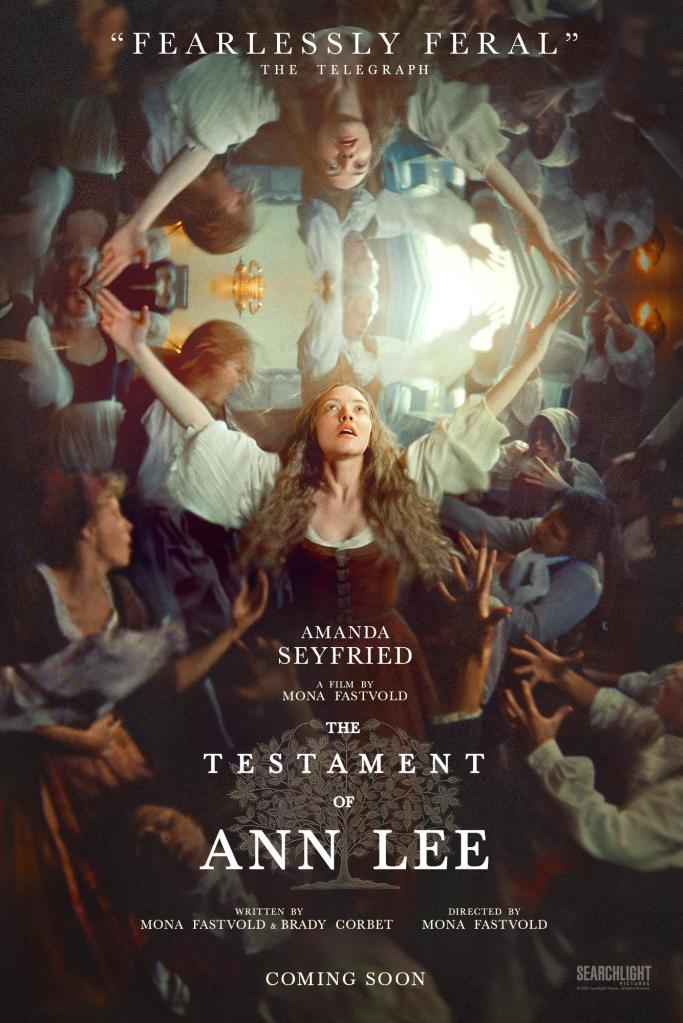
All I kept hearing about The Testament of Ann Lee was how weird it is. “Too weird to get nominated for an Oscar” some said, even though it might have been deserving. And that Amanda Seyfried was great in it. I heard all of that enough times to make me sufficiently curious. So now I can officially confirm I have never seen anything like this movie. Directed by Mona Fastvold and co-written with her partner, Brady Corbet (writer and director of last year’s The Brutalist, which Mona co-wrote), The Testament of Ann Lee is a hard movie to describe. Story-wise, it’s about Ann Lee, the founding leader of the Shaker religious movement. Execution-wise, it’s a musical? Fastvold explained to The Hollywood Reporter, “It’s not a traditional musical and it’s not a traditional biopic. It’s a film with a ton of music, a ton of movement, and it’s about a historical figure, but we don’t really know that much about her, really. I really had to rethink what this could be for myself. And it was hard to look at any other musical as a reference, honestly, because I couldn’t really find anything that quite spoke to this.” The film was also made for an impressively small budget with Corbet quipping, “As you can imagine, the elevator pitch for a Shaker musical was not the easiest thing to get off the ground.” The end result is a very strange, very striking, very ambitious portrait of a hard-to-know historical figure that doesn’t always keep your interest but never loses your attention.
I knew nothing about the Shakers before this film. I’d never even heard of them (or so I thought until I read that they are also well-known for making furniture, a fact only semi-alluded to in the film, and then I remembered I read an interesting book called “The Latecomer” that talks about Shaker furniture… so I guess I technically had heard of them but didn’t realize the extent of their history). The Testament of Ann Lee is a cradle-to-grave biography of the founder of this devout religious sect. It’s described as a “speculative retelling” because not much is really known about Ann Lee. She was illiterate and therefore unable to record her own experiences and beliefs, so most of what is known about her comes from second-hand accounts. Ann Lee was born in Manchester, England in the 18th century and helped form an offshoot of Quakerism in 1747. Their worship practices included violently trembling and seizure-like dancing at gatherings (believed to cleanse the body of sin), leading to the nickname the “Shaking Quakers” and later just “Shakers”. The group’s core beliefs included pacifism, spiritual and physical purity, the collective expunging of sin as a kind of exorcism, social equality extending to gender and race, and the nonbinary representation of God. They also practiced celibacy and communal living. Ann was a devout Christian from a young age, but after getting married, she gave birth to four babies, none of which made it past the age of one. In her grief, Ann fell deeper into religion. She then had a vision (almost like a prophecy… sorry but that played in my head every time someone said that in the film) that led her to believe she was the female incarnation of Christ and amassed her own following. Facing religious persecution, Lee took a small group of supporters with her to America in 1774 to establish a utopian society for the sect, ultimately settling near Albany, New York. While the settlement continued to grow, Lee was falsely accused of treason, witchcraft, and whatever else the Congregationalist establishment of New England could throw at her until her eventual death in 1784. The Shaker population peaked at 6,000 members in the 1840s but, because of their practice of celibacy, has all but died out, counting just three believers today.
Many have drawn comparisons between Ann Lee and The Brutalist, and not just because the films have the same authors. Both were shot in 70mm, include chapters with title cards, and tell tales of tortured geniuses facing social persecution and their attempts at escape. But in terms of storytelling, I think The Brutalist is more successful at creating a sweeping, complex narrative than Ann Lee. Mostly because of Ann Lee’s unknowableness. Because so little is known about her and the movie is trying to fill in the blanks, it often sacrifices deep character exploration in the name of a complete biography. We see the plot move forward without ever really understanding what Ann wants. For her movement sure, but for herself not so much. The closest insight we get is the inference we can make about her extreme trauma. She lost her children, declared celibacy as the only way to achieve purity from sin, and became known as “Mother Ann” to her flock. But in keeping with the Shakers’ radical ideas of feminism and equality, Fastvold felt it was important to give this real, female historical figure the same epic treatment that The Brutalist’s fictional architect received: “I thought Ann Lee deserved something grandiose and wonderful,” said Fastvold at the Venice Film Festival. “How many stories have we seen about male icons on a grand scale, again and again and again? Can we not see one story about a woman like this?”
But while Ann Lee’s life story may not feel epic on its own, the presentation of it in musical format certainly pushes it over that edge. Corbet told The Hollywood Reporter, “It became clear to us in the [Ann Lee] writing process, they were a musical people. They worshiped through song and dance. We were like, ‘Let’s do a musical.’” The songs in the film were all adapted from more than a dozen original Shaker hymns with the help of Oscar-winning composer Daniel Blumberg, who worked with Corbet on The Brutalist. But it was the dance numbers that stood out for me. The choreography from Celia Rowlson-Hall is astonishing. It’s not traditional dance or musical theater, but more like tons of bodies moving and contorting all over the place. The movie is very visceral and raw, not shying away from uncomfortable moments. That energy comes through in the movement. It’s not elegant and fluid. It’s ecstatic and expressionistic. The entire film almost feels like one long interpretive dance performance. Mona Fastvold has a background in choreography and performance art, making her especially suited to capture these numbers to film. The musical framework ultimately transforms the narrative into something experiential and completely original rather than purely biographical.
It takes a brave performer to sign on to such a demanding and singular role, but Amanda Seyfried was up for the challenge. This is her first time singing on screen since Mamma Mia 2 in 2018. Her voice is so beautiful with such a clear and pure tone, it really does emphasize the angelic nature her character tries to embody. But on the other end of the spectrum, the role also asks her to portray the emotional hysteria of passion, grief, and desperation. The physical and vocal challenges of the role required absolute commitment and dedication. And that comes through in her incredibly moving performance. Seyfried stars alongside Thomasin McKenzie, Lewis Pullman, Stacy Martin, Tim Blake Nelson, Christopher Abbott, Matthew Beard, Scott Handy, Jamie Bogyo, Viola Prettejohn, and David Cale, all of whom share the same total commitment.
What’s notable about the way the film approaches the subject matter is that it does so with full sincerity. There is no winking, no judgement on the Shakers or their practices and beliefs. Instead, it is respectful and curious from an intellectual standpoint. A fully unbiased observer, which is actually fairly hard to achieve. Also hard to achieve is how good this movie looks for the small budget it was made for. Yet, Fastvold wasn’t willing to compromise on her big ideas, somehow producing this epic musical for $10 million (a fraction of the cost of major studio movies). It isn’t lost on her how she became her own Ann Lee in getting this movie made: relentlessly pursuing a vision that she had complete faith in. Sometimes I say, “this movie won’t be for everyone”. In this case, I don’t know if this movie is for anyone. If you want to see something you have definitely never seen before, I’d recommend it. If you want to appreciate the art of dance or filmmaking, I would also recommend it. I don’t even know if I necessarily liked it. But what I do know is I will be thinking about it for a long time. And to me that makes it worth the watch.
2026 Count: 6 movies, 2 seasons of television, 0 specials
 I Think I've Seen This Film Before