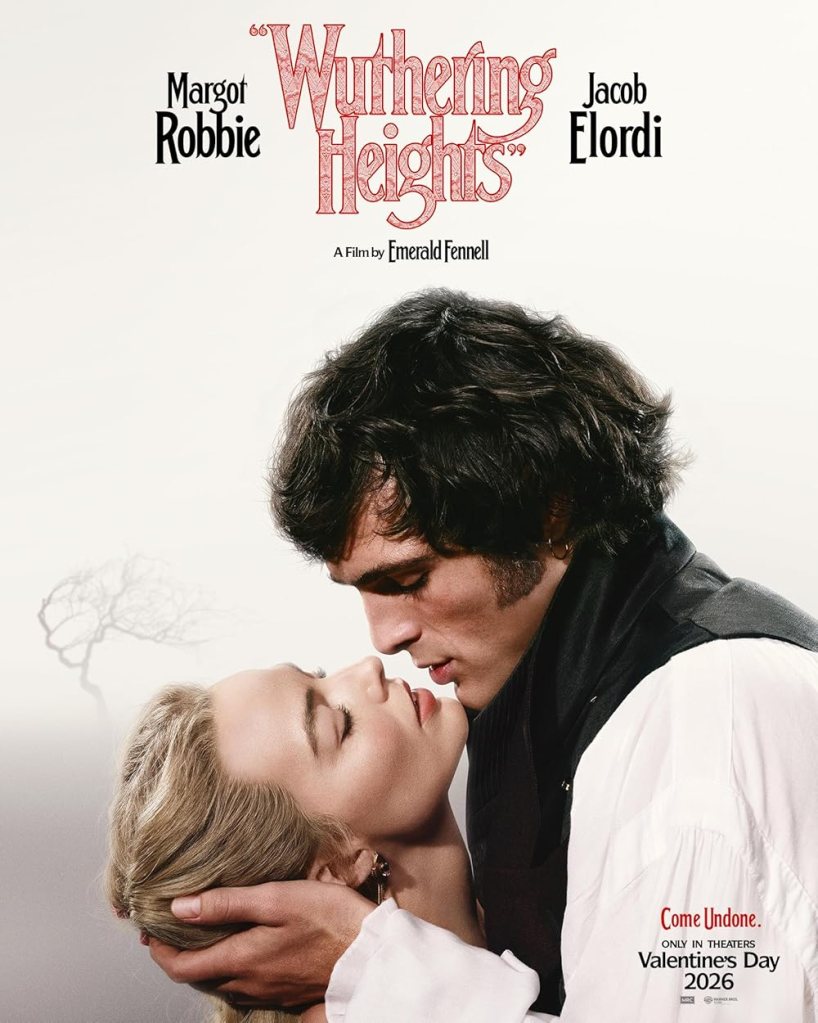
When I turned 29 in August, I made a list of 30 things to do before I turn 30. One of the items was to read a classic novel. I chose “Wuthering Heights”. Not necessarily because this movie was on the horizon, although I did want to finish the book before the movie came out. But I just felt like I’d always heard the title thrown around without knowing much about it and wanted to find out for myself. Well I can now say it was a bigger undertaking than I had previously realized. The book is extremely complex from its language to its characters to its storytelling devices to its themes. It’s a tough but fascinating read. And as much as I want to say I’m here right now to talk about the movie, not the book, it’s virtually impossible to separate the two. However different they may be. From the initial casting of Margot Robbie and Jacob Elordi as the leads, this movie has been controversial. Book purists had issues with every set photo that was leaked. The whole time reading the book I thought over and over, “How are they going to make this a movie?” The trailers and the tagline (“inspired by the greatest love story of all time”) immediately told me the film was going for a different version of the story than what’s told in the book, which is fine… to an extent. I was fully prepared to judge the film on its own, as seemingly more Fifty Shades of Grey than a faithful adaptation. Both kinds of movies have their place in the world. But I don’t know if it was because I couldn’t get the book out of my head or if I just wasn’t 100% sold on the chemistry of the leads, but the movie just never fully clicked for me.
As previously mentioned, the film is based on the 1847 novel “Wuthering Heights” by Emily Brontë, a dark, gothic tale of obsessive love and vengeance told through the relationship between Cathy and Heathcliff. The novel has been adapted for the screen more than 20 times in multiple countries and languages. Why do creators keep coming back to it? Honestly I think it’s because of how difficult the material is. It’s like their white whale. They all want to be the one to finally get it right. Or at least right in the sense of making a good movie, not necessarily an accurate adaptation. But none of the previous works (or this one so far) have reached universally loved or acclaimed status. What makes it so challenging? The book is fascinating in the way it’s written. It’s weird, it’s dark, it’s mean, it’s very confusing. It has many characters with the same names (kind of like Game of Thrones), but, most notably, it’s told from a third-person perspective. A man (named Mr. Lockwood) comes to Wuthering Heights years after most of the events of the story have happened and longtime servant of the house, Nelly Dean, tells him the entire history of the place. Mainly the story of Catherine Earnshaw and Heathcliff. But because of this narrative structure, we never get any internal insight into Cathy or Heathcliff and never see them alone because we are only hearing about them from secondhand accounts of people who were with them when things happened or heard about them from someone else. The book is also full of unreliable narrators. Every story is tainted by the opinions of the person telling it, making it difficult to know what’s true. And nearly impossible to adapt faithfully. Director Emerald Fennell said just this when explaining why the title of her film is in quotation marks: “The thing for me is that you can’t adapt a book as dense and complicated and difficult as this book. I can’t say I’m making ‘Wuthering Heights’. It’s not possible. What I can say is I’m making a version of it.” I completely agree with that. But then she continued, saying, “There’s a version that I remembered reading that isn’t quite real. And there’s a version that I wanted stuff to happen that never happened. And so it is ‘Wuthering Heights’ and it isn’t. But really I’d say that any adaptation of a novel, especially a novel like this, should have, you know, quotation marks around it.” And that’s where things get really messy.
Emerald Fennell has been on record, in that same interview and in others, about how big a fan she is of the novel. “Like anyone who’s obsessed with ‘Wuthering Heights,’ I’m a fanatic. I just adore it,” she told Variety. “The moment I read it, it just broke me open.” But taking the book and making a version of it based on the parts you remember, that admittedly may not be accurate, and also adding in parts you wanted to happen that didn’t is more like fan fiction than adaptation. Many people remember the romance and forget the rest. Maybe my first ever introduction to “Wuthering Heights” was this scene in Friends, that Jennifer Aniston reminded us all of this week (not me, I never forgot), where Phoebe describes the plot of the book as, “It’s this tragic love story between Cathy and Heathcliff.” It is… but it’s also not. That’s definitely part of it, but the book isn’t about love, it’s mostly a tale of revenge and cruel people dragging each other down (and class and race and ghosts and some other light subjects). Cathy and Heathcliff’s love story is tragic because they never get to be together. Fennell’s take doesn’t exactly give them a happy ending, but it does present a version where they at least get to be together for a brief moment.
I knew from the love story marketing that the film would be different from the book. I also assumed the movie would only cover Part One of the novel (because it hits a real turning point in the story halfway through). But I was still surprised how much was changed. Even details that seemed insignificant to alter. The film really isn’t the book at all, just a story that uses the same character names as the novel. It’s actually more like “Romeo and Juliet” than it is like “Wuthering Heights”, a tale of forbidden romance and doomed lovers. There’s even a scene in this film where a character describes the plot of “Romeo and Juliet”. If Emerald Fennell wanted to make “Romeo and Juliet”, then she should have just made “Romeo and Juliet”. I don’t necessarily think it’s sacrilegious to change a novel or any work when adapting it, even when it’s something as classic and revered as this book. But I do think it’s strange and makes me question, when you’re changing everything about it, why not just make an original story? Maybe it gets more attention and a built-in audience when it’s a story people are already familiar with, but then those people also feel let down when it’s different. Critics, scholars, and book lovers alike are divided on the film’s departures from the text. But one thing that isn’t up for debate is the way the movie has caused interest in the novel to skyrocket. Sales of “Wuthering Heights” in the United States more than doubled in 2025 compared with the previous year, while the United Kingdom saw a 469% increase in copies sold from January 2025 to January 2026. I think that’s incredible and would encourage people to read the book! (Or, if you’re just curious, I’m happy to give you a full book synopsis to the best of my ability – just reach out!)
I am big fans of both Margot Robbie and Jacob Elordi but I’m not sure they were the right people to take on these iconic roles. For a few reasons. Margot is a little too old for this role. Even though they seemingly aged Cathy up (she’s in her late teens in the book), she’s still 35 playing a character who is supposed to be very childish and petulant. Jacob Elordi was likely cast because he’s known for playing the bad boy heartthrob (and he’s previously worked with Fennell), but his casting was highly contentious given the centuries-long debates over the character’s race. “Is Heathcliff white?” could be a full essay all on its own, but the bottom line is that he is undoubtedly “other”. The novel is almost primarily about race and class, with Heathcliff as the central figure through whom those conflicts are explored. Not only is Jacob Elordi white, but he also fits easily into an upper class world, removing all of those tensions that add to the forbiddenness of Cathy and Heathcliff’s relationship. The race-blind casting of all the roles (supporting actors include Hong Chau, Alison Oliver, Shazad Latif, Martin Clunes, and Ewan Mitchell) is just generally confusing in a story that is so specifically about race. But this film chooses to focus on love. This might be my most controversial take, but I just didn’t totally feel the chemistry between Margot and Jacob. They’re both objectively stunningly hot people, but do I buy them together? I’m not so sure. That being said, I was surprised I cried at the end of the film. I didn’t think I was really emotionally invested but it still got me. It’s not really the fault of Margot or Jacob, I just think they were kind of miscast in these roles.
With Promising Young Woman, Saltburn, and now Wuthering Heights under her belt, Emerald Fennell has become a brand name filmmaker. And a divisive one at that. She has a distinct, recognizable aesthetic that is provocative on purpose. Love her or hate her, it works. It gets people talking. More than that, it gets them arguing. But while Wuthering Heights sold itself on her signature scandalous energy, it’s not nearly as salacious as Saltburn, a movie that was shocking for shocking’s sake. Wuthering Heights has its moments of hot and horny (Heathcliff shielding Cathy’s face from the rain with his giant hands is undeniably attractive), but it trades more in lust than in kink. Mostly the film is about yearning, an extremely hot (in all meanings of the word) topic right now. The Hollywood Reporter called it, “Wuthering Heights for the Bridgerton generation.” There’s no nudity, nothing too wild, and honestly not a lot of sex (it should be said, something the book has absolutely none of). Saltburn was all freaky all the time. One scene literally featured a character, um, let’s say “making love” to another’s grave. Which is kind of ironic to think about in the context of Wuthering Heights because a key scene in the novel involves Heathcliff digging up Cathy’s grave just to hold her dead body. The film tries to reflect the book’s gothic vibe with the inclusion of some random dark and violent moments (and doesn’t really achieve the same tone). But, in doing so, it also loses the perverse, satirical humor that balances out some of the more brooding stretches of Saltburn and makes it a more fun watch.
Where Fennell really excels is her visual aesthetic. It rubs some people the wrong way, but I find it stunning and striking. It’s anachronistic for this story but that doesn’t bother me. The colors and costumes pop off the screen. Suzie Davies’ grandiose production design is incredible. The exterior design, the interior design. I mean, wallpaper replicating Cathy’s skin? Who thinks of that? The fog and the rain only added to the melodramatic vibes. The film is soundtracked to original music from Charli xcx, also anachronistic but also works for me (“Dying for You” has not left my head since I heard it over the closing credits).
I would love to know how I would have received this movie if I didn’t read the book. Would I enjoy it just as a love story? I really thought I could evaluate the movie as its own distinct entity, but that proved to be hopeless. The book is just undeniably thorny. I still find myself thinking about it often, going over it in my head trying to understand it. I couldn’t put it aside while watching the movie. I think reading the book did impact me and my viewing of the film for the worse, but I am still really, really glad I read it. And I didn’t dislike the film, but I guess I didn’t really know what to feel. Like everything related to Wuthering Heights, it’s complicated. Mainly I think reducing a book about love, hate, cruelty, passion, despair, rejection, grief, loss, haunting, vengeance, race, class, gender, and family to just a select few of those ideas greatly diminishes the impact and importance of this story. It’s special for a reason. It’s not just another run-of-the-mill, star-crossed lovers tale. The complications are what have made it so enduring. But maybe it really is unadaptable. I do commend Emerald Fennell for trying and I honestly like her provocative style of filmmaking. At the very least, it’s never boring. I would recommend Wuthering Heights (both the film and the novel) so everyone can decide for themselves where they fall in what I can only imagine will be an ongoing Fennell debate. Good reviews are preferable, but getting people talking leads to the kind of box office returns that can fuel a successful career.
2026 Count: 10 movies, 4 seasons of television, 0 specials
 I Think I've Seen This Film Before