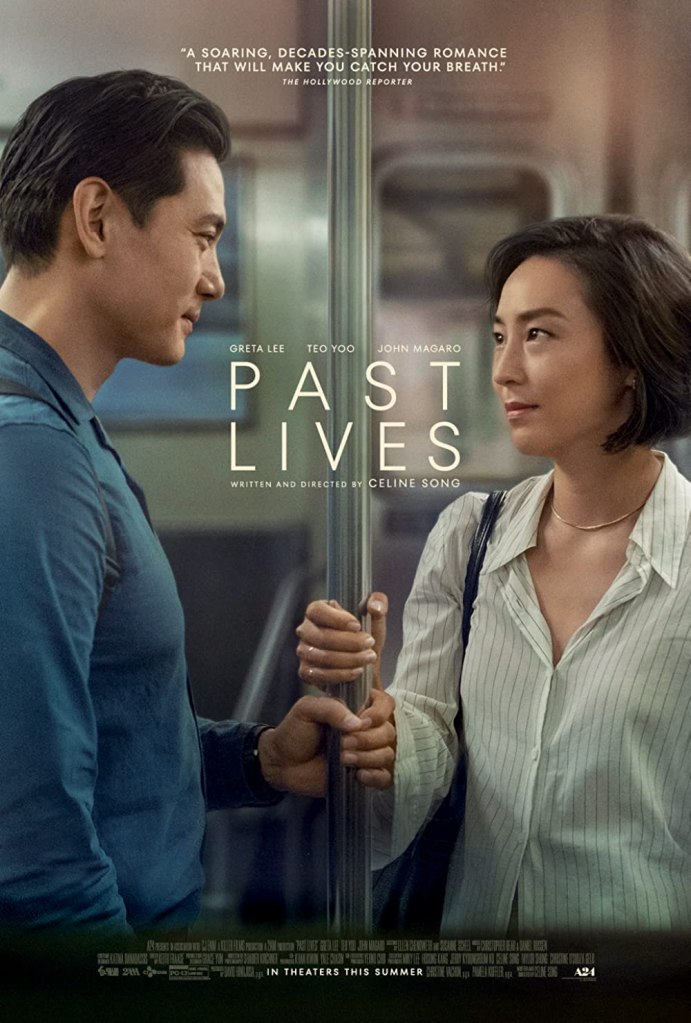
This movie really broke my heart. I went into it kind of expecting that and it sure delivered. As an indie movie, it wasn’t initially on my radar until it started to get early Oscars buzz, so I had to check it out and I’m really glad I did. I’ll cut to the chase on this one: you should all check it out too.
Past Lives is not a big, commercial blockbuster. It feels like an indie movie in the truest sense. It’s quiet, slow, beautiful, not overly dramatic or showy or big, and doesn’t have a lot of dialogue. When there is dialogue, half of it is in Korean with subtitles. All of this adds up to a movie that feels so painfully real, you could be eavesdropping on a conversation instead of watching it on a screen. While the reality helped the movie’s emotional impact, and while the film is really stunning to look at, what I responded to most was the story.
For those unfamiliar (as I’m sure most are since this is a lesser known film), Past Lives essentially details the making of a love triangle. Nora grew up in Korea and was best friends with Hae Sung. They had a juvenile flirtatious relationship until Nora’s family moved to Canada when she was 12. The two lost touch until reconnecting through Facebook in their 20s when Nora was living in New York and Hae Sung was still in Korea. After an extensive Skype relationship, Nora decides they need to take space so she can live her life in the real world instead of over a computer. Soon after this, she meets Arthur, a Jewish-American man, and they fall in love and get married. Years after this, Nora and Hae Sung reconnect again. What happens next, you will have to watch to find out.
It isn’t so much the workings of the plot that set this movie apart for me (we’ve seen love triangles in almost every story ever told), but it’s the themes and questions the characters and the movie ask while trying to sort through the feelings that come up in this situation. The title of the movie, “Past Lives”, comes from a major theme discussed which is “in-yun”. In-yun is the idea in Korean culture that anyone you have ever interacted with in any way (like even your clothes brushing while passing each other on the street) you were connected to in a past life. The movie introduces this concept to question: are we meant to be with certain people? Is it fate? Is it destiny? Are our past lives informing our present life?
The concept of in-yun reminded me of Taylor Swift’s song “invisible string” (shocking, I know). In the song, Taylor says she likes to think that from the beginning she was tied to her current boyfriend, and everything that happened in their lives was this string pulling them together, even when they didn’t know it. Fate was behind everything all along. I always thought this was a really nice idea when you can look back on it and think “if I had never done this or gone there or said that, then we wouldn’t have met” but when you’re in the middle of it, when you don’t know the destination of where that string is pulling you yet, it’s hard to believe you’re going anywhere at all.
But in-yun and “invisible string” also bring up other questions. Like, if you believe in fate, do you believe that there is a right person that you’re destined for? Is there such a thing as right person, wrong time? But if it’s the wrong time, does that mean that they’re not the right person after all? Is there a set plan for your life that you should try to follow, or is whatever decision you make the right decision because it’s the one you made? Will you always just end up wherever you’re supposed to be? Every decision in life, even down to the miniscule ones, comes with a “what if?” What if you had chosen differently? How would that affect your life? I could go on and on with the big life questions this movie had me thinking about afterwards. I think that’s partially because of the effectiveness of the film, but also partially because these are questions that I’ve asked myself before anyway. I don’t have answers to them and I don’t even necessarily know what I believe (it probably changes day to day), but I find them interesting to explore and I think I would like to believe that there’s a larger force out there pulling me towards the things that are meant for me. It’s a very romanticized, cinematic way of thinking and, like one character in the movie says, it’s like thinking of your life as a story. What version of events makes a better story?
I don’t want to say too much else about this movie because I don’t want to give it all away, but I think ultimately what makes the story so real and crushing is that you care about and feel for all of the characters. There is no bad guy. They are all just real people looking for love and doing their best to be happy. Besides being about love, it is lightly a story about identity and who you are in a relationship. As an immigrant, Hae Sung represents Nora’s Korean heritage while Arthur reflects her new life in America. Both of these sides are a part of who she is and yet neither fully captures her.
Like I said, this is not a big, loud, in-your-face movie. It is mostly quiet and moving. But it’s really so beautiful, both visually and emotionally. It made New York City look gorgeous (shoutout to Madison Square Park, I would recognize you anywhere). It hurt my heart in more ways than one (yes I did cry in the theater). It hit me really specifically in an emotional and intellectual place where it reflected on my own personal thoughts and questions about life. I’m still thinking about it long after leaving the theater. And there’s a good chance it’s in the mix for the upcoming awards season. If you have the space for it, Past Lives has a lot to offer.
2023 Count: 12 seasons, 32 movies, 1 special


I think this was one of your best reviews to date despite the Taylor Swift reference (and why isn’t there some connection to Harry Potter?) You captured the essence of the movie and how it made you think and feel. Great job!!!
LikeLike
Why “despite the Taylor Swift reference”?
LikeLike
I was joking
LikeLike