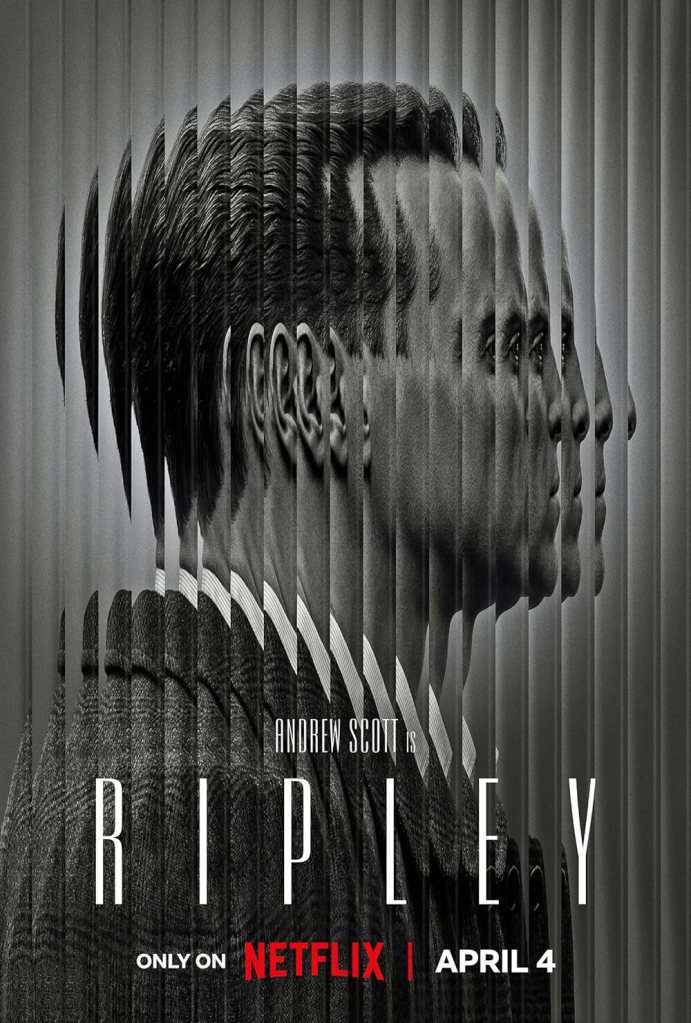
I think the best way to do a “remake” in Hollywood is to create something as different as possible from the original. Some may say that defeats the purpose as a remake is an easy way to guarantee success by repeating a winning formula. And that’s true in theory. But in practice, a remake is never as good as the original and the more it tries to be the same, the less it justifies its existence in the first place. Why do we need to just make the exact same thing, the exact same way again? Ripley doesn’t technically fit these parameters as the story is adapted from the Patricia Highsmith novel and not just taken from the 1999 Anthony Minghella film The Talented Mr. Ripley, but, for most people, the movie will be the biggest comparison point as it is the most famous version of the tale. And, intentionally or not, Ripley the miniseries does not try to recreate the magic of its extremely popular predecessor. But, instead, it works to create a brand of magic that is entirely distinct.
The tale in question tells the story of Tom Ripley, a struggling New York con artist who is recruited by a wealthy man to bring his wayward son back from Italy during the 1950s. After heading abroad, Tom’s encounter with Dickie Greenleaf’s luxurious and carefree existence becomes the unexpected catalyst for a descent into a labyrinth of deception, fraud, and murder. The first thing you will notice about Ripley is the distinct visual language. There is such a clear, thought-out vision that comes through in every shot. Everything about the way this series is made from the look and feel to the sound to the pacing makes it feel like an old Italian movie from the 1950s that was just unearthed. Where the movie The Talented Mr. Ripley is bright, colorful, and flashy, depicting the aspirational “la dolce vita” version of an Italian summer, the series is shot in black and white and takes place during the bleaker, chillier winter months. But instead of looking dull, the black and white palette makes everything look classy and expensive. The cinematography is rich and gorgeous. The black and white also works in tandem with a running motif throughout the series: the work and life of Caravaggio. Known for his employment of light and shadows, the influence of Caravaggio’s work is seen in every frame of Ripley. As a person outside of his art, he was also a notorious criminal and murderer who was forced to flee Rome. There are obvious parallels to our protagonist, Tom Ripley, who, over the course of the series, develops an obsession with Caravaggio’s work.
One word that kept coming to mind while watching this series was “painstaking”. It is that very feeling that creates the majority of tension in this thriller. When Tom commits a crime, when he has to dig himself out of a hole, when he is executing a plot, it all mostly happens in real time. We see almost every second, every detail. It is borderline excruciating to watch these sometimes 20 minute sequences tick on. Even moments with much lower stakes utilize this same laborious detail. So much of the series is shots of people walking, climbing numerous flights of stairs, driving, getting in and out of elevators, and walking into different hotels. This seemingly never-ending repetition is furthered by the set design which features a lot of geometrically precise architecture. We are then pulled even deeper into the paranoia of our main character with the way the show presents background characters. The camera lingers on shots of almost every person Tom Ripley comes into contact with, shots of them looking at him. It makes us wonder, are they suspicious of him? Do they know something? We almost never get an answer.
While to me the filmmaking of Ripley is the most notable feature, the show wouldn’t be anything without the performances of the main cast. Andrew Scott plays Tom in the most awkward and unsettling way. He’s not likable, and not just because he’s a criminal but because he’s so unreadable. The character is so interesting because he’s a career con artist but he’s not a criminal mastermind. He’s good at his grift but he’s also not. He makes a ton of mistakes and isn’t always good at thinking on his feet. You imagine a seasoned scammer to never sweat or get ruffled but Tom gets ruffled all the time. And yet somehow he still manages to fool most people. The genius of the show is in how it almost forces you to root for Tom to fool people, to get away with it, because of that painstaking tension. You want it to work out so the anxiety will end. But then, afterwards, it is almost equally unsettling to see everything work out so well for him. Dakota Fanning plays Marge, Dickie’s girlfriend, in a very different performance from Gwyneth Paltrow who had the movie role. Dakota has a much calmer, more grounded energy than Gwyneth and I sometimes felt like she seemed too normal to be interested in someone as spoiled and cavalier as Dickie. However, her performance in the final episode and her specific choices there were so fascinating and I was overall happy to see her on my screen. The appearance of Maurizio Lombardi as Inspector Ravini brings an entirely different, comedic energy to the show. Ravini is very dry and has no patience for Americans. The comedy of the cultural clashes and Ravini’s waning politeness are surprising and welcome.
Ripley is really unlike most television shows coming out today. I don’t think it’s for everybody but if you want something different, there’s a lot to like and appreciate here. Personally, I think the movie version aligns more closely with my taste but I’m glad I watched this show and ended up enjoying it more than I thought I would at the beginning. Probably requires a little patience and level of attention but could be worth a shot if you’re willing to try!
2024 Count: 17 seasons/specials, 30 movies


I may watch this based on your review. It was not on my radar before I read this. Thank you!!
LikeLike