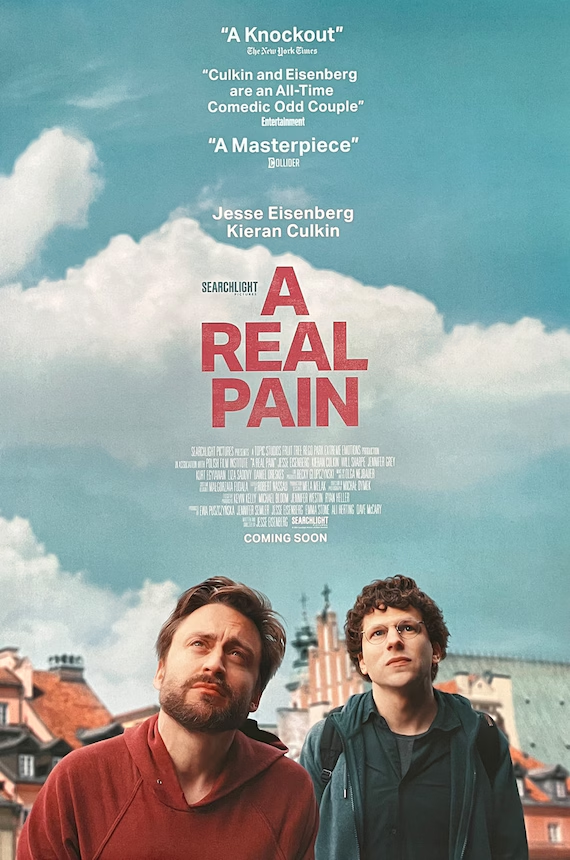
Even before receiving glowing reviews at its Sundance premiere this year, A Real Pain was high on my list of anticipated films. The second directorial feature from Jesse Eisenberg (he also wrote the script) stars himself alongside Kieran Culkin, both of whom have very different but very amusing styles of humor that I am a fan of. I was really looking forward to seeing the two interact and bounce off each other. A Real Pain follows cousins David (Eisenberg) and Benji (Culkin) on a tour through Poland to explore their family history and honor their beloved grandmother after her passing. The two were close as children but have grown apart in adulthood and often struggle to connect due to their opposing personalities. Their clashes throughout the journey are sometimes funny and sometimes heartbreaking, all while reckoning with the history of the Holocaust on a larger scale.
Jesse’s character, David, is a straight-laced, slightly neurotic, average guy with a sales job and a family. His need to be in control of situations, to fly under the radar and not make a scene, and his feelings of both annoyance and envy of those who move carelessly throughout the world made him more relatable to me than I’d like to admit. Kieran’s character, Benji, is the other kind of person, one who is completely unrelatable to me. He’s a kind of a trainwreck without much success in life. He’s a loose cannon, constantly running his mouth with no filter. His comments run the gamut from obnoxious and inappropriate to insightful and empathetic. And yet, while offensive and unpredictable, people are drawn to Benji. He’s an easygoing, charming when he wants to be, extrovert with high levels of emotional intelligence. Benji is what’s known as the “Magical Pest character”. Like Bill Murray in “What About Bob?,” it seems clear that this person is troubled and bothersome, but somehow people can’t help but to love them. To see through their frenzied exteriors to their pure hearts. Benji wears his emotions on his sleeve. A therapist once told me that when we’re young and we have strong emotions, we throw tantrums to get them out. But when we reach a certain age, society tells us that it’s no longer acceptable to express ourselves this way. But the emotions are still there, just as strong, and they need to go somewhere. Sometimes it’s healthier to let them out. That’s where the envy comes from. It’s not illogical to feel resentment for people who feel free to let their emotions erupt wherever, whenever, however when the rest of us feel constrained by the societal pressure to maintain composure and keep it bottled up inside. It doesn’t seem fair that we should have to follow these unspoken rules of human behavior when others choose not to. But at the same time, Benji’s unrestricted emotional expression does not equate to a well-adjusted life. He feels everything, maybe too much, and struggles to get out from under the weight of his own oversized feelings.
True to its title, A Real Pain examines the idea of pain in many aspects. When faced with the atrocities of the Holocaust, it’s easy to feel like our modern day, small scale problems are completely irrelevant. We feel stupid for even being upset about them. They’re champagne problems, first world problems. Our Jewish ancestors had REAL problems, REAL pain. But something as monumental as genocide and trauma is nearly impossible for most of us to really internalize. How can we honor this history while still living our lives? Do we have to suffer in reverence of their suffering? Is it disrespectful to be preoccupied with our minor troubles when these people had to deal with an infinite amount more horror? It’s a tough concept to reconcile. David describes his pain as “unremarkable”. Maybe in the grand scheme of things that’s true. But I recently read a book (“Adelaide” by Genevieve Wheeler) that said, “Pain is pain is pain. It was important to recognize your privilege, yes. To show gratitude, to count your blessings. But it was also important to acknowledge and accept your pain, to understand that no matter how large or small your problems, your losses, your wounds—they are yours. And you’re allowed to feel them.” Just because others may have been through worse, that doesn’t make your pain less valid. Perspective is important. Understanding and respecting our history is important. But the only life we’re living is our own, so the pain we’re most familiar with is our own. There isn’t a finite amount of pain in the world (unfortunately). Allowing ourselves to feel it doesn’t take anything away from anyone else. And exposing ourselves to this massive-scale trauma can actually help us to better understand ourselves. Like Benji says to David in the film, “We’re on a Holocaust tour. If now is not the time to grieve, I don’t know what to tell you.”
Sometimes the best way to deal with your own pain is perspective. Or distraction. Or both. Benji is in pain and maybe thinks this trip will help heal him in some way. But you know what they say: wherever you go, that’s where you are. Running away from your pain, ignoring it and hoping it will go away, is not a long term solution. It will always catch up to you. People think experiences like the one David and Benji embark on will change them. And, sure, you will likely learn things and broaden your worldview. But you will usually not be fundamentally changed as a person. You will not be completely healed. This is reflected in the film with Benji, in particular. He ends the movie in exactly the same place as he started. Not just mentally but physically, sitting alone in the airport. Maybe things will be different after this, but maybe they won’t. I really liked how true to life this felt. Movies tend to show character arcs and transformative experiences when much of life is not like that. People do grow and change but it takes time and often more work than just a brief, albeit powerful, trip.
A Real Pain is often uncomfortable to watch. Intentionally. The character of Benji seems to be causing a visceral response in people. He gets under your skin, he makes situations awkward, and he’s so unpredictable and volatile it can be distressing. This really speaks to the power of Kieran’s performance that he is able to elicit such authentic feelings from the audience. Benji operates at a frequency that is so perfectly calibrated to make viewers feel the same way as the people in his orbit in the world of the movie. The movie is also uncomfortable because of its subject matter. The film strikes an interesting tone that often feels fairly light and humorous despite the fact that these people are discussing a horrific moment in history and their own personal relationships to it. But in a scene where the group visits a concentration camp, the tone shifts. We see the characters wander slowly around the grounds, taking in their surroundings, in complete silence. You could hear people in the theater shifting in their seats. The lack of sound is both reverent and also feels like the air being sucked out of the room. Seeing the details of this place and the way the experience of being there plays across the faces of the visitors, it’s enough to make you want to throw up. I read that they were granted permission to shoot on location at the camp “because they respected the script and Jesse so much”. I think it was handled so well. This is something that should be uncomfortable to see. Part of the beauty of the film is the way it knows how to pick and choose its moments of when to balance out the pain with humor and when to dive into it headfirst.
Typically I stay far away from any movies or television that make me feel awkward or cringey or uncomfortable in any way. That’s just not enjoyable for me. But I actually didn’t mind it at all in this case. Maybe because it was all coming from a real and genuine place and not just with the intention of evoking a response. The film nails both balance and intention. It is funny, moving, and full of heart. The details are chosen with purpose. Like the house used for the cousins’ ancestral home being Eisenberg’s real family’s house they were forced to leave in 1939. And like all of the Chopin music used for the film’s score being played by Israeli-Canadian pianist Tzvi Erez. It just doubles down on the fact that, while the story in this movie is fictional, the history is real. And it still reverberates through many of us today.
A Real Pain is the perfect combination of an odd couple movie and a road trip movie. I really enjoyed watching it and spending time thinking through its ideas afterwards. I’m confident the film will make a run during this upcoming awards season and I look forward to seeing how it fares. I would definitely recommend seeing this movie! I think it has a lot to offer.
2024 Count: 29 seasons/specials, 60 movies


you really nailed this review and I always like when you inject your feelings about yourself in reviews. Not many can open up like that to the world. You are evolving.
LikeLike
Thank you ❤️
LikeLike