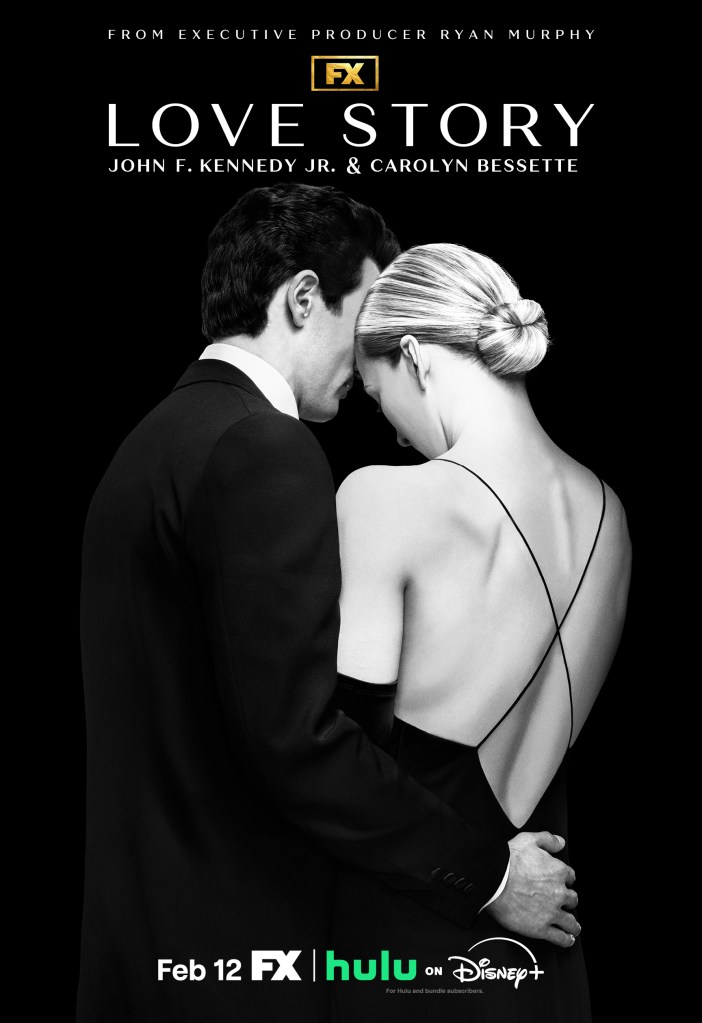
I’m usually allergic to a Ryan Murphy show. Obviously not Glee, but pretty much everything after that. Scream Queens, Pose, Monster, All’s Fair and more have a camp sensibility that is just not for me. So I was surprised when not only was I interested in watching Love Story: John F. Kennedy Jr. & Carolyn Bessette, but also that it was actually getting good reviews. It all made more sense when I realized that although the show was produced by Ryan Murphy as part of his extended “Story” universe (American Horror Story, American Crime Story, American Sports Story), he didn’t actually write or direct Love Story. So while it has some definite Murphy touches, it’s not as comparable to his other work. The man in charge here was Connor Hines, a first-time showrunner who’d been fascinated by Bessette and Kennedy long before Ryan Murphy announced plans for a show. Working off Elizabeth Beller’s book “Once Upon a Time: The Captivating Life of Carolyn Bessette-Kennedy”, Hines created the first volume of the planned new anthology Love Story series (“American” was dropped from the title). This show had a lot working against it from the very beginning: the reputation of Ryan Murphy’s work not being taken seriously (not that it should have been), internet backlash to paparazzi set photos during filming (users harshly criticized Carolyn’s look from her wardrobe to her shade of blonde), and pushback from the Kennedy family (Jack Schlossberg, JFK’s grandson and JFK Jr.’s nephew, has been very vocal about his distaste for the show, calling it out for “profiting off” his uncle’s life in a “grotesque way”). And yet, they managed to make a show that I really enjoyed. Sure, there’s plenty that doesn’t work, but there’s also plenty that really does. And not only did I find it entertaining as a television show, but it also managed to captivate and influence culture in a very real way.
There’s no real spoiling the story here since it’s fairly well-known history. The show follows the couple from the start to the tragic end of their relationship. But it’s not just going through major documented plot points as they happened; it’s a look into the price of fame and what that does to a relationship and to an individual. The show starts with the early days of their romance, the flirtation, the honeymoon stage. It’s two beautiful people with big personalities falling in love inside the bubble of their own passion. But over time, the outside world starts to bleed through. We see Carolyn, a radiant, confident, enchanting woman, become a shell of herself as she’s relentlessly hounded by the press and the public who both worship her and want to destroy her. Many don’t think she’s good enough for the golden boy, JFK Jr. No one is. While he himself struggles to try to live up to the weight of the legacy on his shoulders, he was born into the public fervor. He knows nothing else and can’t help Carolyn deal with the attention. They love each other but can’t understand each other and the wedge between them keeps growing wider as the world around them keeps closing in. Carolyn simply cannot exist in John’s world, one that seems intent on crushing her.
Executive producer Brad Simpson told Variety, “The way into the story was not through John’s perspective, but through a commoner entering the palace. That’s a classic story.” It is. And the allusion to royalty is apt in more ways than one. The Kennedys are a last vestige of American political royalty that just doesn’t exist anymore. That’s why fascination with them runs so deep. Netflix even currently has a Kennedy show in the works inspired by The Crown. They are, for all intents and purposes, American royalty. Making parallels between Carolyn Bessette and Princess Diana all the more explicit. The show (which is never subtle) even basically comes right out and says it. The only difference is that while Carolyn was completely closed off and private, not allowing anyone to know her, Diana was open and friendly with the public. And as Carolyn notes, watching the news reports of her death on TV, they still killed her. She gave them everything but they still wanted more.
Love Story is very internal, living inside the spaces of John and Carolyn’s relationship rather than among the public. But we feel the outside pressure growing through the toll it’s taking on them. Episode 8 is like a two-act play. It’s basically just two scenes, about a year apart, showcasing John and Carolyn arguing in their apartment. It’s heartbreaking and frustrating and claustrophobic and fascinating. This episode really worked for me despite the dialogue throughout the series being a real low point for the show. Mostly because absolutely no one talks like this in real life. Characters are constantly monologuing and therapizing themselves and each other and just saying the thing out loud instead of letting it live in the subtext. I was also not a fan of the final episode of the show. It’s tough to know how to end something when everyone already knows the ending. And when that ending is utterly tragic. We don’t actually see the crash, but I really didn’t like seeing them inside the plane at all. And then halfway through the episode we lose the star-power of the leads and the scenes of other characters grieving seem to drag on. The true magic of the show is really in those early episodes of flirtation and sexual tension. The “will they, won’t they”… even though we know they will. Those characters, free from the shackles of societal mania are who we are drawn to and want to spend time with.
When looking to cast the leading duo, Ryan Murphy said he wanted two unknowns, “two beautiful people you have no pre-existing association with,” Brad Simpson told The Hollywood Reporter. Real ones knew Sarah Pidgeon from 2020’s Amazon Prime series The Wilds, and some may know her from her Tony-nominated performance in “Stereophonic” or her role in the 2025 reboot of I Know What You Did Last Summer, but she was most definitely not a household name when she was cast as Carolyn. But if you were familiar with her work, the high caliber of her performance won’t come as a surprise. She plays both the strength and vulnerability of Carolyn at the same time. The real-life figure made herself intentionally unknowable, making it a difficult role to embody. She was incredibly famous and yet had no interest in fame. She didn’t give interviews or do magazine covers or ad campaigns. Rather than capitalize on her status, she chose to try to hide from it. And that’s where Sarah’s The Wilds skills have a chance to peek through, when she’s playing someone on the verge of a breakdown, feeling like they’re going crazy. She’s heartbreaking and devastating. However, the role also showcases a different side of her. On top of being almost aspirationally mean and elusive, Sarah’s performance adds a teasing playfulness to the character making her feel more like a whole person and somehow even more captivating. Sarah told The Hollywood Reporter, “I found that so interesting, considering she is this icon of minimalist fashion, to have so much spunk and spice, a strong sense of opinion….” Sarah, who had never been blonde before, has truly never looked better than when stepping into Carolyn’s style and gives an amazing performance in her shoes.
JFK Jr. proved to be a much tougher find. After seeing more than 1,000 actors, Connor Hines finally cast Paul Anthony Kelly just three weeks before filming started. A former model looking to break into Hollywood, Paul Anthony Kelly landed an extremely high-profile role for his first professional acting gig. Many people have been critical of his performance. I don’t necessarily disagree but I do think sometimes it works for the role. His JFK Jr. is kind of a hot idiot, so it didn’t always bother me when he sounded like one. The Hollywood Reporter said in their review of the series, “the actor manages here and there to find the lost little boy within People’s 1988 Sexiest Man Alive. Most importantly, he’s able to conjure serious sparks with Pidgeon.” And, yes, that is most important. Because this is a love story! The show is at its best when it is two hot people being hot on screen together. The chemistry, the flirting, the build-up and anticipation. Their romance starts in the classic celebrity and civilian way: he’s interested in her because she’s the only woman in the world who seems to be uninterested in him. I’ve seen enough movies to have this plan ready to go should I ever meet a celeb I want to date. In reality, though, @tvscholar said it best: “Carolyn Bessette is so much stronger than I am, I would’ve lasted two seconds before caving to JFK Jr.” But even more than just enjoying watching hot people be hot, their very real-feeling romance allows the show to have a more natural flow rather than be pushed along from one historical bullet point to the next.
The worst of the worst of this show came in the form of Naomi Watts as Jackie O. This was the most quintessential Ryan Murphy element of the series. There was way too much of her in the show in the first place. It’s not really about her but yet it seemed like the creators just couldn’t resist their fascination with her. But the writing of the character and Naomi Watts’ performance didn’t do her inclusion any favors. It felt so over-the-top and cartoonish that it took me out of it every time she was on screen. Watts is a common fixture in a Ryan Murphy series but her work here brought too much of that energy to a show that works better without it. Grace Gummer as Caroline Kennedy also didn’t really land for me but I thought Alessandro Nivola as Calvin Klein and Leila George as Kelly Klein both shined in smaller roles. I don’t have much to say about Dree Hemingway’s performance as Daryl Hannah, but the characterization really did her dirty. So much so that she wrote an op-ed piece condemning her portrayal. I obviously can’t speak to how it all really went down, but it seemed like for dramatic purposes they needed someone to be a foil to Carolyn.
Part of the fun of the show is the ‘90s aesthetic. The Hollywood Reporter’s review said, “The period setting, conjured through realistically grimy Manhattan streets and an all-bangers ’90s playlist, feels transportive rather than preciously nostalgic.” While I technically did live in 1990s Manhattan, I wasn’t actually old enough to be conscious of it. But it does always remind me of early seasons of Friends (even though it wasn’t actually filmed in New York) which just feels close to my heart. The Bryce Dessner score is great but the show’s needle drops had me looking up the official playlist on Spotify. And most importantly, maybe my number one takeaway from the show was that I need to throw out my entire wardrobe and start dressing like Carolyn Bessette in the ‘90s. And also go blonde (Carolyn’s constant hair flipping in the show just made it look even more glamorous… check back with me after my hair appointment in May). But I am not unique in that reaction. Far from it. The show may have singlehandedly brought back ‘90s minimalist fashion in addition to lines out the door at places like C.O. Bigelow (the store where Carolyn would buy her headbands), Panna II Garden Indian Restaurant (where their first date in the show was filmed), Bubby’s and the Odeon (other famous NYC spots featured in the series). There was even a JFK Jr. lookalike contest, the new measure of a pop culture phenomenon. Nostalgia is a powerful force. But what’s interesting in this case is that it’s young millennials and Gen Z who are feeling the pull created by Love Story. But they (we) weren’t actually around to experience that time. It’s nostalgia for a period, a feeling, we never knew before. Maybe it’s the appeal of a “simpler time”. One without cell phones and social media and being constantly available to everyone and bombarded with information. Or maybe it’s just a new trend and aesthetic to latch onto. Fashion is cyclical afterall. But there’s no denying the cultural impact of Love Story bled over from the screen into the real world.
I had fairly low expectations of this show but it really did manage to exceed them. Yeah there are some corny, goofy parts, the acting isn’t always great, and the dialogue is often, well, bad. But it does somehow capture incredible chemistry, a vibey 1990s NYC, and the ineffable gravity and aura of the couple at the center of it all. Not only that, but it is also a chilling portrayal of public obsession, fame, and celebrity that is still relevant today, albeit in slightly different ways. Love Story isn’t revolutionary television. It’s not must-see TV. But it’s sexy and heartbreaking and completely enthralling in its stronger moments. If you like romance or the ‘90s aesthetic, you should definitely check out this show.
2026 Count: 27 movies, 11 seasons of television, 1 special
 I Think I've Seen This Film Before