**This review contains spoilers**
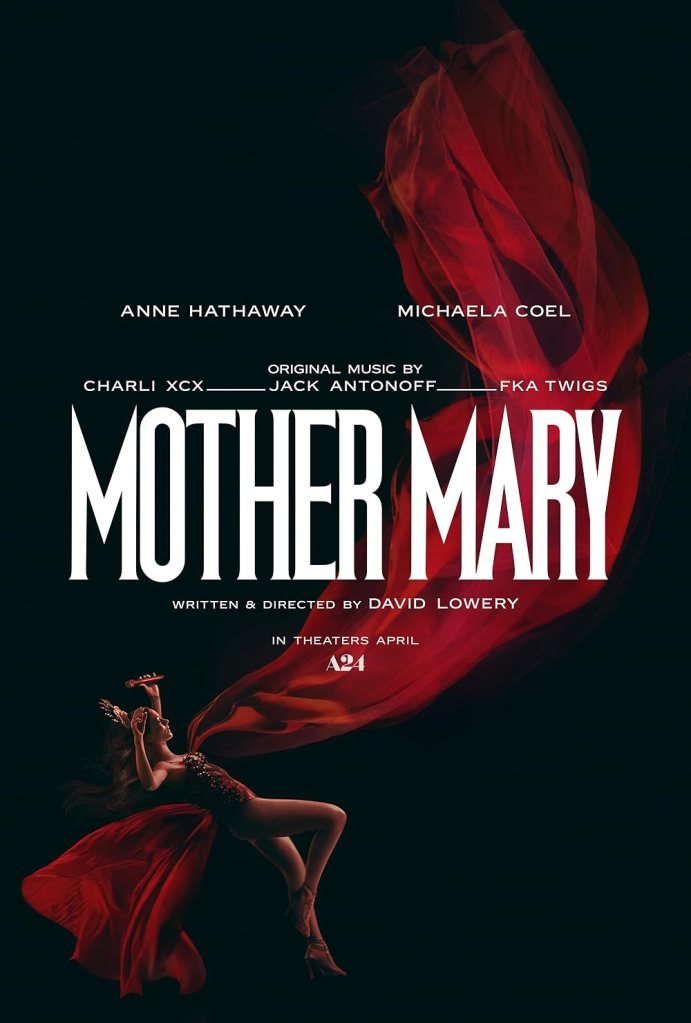
A movie about Anne Hathaway feeling lost in the world of fashion? No, this is not The Devil Wears Prada 2. Mother Mary is the new film from writer/director David Lowery. It is essentially a two-hander between stars Anne Hathaway and Michaela Coel about personal relationships at the intersection of fashion and pop music with original songs written and produced by Jack Antonoff and Charli xcx. To me, it felt like less of a movie and more like a fascinating art piece. The phantasmagoria (a word I learned because of this movie and is so fun to say!) of images is mesmerizing, even when the narrative remains elusive. I never knew what it was actually about or where it was going and everything happening was very, very weird. That’s not to say I didn’t enjoy the experience. I still don’t really know how to feel about it, but it’s been amusing to try to parse. In short, this “gothic metaphysical fantasy” isn’t easy viewing; it’s complex, thorny, inconsistent, at times frustrating, but always interesting.
The first hour of Mother Mary is like a one-act play. Legendary popstar Mother Mary (Anne Hathaway) shows up on the doorstep of her former fashion designer and best friend, Sam (Michaela Coel), begging for her help with a dress. Mary needs the perfect outfit for a performance just days away that will mark her return to the stage after a troubled period out of the spotlight and Sam is the only person she trusts to do it. But Sam is still hurt by the way Mary dumped her, as a co-worker and a friend, 10 years earlier when she really started to break big, even though Sam was the one who helped invent the “Mother Mary” image in the first place. Despite the betrayal, Sam lets Mary in and they talk. About life, their careers, their relationship, trying to find answers and healing. The mood between them swings from bitter to nostalgic to angry to sad to sinister. David Lowery has said the idea started out this way, “as simply a one-location script loaded with dialogue as two artistic souls confront each other about past wrongs and mistakes” (Deadline). And the first hour tricks us into thinking that’s what the entire film will be: a back-and-forth between former friends, a talky relationship drama set in the glamorous world of music and fashion. Until the second half quickly heel turns into something else.
One of the taglines for the film was “This is not a ghost story” (ironic, because David Lowery previously made a film called A Ghost Story). Well, it turns out it quite literally is. As the two women delve deeper into their time spent apart, reeling from the wounds of their separation, Sam reveals an experience she had the last time she ever listened to Mary’s music where, after attending her concert, Sam was struck with a horrible toothache. The tooth was removed and Sam later woke up in the middle of the night to a vision of a spirit in her room in the form of a red swirl of fabric that then disappeared into the night. Mary then confesses that after a séance with friends that was supposed to be for fun went wrong, she was possessed by the very same spirit Sam had seen. The two decide they need to perform an exorcism to release the spirit from Mary. So, yeah, it most definitely is a ghost story. While the first half of the film is slow and conversational, the second half begins to move a lot faster, incorporating flashbacks, montages, and special effects as it adopts a darker, creepier tone to tell the tale.
It’s not entirely clear what David Lowery is trying to say here. At least to me, but I don’t think I’m alone. There are a lot of threads woven into the swirling fabric of the spirit we see onscreen. But the meaning is only further clouded by flouncy, cryptic dialogue, spoken mostly by Sam, in a way that no real human would ever talk. Even within the film, Mary calls her out saying, “These metaphors are exhausting.” The dialogue does fit with the surrealist world the movie creates, but I did bump up against it while watching. In part, the film is about relationships, especially those that are also creative partnerships. I do like that the movie doesn’t exposition dump about Mary and Sam’s backstory; it makes you put the pieces together on your own through their conversations. We can glean that Mary’s rise to fame was the downfall of the relationship between the pair. It couldn’t survive the growing gap in their fame and fortune. But the movie is also filled with homoerotic undertones that kept me wondering if it was going to fully go there Spoiler alert: it doesn’t, but there still does seem to be an extra layer to this relationship. Mary tells Sam she has written a new song that “might be the best song ever written in the history of songs.” It’s called “Spooky Action”, which (according to Variety) “is a reference to Einstein’s principle of ‘spooky action at a distance’ — the idea that separated particles, even when they’re light-years apart, can have an effect upon each other. That’s a rather ponderous metaphor for what in another movie might come down to, ‘I still think about you.’” More metaphors! But in Mary’s case, this is how she expresses herself: through art, through performance. Performance is also a key part of the story, looking at the person behind the stage persona.
The popstar Mother Mary is modeled off of many modern-day popstars. I had heard leading up to the film’s release that both David Lowery and Anne Hathaway were citing Taylor Swift, and specifically her Reputation Stadium Tour concert film, as inspiration in their press runs. So when the movie started, I was expecting to see a full Taylor analog in Mary. And I did see some of her, but I also saw more of Lady Gaga. There’s also a clear Madonna parallel, I mean her name is literally “Mother Mary”. The more dance pop sound, religious imagery, and extravagant wardrobe (beautifully done by costume designer Bina Daigeler) were all decidedly not Taylor (save for one Lover bodysuit replica). But then, the movie takes its second-half twist. One vignette, depicting Mary post-possession slowly falling apart, unlocked the full Taylor connection for me. The scene shows Mary coming off stage after a performance at the top of a staircase backstage and then walking up a nearby flight of stairs to get back onstage for the next show. She does this over and over, show after show, with increasing fragility. By the end, she’s falling offstage, barely conscious, into the arms of her backup dancers and they’re pushing her right back up the staircase and back onstage for the next performance. I’m calling it the “I Can Do It With a Broken Heart montage”. For those unfamiliar, Taylor’s song “I Can Do It With a Broken Heart” from her album “The Tortured Poet’s Department” (please treat yourself to my full TTPD album review!) is about her work ethic and her commitment to her craft. If you’re sick, hurt, sad, tired, or possessed by a ghost, you’re still getting up there to perform. The show must go on! Taylor’s own performance of this song during The Eras Tour told a similar story to the scene in Mother Mary. Taylor faux collapses after a song and her dancers dress her, fix her makeup, and push her right back into the spotlight despite her protests. But as soon as the song starts, she snaps into showgirl mode. She’s there to entertain and nothing else matters. One such potentially show-crippling moment was early in the Eras Tour run when Taylor tripped between costume changes and suffered a nasty wound to the palm of her hand. The show was, of course, unaffected and she went on as if nothing happened. But in Mary’s case, the same injury, a large gash in her hand, is the opening the spirit uses to enter her body and possess her. If that’s a coincidence it feels extremely eerie. The spirit, which is literally a swatch of fabric, comes from within Sam and then penetrates Mary. In the height of the exorcism the women perform, Sam pulls the spirit out of Mary’s chest like a magician pulling an endless trail of scarves. It connects them. They are bound by it. A not-so-invisible string. Taylor’s song “invisible string” from the album “folklore” ponders the way fate is the silent driver behind all of life’s experiences. Nothing is accidental, everything happens for a reason, the universe has plans for us. Mary and Sam are forever cosmically connected. “Spooky Action.” For whatever reason, they were always meant to find each other again.
I know I find Taylor references in everything (I actually think it’s a fairly impressive skill if I do say so myself) but it’s more relevant here than in most cases. The creators specifically cited her as source material! They also used cinematographer Rina Yang to shoot the concert scenes, the same cinematographer behind All Too Well: The Short Film as well as Taylor’s music videos for “Anti-Hero”, “Bejeweled”, and “Lavender Haze”. They’re asking us to make these connections! But the film also speaks to more than just Taylor the artist. It looks at the popstar as persona, an icon, an entity bigger than just one human. The unknowable nature of a global superstar and the mystique that creates. The less we know, the more we want to. It’s the public that wants to possess these stars in real life. The dichotomy between the sheer size of crowds and the intimacy that’s created at the shows amongst the fans but also between the star and the fans. Swifties probably more than any other fan base are the perfect example of cult-like devotion that parallels the religious iconography of Mother Mary. All that being said, the movie seems to have a lot on its mind, but if it has a point of view on any of those topics, it’s not clear. Whether the true meaning is buried too deep underneath the layers of symbolism and style to be properly analyzed or, at the core, there’s actually nothing tangible there, the film leaves us wanting. There’s so much potential, so much thread to work with, but it doesn’t ultimately end up coming together.
The entire film rests on the performances of Anne Hathaway and Michaela Coel as they are the only two people on screen the majority of the time. Anne (shoutout to a Millburn High School alum!) gives an incredibly physical performance, not just singing and dancing in full concert performances, but she also spends most of the film crying or on the verge of tears. She’s shaking and timid and thin with wet hair, showing the physical toll this possession has taken on her. In one jarring scene, she performs a dance to no music in Sam’s barn. It’s Mary in her weakest form with zero artifice, just her in a tank top, sweatpants, and bare feet, moving violently with an emotional rawness to the sound of silence. The only noise is her body pounding on the wood floor (it wasn’t the point of the scene, I don’t think, but I was on edge the whole time worrying she was going to get a splinter… I mean bare skin writhing around on an unfinished wood floor is psychotic). It’s kind of beautiful in a horrifying, surrealist way. But you can tell how committed Anne was playing this character. Even though she’s an experienced singer, her background is more musical theater, so she also had to train as a popstar in all aspects. Despite Mother Mary being the titular role, it’s Michaela Coel’s Sam who really drives the film. Michaela’s face is so incredibly striking, it speaks volumes for her. She’s also adept at being creepy, often pulling this look where she smiles without blinking and her eyes start to tear up. Together, their chemistry is electric. They make us feel the full weight of their history and how they’re both still harboring wounds from it in the present. FKA Twigs also shows up for a scene to be impressively creepy and Hunter Schafer is great in limited screen time but would have loved to see more of her. Maybe the most notable thing about the cast of Mother Mary? There’s not one single man in the film. Not even one mentioned by name or in abstract. I can’t think of a single other movie I’ve seen that I can say that about.
Mother Mary is gorgeous to look at. Cinematographer Andrew Droz Palermo does a great job with the visual palette, especially the hallucinatory quality of the more haunted scenes and the spirit itself. And the performances are from two stars giving it their all. But is there any there there? Some of the more cynical reviews have called the film “vapid” and “pretentious”, lamenting that it feigns depth instead of actually having any. Others have just said it values style over substance, which I would tend to agree with. I do wish there was actually more to parse in the movie because it does at times seem like it has ideas about fame, creativity, inspiration, and possession. All concepts I’m particularly fascinated with because of my personal devotion to the world of pop music and celebrity. I’m still not sure if I liked Mother Mary or would recommend it. I most likely wouldn’t watch it again. But it is the kind of movie I walked out of just dying to think, read, talk, and ultimately write about. Even if I never arrived at any answers, I did have fun asking the questions, reading the theories, and attempting to put the pieces together in my head. So I guess that makes the whole experience worth it.
2026 Count: 31 movies, 15 seasons of television, 1 special


One thought on “Mother Mary”