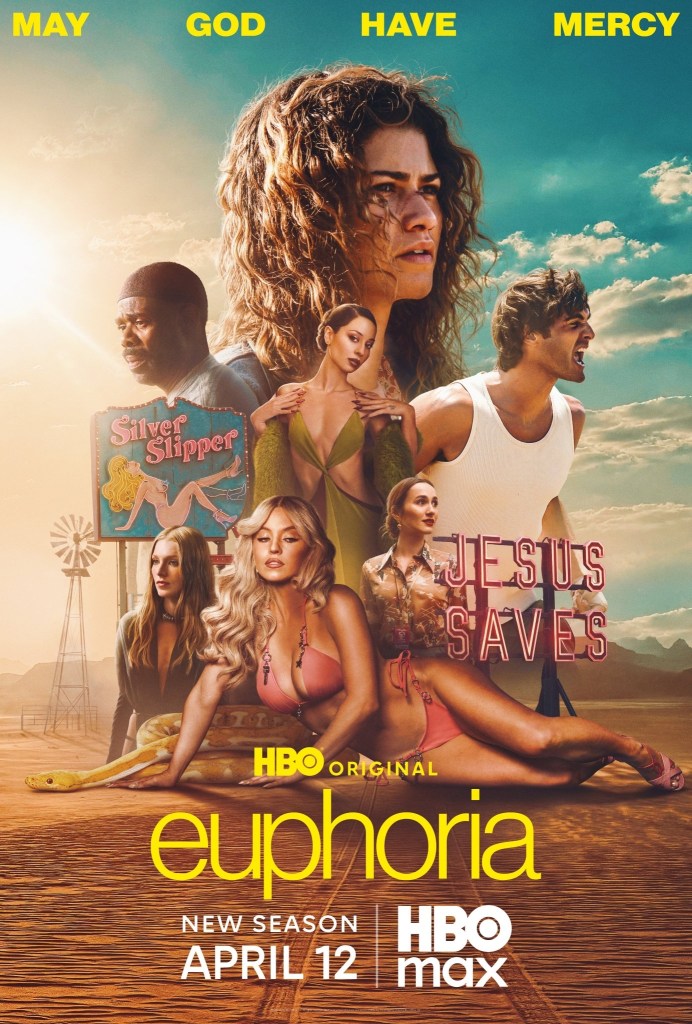
The first two seasons of Euphoria scored a total of 25 Emmy nominations and 9 wins, including back-to-back victories for Zendaya (becoming the youngest ever recipient of the award for Outstanding Lead Actress in a Drama Series at 24) and a guest actor win for Colman Domingo. Yet, despite all of the critical and cultural success, Euphoria has always been controversial. Maybe its success is a direct result of the controversy. The show was provocative in both story and visuals, depicting harsh realities in raw and beautiful ways with a stylistic flair the show basically invented. But now, more than four years have passed since the last season of the show left us hanging. And, while this is technically Euphoria season 3, it feels like something else entirely. The show we used to know is gone, replaced by new aesthetics, new plotlines, and hollow versions of the characters we fell in love (or in hate) with. I’m all for shows taking big swings, but not when they come at the sake of totally upending established cannon. Or when they take too many swings that don’t coalesce into a cohesive story. There are definitely artistic elements and pieces of ideas to appreciate in this rebranded version of Euphoria, but it mostly feels disjointed, half-baked, and doesn’t serve the characters or the fans.
In the first two seasons, our characters were in high school, not only giving the story easy plot mechanics for them all to be together, but also letting the high style reflect the high emotions running rampant through those teenage years. Season 3 follows the real-life passage of time, picking up five years after the events of season 2. Rue is working as a drug mule, Cassie and Nate are engaged and living in the suburbs, Jules is a sugar baby, Maddy is a talent agent, and Lexi is working as an assistant on a TV show. But without the central idea of surviving high school holding it together, the show spins out of control. Variety wrote of the shift, “What was once an eye-catching clique of wayward teens bathed in purple hues has metamorphosed into a barren hellscape rife with drug-smuggling cartels, pistol-packin’ pimps, sugar daddies with mummification kinks and online streamers.” This season has a lot on its mind and creator Sam Levinson (who also writes and directs all episodes of the show himself) clearly has a bunch of stories he wants to tell. But instead shoehorning these ideas into an existing show, it might have worked better on all fronts to execute this season as something brand new. Because the result is something entirely overstuffed with themes so muddled they border on nonsensical. The more you try to dig into them, the less they hold any meaning.
Sam Levinson said in an after-the-episode interview that this season is about showing that you can only outrun your mistakes for so long and that actions have consequences. Sure… however I think that could apply to any season of this show. Or any season of any show, really. To me, this season of Euphoria had two prevailing themes: the commodification of the human body and the intersection between religion and addiction. Everyone is performing: Lexi works on legitimate production with professional actors, Maddy and Cassie operate in the world of influencers and OnlyFans performing for an online community, Jules is a sugar baby becoming who her clients want her to be, and Rue spends much of her time in a strip club surrounded by exotic dancers performing on stage but also herself playing double agent to various bosses. But most of these performances also involve selling your body or using it for some kind of gain: OnlyFans, sugar babies, strippers, drug mules. Euphoria highlights a hard truth that many already know: everything costs something. And in 2026, there are many ways to pay that don’t involve money. The problem is, this idea isn’t new. And Euphoria isn’t even the only television show of this year to interrogate the idea of OnlyFans and influencer culture. It also doesn’t seem to have anything new to say about it. So why put it front and center on the show? Euphoria’s biggest cache has always been provocation and controversy. But where does trying to push that actually cross the line over into exploitation? It’s Sydney Sweeney’s character of Cassie who is at the center of this storyline which feels especially meta since Sweeney herself has become a lightning rod for this exact kind of debate in the public consciousness. Cassie was always a character who measured her self-worth through attention from men (in short: daddy issues), but season 3 Cassie becomes an even more outsized, sexually forward, parody of herself. At the same time, Sydney Sweeney, who became a sex symbol in Hollywood because of her body and the way she showed it in previous seasons of the show, seems to have moved past just embracing her body with confidence while taking other roles that weren’t defined by it into also becoming a parody of herself, playing into all the jokes and her public image (both positive and negative). She’s gone from trying to be a woman who can appeal to everyone to being a woman who appeals to men. Say what you want about her (about her image, her politics, the fact that she’s dating Scooter Braun), but, without judgment, she’s a woman who knows her easiest audience and is using that to further her career and finances. Just like Cassie. So is Sam Levinson using Cassie’s story to comment on Sweeney’s real-life persona? Maybe to point the blame back on the public for the way we react to her? But, if he is, the message isn’t clear. It mostly feels like creepy leering on his part, an excuse to put Sweeney in countless skimpy outfits, sexually explicit situations, and fetishistic scenarios. That actually applies to most of the women on the show. Redditor @fvckuufvckingfvck observed, “Especially this season the women on the show feel way more observed than understood… Sure, the aesthetics are incredible and the emotions are heightened, but to me there’s always this lingering sense that the camera is fascinated with these girls and their bodies rather than truly inhabiting their perspective.” To that effect, I can’t understand what Sydney Sweeney is getting out of this. Unless she has decided to fully give herself over to this persona where she exists solely as an object of men’s desire or if she believes there’s a deeper commentary in this storyline that just isn’t coming through the way she intended, the just episodes played to me like a weekly Sydney Sweeney humiliation ritual. And I’ve said this before: I enjoy provocative art. But only when there’s a meaning behind the provocation, not just being controversial for controversy’s sake. I will say the backlash to the depiction of sex and nudity this season has felt a little overwrought and honestly surprising. Did these detractors even watch the first two seasons? In some ways, Euphoria has always been like this. Maybe even more exploitative considering the characters were supposed to be in high school back then. But maybe audiences across the board are sensing the lack of narrative or thematic reason for the explicit content this time around, causing it not to sit as well. But if the goal was controversy above storytelling, the show was definitely successful in creating uproar and conversation. Personally, I’d like my entertainment to aim higher than that.
While sex and performance have always been a part of Euphoria, religion enters the mix as a new central idea this season. In some ways it encompasses the season as a whole. Sam Levison has said that religion in the show, the idea of believing in something greater than yourself, is supposed to be a foil to the social media/OnlyFans storyline which depicts a kind of narcissism. Many of the characters also spend the season making deals with a metaphorical devil: Rue and Alamo, Maddy and Alamo, Cassie and Maddy, Nate and Naz, Jules and her sugar daddy, Ellis. But, mostly, the idea of religion, specifically Christianity, comes through in relation to addiction and drugs. Rue’s back and forth between addiction and recovery was always the driving force behind Euphoria, the throughline that the show revolved around. This season, Rue’s personal relationship to drugs takes somewhat of a backseat even though her story is still based in the world of drugs. Now, she’s on the side of the dealers. Sam Levinson told The Hollywood Reporter he originally had a different ending in mind for the show but then in 2023, Angus Cloud who played drug dealer Fezco in the first two seasons, died at age 25 from a fentanyl-related overdose. Levinson said he used the new season to honor Cloud and “keep him alive” through storytelling. He added, “I wanted to deal with that. I wanted to deal with questions about faith, about a power greater than ourselves. What it means to surrender your life and your will to God as you understand him.” Belief in a higher power is inextricably linked to addiction recovery. It is quite literally the second step in the infamous twelve step program. And it has popped up on the show before, with Rue’s sponsor Ali (Colman Domingo), particularly in a special between-seasons episode centered entirely around the two having a conversation in a diner. But Rue never seemed to buy into the idea. Until now. Suddenly she believes in God, listens to the Bible on tape in her car, and dreams of returning to “the promised land” (a secluded homestead in Texas with a religious family… who, it should be noted, are right-wing traditionalists decrying the “pure evil that’s pouring across our border”. So, again, not sure what point that’s supposed to be making about our relationship to religion. Lots of mixed messaging here). Colman Domingo told Variety of the religious themes this season, “A lot of the people who suffer from the disease of addiction that I’ve known also get very addicted to religion. It becomes an addiction. There’s a greater euphoria when it comes to religion.” I actually think that’s a really fascinating idea but I don’t see that anywhere in the show, so I can’t say that’s what Sam was going for. What was he going for then? It’s still pretty unclear. And the longer the season goes on, the (pardon the pun) preachier it gets. About religion and drugs. The finale episode features both a conversation where Lexi tells Cassie that the Bible is “kind of incredible, actually” and a monologue from Ali about the dangers of fentanyl that’s essentially just a PSA. Levinson, who is open about being in recovery from addiction himself and has put many of his own experiences into the character of Rue (I can’t even start to get into his relationship to race and why his “insert character” is a young Black girl when he is a white man) told The Hollywood Reporter, “I was really angry about fentanyl, the fact that in 2023, the year Angus died, 73,000 Americans died of fentanyl overdoses. I couldn’t understand what it was about our country that we were allowing so many people to be poisoned.” I don’t disagree with the sentiment. But I do think the real-world warnings about the opioid epidemic get lost or feel out of place with the heightened, operatic, surrealist tone of the rest of the show. And to make an entire three-season show about the dark, raw struggles of addiction only to end it with the message that fentanyl will kill you and we should all find religion to save ourselves is incredibly reductive.
Euphoria has always been a style over substance show but this season changed both the substance and the style. The first two seasons gave us a hyperstylized version of reality where everyone wore bright eyeshadow, glitter, and rhinestones and scenes were accented by dreamy lighting, saturated colors, and fantasy sequences. The score by Labrinth supercharged these moments, often making it all feel more like a music video than a television show. But this specific aesthetic that Euphoria didn’t necessarily invent but definitely popularized was the show’s calling card. If you didn’t know anything about the plot, you knew about the makeup, the visuals, and the drugs. The shift away from that alone makes season 3 feel like a different show entirely. Sam Levinson told The Hollywood Reporter of his intention for season 3, “I liked the idea of sort of the wild west of adulthood and this frontier feeling where anything is possible.” This metaphor is reflected quite literally in the look and feel. Euphoria season 3 is part old-school Western, part gritty Hollywood story. Gone are the days of glitter, romance, and dreamy fantasy. That’s all been traded in for neon signs, gaudy decor, dusty desert landscapes, and an Americana aesthetic, highlighting shots of Coke bottles and American flags. The color palette has switched from purples and blues to yellows and reds. Labrinth’s operatic, ethereal score is replaced by one from Hans Zimmer that felt simple and uninteresting (I think the loss of the Labrinth score is one of the things that hurt the show the most this season). Euphoria became the first TV show to be shot in VistaVision with this third season. Cinematographer Marcell Rév also used a wider aspect ratio and 65mm film to create a rich, saturated look. The show has always brought a more cinematic style to our television screens and I appreciate it for that. It does look incredible and some of the visuals are awesome. “We have a motto of: Evolve or die,” Levinson told The Hollywood Reporter. “We wanted to make sure we were changing things up.” Just because it’s different, doesn’t necessarily mean it’s bad. But it just makes it distinctly not Euphoria.
One of the reasons for the long wait between seasons was scheduling issues. The cast, made up of mostly unknowns when the series began back in 2019, has become a collection of the biggest stars in Hollywood. Zendaya was already well-known from her Disney days and her role in Marvel’s Spider-Man movies as well as The Greatest Showman, but the show marked a shift in her career to more adult roles and she’s been one of the most famous, bankable movie stars ever since. Despite a filmography ranging in genres, famed directors, and box office success, I still think Euphoria brings out her greatest performances. I don’t think anything this season quite reaches the heights of some of the Rue-centric episodes in previous seasons where she really goes on the rollercoaster of addiction but in this shakier season 3, Zendaya carries the show. Her performance as Rue is so incredibly fearless; she’s not afraid to look ugly, crazy, gross, or immoral and is able to be funny, heartbreaking, unlikable, and hopeful all at the same time. She’s an undeniable star. Sydney Sweeney has become almost more of a celebrity than an actor, better known for her controversies and looks than her work, but she has done a lot of notable work. The romcom Anyone But You that she executive produced and starred in was a massive box office success and her performance in the first season of The White Lotus was critically acclaimed. As was her performance in Euphoria, historically. As Cassie took on a bigger role in season 2, Sweeney’s talent was widely recognized. And while I have issues with her characterization (as previously stated), I have to admit, she’s really good in this role. I’m not always a fan of her acting (she was a weak spot for me in The Housemaid), but she plays Cassie perfectly. She’s funny and melodramatic, ditzy and narcissistic but while still maintaining an edge. Twitter user @_garrettcharles wrote “nobody has ever smiled while crying the way Sydney Sweeney does and you have to give her that”. Jacob Elordi’s claim to fame when he was cast on Euphoria was being the hot guy from Netflix’s The Kissing Booth and now he’s been nominated for an Oscar. Maybe Elordi’s now prestigious standing is the reason for the lobotomization of his character. Nate Jacobs was a sociopath. A truly heinous, violent villain that you love to hate. But the Nate Jacobs of season 3 has zero traces of his former self. He went from an unhinged alpha male to a devoted partner and a punching bag. I can accept that people can change over a five year time jump, but we’re given no evidence as to why such a drastic change might have happened. Twitter user @shin_kale_rider pointed out that “… Nate being this sociopathic bully when dealing with defenseless teenage girls but not with adult gangsters who can actually fight back is kind of a good writing choice” and I agree that argument tracks for those specific instances, but not for the full rewriting of his character. Does Jacob Elordi not want to be associated with such an evil character anymore? Was he just so one-foot-out-the-door with the show at this point he couldn’t muster up the full Nate Jacobs energy anymore? Or was this a Sam Levinson writing choice? It was also pointed out to me that Nate is the only male main character left on the show. In the first two seasons we had Fez, McKay, Ethan, and Elliot in the mix but all have disappeared for various reasons. Once again, in the hands of Sam Levinson, the balance of Euphoria is tipped towards women in a disquieting way. Maddy is another character this season who seems to have lost her edge. She’s always been one of the most interesting characters on the show and Alexa Demie is a striking performer, but season 3’s storyline didn’t let her shine the way she can. It could’ve been worse, though. At least she wasn’t Lexi (Maude Apatow), who only shows up when the plot needs her and isn’t given any emotional arc or agency, or, even worse, Jules (Hunter Schafer), who was basically MIA for half of the season and was so disconnected from the plot that nothing would have changed had she not been there at all. Jules was once so central to the story that she was given 1 of 2 standalone special episodes just about her and her character. And now she barely exists. As previously mentioned, Angus Cloud passed away before the production of the season but his character, Fez, was kept alive in the world of the show. I didn’t mind him being alive (it is explained that Fez is away in prison so he’s not seen), but I really didn’t like scenes where Rue spoke to him on the phone. I spent their whole conversations anxious we’d hear his voice created by AI or something in a distasteful, desecratory way. It never came to that, thankfully, but the scenes were unnecessary regardless. Colman Domingo’s Ali is a character who has floated in and out, appearing in 11 of the series’ 26 total episodes, but has always left an impact. This season was no different. Ali is in very little of the early season but then, suddenly, the entire ending of the series hinges on him. I like his character and I like the performance but it was all representative of a large problem throughout the season: the sidelining of our main characters to create space for smaller or new characters we don’t care about. Season 3 saw the introduction of Adewale Akinnuoye-Agbaje as Alamo Brown (Mr. Eko from Lost!), Sharon Stone as Patty Lance, Marshawn Lynch as G, Darrell Britt-Gibson as Bishop, Rosalía as Magick, Kadeem Hardison as Big Eddy, Anna Van Patten as Kitty, and the return of Martha Kelly as Laurie and Chloe Cherry as Faye Valentine. With all these new players on the board and the escalating war between Alamo and Laurie’s drug gangs taking center stage in the story, our core characters often get lost in the shuffle. Another casualty of the show’s growing pains.
Season 3 felt like less of a progression for the show and more like Sam Levinson trying to fit a Quentin Tarantino movie into the existing parameters of Euphoria. Jules tells Rue this season, “You can’t just show up after all this time and think everything’s gonna be the same.” She’s right, after four years, the show isn’t the same and it couldn’t be. Alamo also tells Rue, “That’s the beauty of this country we call America. Anyone can reinvent themselves.” That idea seems to have been the impetus for this season. Sam Levinson brought his familiar brand of excess and controversy (seeming to double down on the creepiness this season) and applied it to an entirely new world. As Cosmopolitan described it, “… a season of TV that couldn’t quite decide what it wanted to be: a Western, a drug mule crime story, a Hollywood fairytale gone wrong. But in trying to do it all, it did none of it well.” As much as I dislike his portrayal of women (in Euphoria and the god-awful The Idol) and race (much of the dialogue in the show this season is extremely questionable considering he wrote it all himself, despite the fact that Colman Domingo told Variety, “I want to applaud Sam. This season, to see such robust, propulsive Black characters — all very different — in scenes together was extraordinary.”) and lots of other things, I actually do think Sam Levinson is a talented filmmaker with a keen artistic eye. If he can get on the right project with a team that can check him and keep him in line, I think he can make something really great. Maybe something like the first season of Euphoria that I found myself deeply missing while watching the mess of season 3. Or maybe something entirely different which, if this season is any indication, he’s already trying to do. I don’t think season 3 of Euphoria was a total waste of time; there were pieces to like and appreciate scattered throughout. But I do think we all could have lived without it. Let’s just hope they really mean it when they say it’s over for good because everyone, actors and creators alike, seem to have already moved on in their minds even before they made this season.
2026 Count: 42 movies, 23 seasons of television, 1 special

