**This review contains spoilers**
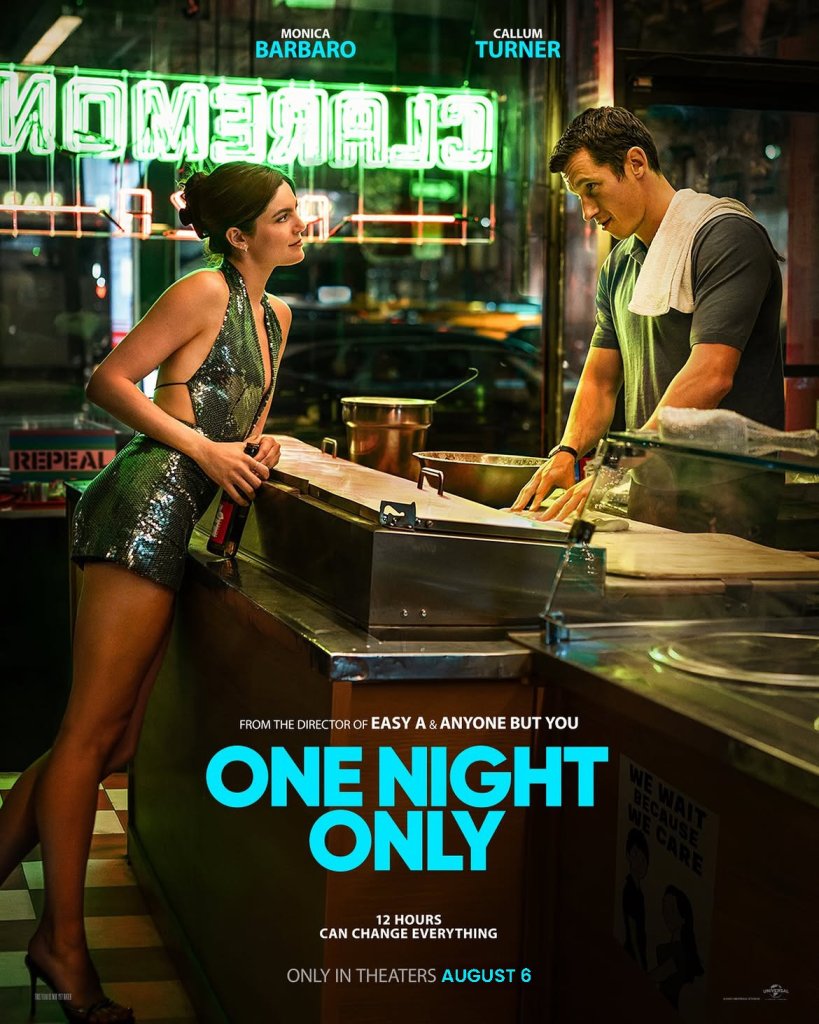
I’m a simple girl, I love a rom-com. But the genre’s been in a precarious place since it peaked in the 90s and early 2000s. Director Will Gluck has been a pretty steady hand in the space, though. Easy A is a stone-cold classic (although maybe not really a rom-com), Friends With Benefits is a perfect always-on-TV rewatchable, and his last film, Anyone But You, was a surprise hit, becoming the highest-grossing romantic comedy globally in years. So then why was One Night Only such a flop? The movie has many classic rom-com elements: attractive, charming leads, funny and romantic moments, tons of cameos, the backdrop of a beautifully shot New York City. And the idea of high-concept romantic comedy isn’t new. We’ve seen stories that involve time loops (Palm Springs), memory loss (50 First Dates), and the afterlife (Defending Your Life) and all deployed successfully. But One Night Only proves that there is such a thing as a concept too high to surmount… and that concept is the sex purge.
That is how One Night Only has come to be colloquially known on the internet because of its premise. In The Purge movies, an annual 12-hour period declares everything, including murder, legal. In the world of One Night Only where premarital sex was outlawed in the U.S., the ban is lifted for an annual 12-hour period. When the first trailers for the film came out, people had a lot to say about it. They were mostly bewildered by the concept. While that is totally fair, I was a defender of the movie. Haven’t you guys ever heard of a premise before? Every movie has some kind of set up, some are just more complex than others. But after seeing the movie, I was genuinely shocked how much it actually focused on said premise. To me, the best version of this movie starts by saying “hey, so this is the one night of the year where single people are legally allowed to have sex” and then never acknowledges that again. But, instead, One Night Only just doubles down on trying to explain the premise. There’s dialogue about the politics and mechanics and laws and enforcement and science and technology around “the mandate” and scenes featuring news coverage, window signs and posters, and people arguing about their political beliefs. I’m not sure if it’s their way of trying to help it make sense to the audience or they’re attempting to find humor in the absurdity of it all or just trying to create a more lived-in world, but whatever the reason, it only hurts more than it helps. Because that’s not why we’re seeing the movie. No is there to understand the political landscape of this alternate world. We’re seeing it to see a rom-com. So give us the set up and then get on with the rom-com.
What I really don’t want is politics in my rom-com. Especially when the politics are about a conservative, fascist state that isn’t so far off from our own reality. I don’t want to be thinking about how the government is trying to take away women’s rights while I’m trying to watch Monica Barbaro and Callum Turner be hot on screen. But the movie’s strange insistence on constantly reminding us of its conceit both adds too much political satire to ignore and also skims the surface of it so lightly that it doesn’t provide any active commentary. To say the movie leaves viewers wanting is an understatement in many senses, but particularly when it comes to the politics. You can’t just chum the waters with all of these glancing ideas and then not actually bite into anything. It’s actually irresponsible to represent some of these viewpoints this way and then not be clear about your perspective. “The mandate” is bad. Obviously. But that’s as deep as One Night Only is willing to go. Again, I in no way think this movie should be about a resistance movement against sexual puritanism, but the movie opened the door to that conversation. Did they think people wouldn’t walk in?
The ending was especially concerning in terms of messaging. Our central couple, Allie and Owen, after finally having their big rom-com reunion ending, decide not to have sex in the last few minutes of their free because, “What if we didn’t let the mandate win?” No one can see me right now but I’m taking a moment to collect myself and try to understand how them not having sex is somehow an act of political rebellion? The more I think about it, the more frustrating I find it. In a political sense, of course, because whether it’s intentional or not the messaging here is pro-abstinence. As Variety put it in their review, “Waiting can be sexy, sure. Governmentally enforced waiting under pain of incarceration? Kind of an ick.” But even just from a rom-com storytelling perspective it’s unsatisfying. It made me think about the ending of one of my favorite rom-coms, The Proposal, where Ryan Reynolds says to Sandra Bullock, “So Margaret, marry me, because I’d like to date you.” (They need to get married so she doesn’t get deported back to Canada… if you haven’t seen The Proposal, what are you even doing?) The ending of One Night Only could’ve been exactly the same. “Let’s make the most of this one night so we can spend the rest of the year getting to know each other.” Keep your acts of political resistance (if this even qualifies as that) out of my rom-com and just let the hot people hook up! Variety’s review also perfectly summed up the struggle of trying to digest this movie: “Is this overthinking a breezy late-summer date movie? Well, it would be, if One Night Only weren’t itself so simultaneously over- and under-thought: It rests on a structuring plot gimmick too complicated and too consequential to simply operate as romcom machinery, without straying into story territory it has no intention of covering.”
If we’re just talking about the rom-com side of things, it’s better… but not much. It starts with the classic meet cute of Owen throwing up on Allie. And then another meet cute later where they fight over a condom. And so begins a series of unfortunate events both together and separately over this one night. I found the pacing of the story to be really uneven. It takes a while for the two main characters to even be together in one place and then the movie keeps pulling them apart for long chunks and you’re just waiting for them to get together again. That’s the point of a romcom, to see the main couple together and interacting. But One Night Only has so much stopping and starting where Owen and Allie are apart and then they’re together then they’re apart again. It never lets the characters or the audience settle into a rhythm. Also, for a movie ostensibly about sex, there’s no sex in the movie. Director Will Gluck spoke about this to Variety in comments I found fairly concerning: “Recent studies have found that Gen Z and Gen Alpha don’t want to see sex on screen. Was that a concern while making this movie?” “The answer is 100% yes. I went through this on two movies. I have long pages of empirical data about it. The only thing is I don’t think it’s just Gen Z and Gen Alpha. I believe it’s been a societal shift from taking nudity in adult situations and putting them on your phones at home for everybody. Now it’s more of a private, intimate thing that people don’t want to see when they’re in a shared experience. Whenever people now see nudity or very adult situations in a big theater, they get uncomfortable.” Maybe it’s because I’m not Gen Z or Gen Alpha but what are we even talking about here? I’m not advocating for anything gratuitous, but to excise things that are literally part of the story because some people might feel uncomfortable watching it? Making decisions about how to shape your movie based on “data” rather than what you as a filmmaker want to communicate with your work is a bleak approach to the craft. Why even choose to tell this story if you’re going to sand off all the edges? Or any story for that matter?
I have to say, Callum Turner and Monica Barbaro are innocent of any wrongdoings perpetrated by this movie. They’re both funny and charming and attractive. And definitely deserving of a better film to showcase their rom-com chops. Maybe I wasn’t paying enough attention to the marketing, but there were at least 10 people I had no idea were in this movie (for like one scene cameos) including Pete Davidson, Este Haim, Ziwe, Nicholas Braun, Julia Fox, Mike Birbiglia, Ben Marshall, Bobby Cannavale, Sydney Cole Alexander (Natalie from Severance), Jay Ellis, and Flava Flav (oh, wait, that’s more than 10). Glen Powell and Sydney Sweeney (stars of Will Gluck’s last film) also make photo cameos. Michelle Hurd is here as a police detective which I can only assume is a nod to her role as Detective Jeffries from Law and Order: SVU. Molly Ringwald and Maya Hawke are both slightly more substantial parts of the cast and I hate to say I thought they were both genuinely bad. Their performances were both so offbeat, it took me out of the movie.
I think somehow in writing about this movie I decided it was more evil than I had initially felt leaving the theater. It was funny and entertaining, but I wouldn’t have any desire to watch it again. And I really just wanted to like it a lot more than I actually did. It had some really good rom-com pieces, like the leading actors and the jokes and New York City looks and feels spot-on (you can tell it was actually filmed here so definite points for that!), but it just couldn’t make them all come together in a way that was enough to overpower the genuinely bizarre plot and the movie’s handling of it. I’m always pushing for more studio rom-coms. And I do want to commend this one on at least being original. In the last few weeks, both a Serendipity remake and a How to Lose a Guy in 10 Days sequel were announced. I’d take 10 more swings and misses like this instead of recycled stories like that anyday. But maybe we’re finding out there’s a limit on how far we can go with the high-concept ones. I guess you never know where the line is until you cross it.
2026 Count: 62 movies, 41 seasons of television, 1 special

