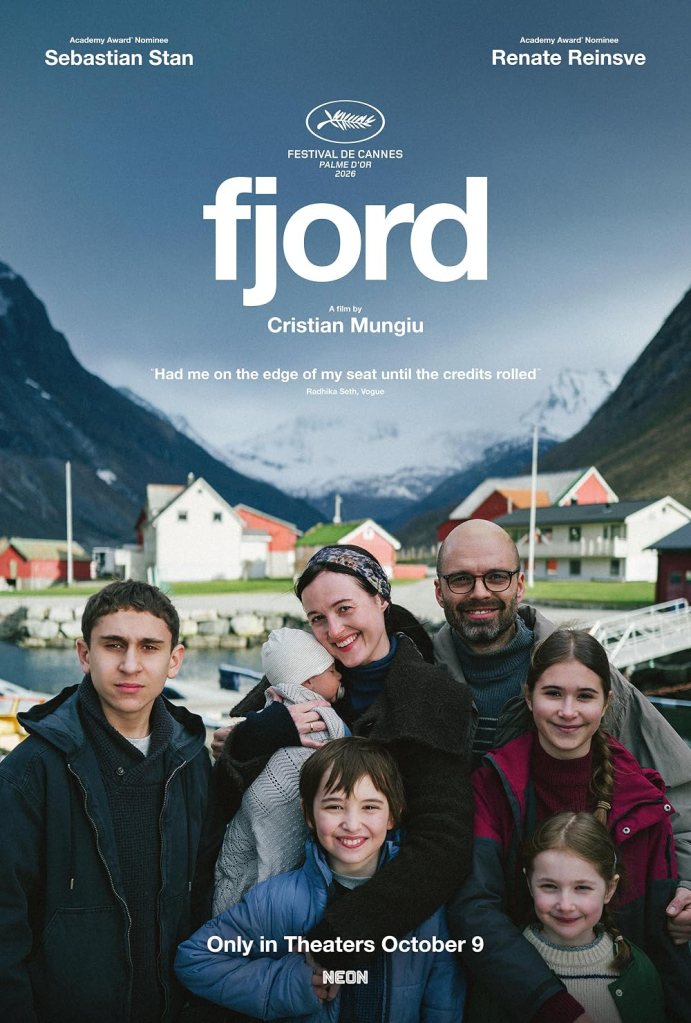
As the winner of this year’s Palme d’Or (the top prize) at the Cannes Film Festival, Fjord immediately entered the Oscar race and my watchlist. The movie comes from Romanian filmmaker Cristian Mungiu who previously won the Palme d’Or in 2007 with his film 4 Months, 3 Weeks and 2 Days, an abortion thriller set in Communist-era Romania… if that gives you any indication of the weight of his work. Fjord is his sixth feature film but the first to be set and shot outside of Romania and to be partially English-language and also the first film of his that I have seen. Naturally, I did some homework and have gathered that Mungiu’s films often deal with societal issues, ethical dilemmas, globalization, and cultural divides between eastern and western Europe in ways that make his work challenging and divisive. In Fjord, he takes on the clash between progressive and conservative values, specifically when it comes to parenting, education, and religion in Norway. It’s the kind of movie that’s made for discussion, operating totally in the grey areas without taking sides and asking audiences to sit in the discomfort of moral ambiguity.
Fjord follows the devoutly religious Gheorghiu family made up of father Mihai (Sebastian Stan), mother Lisbet (Renate Reinsve), and their five children after they have relocated from Romania to Norway. Mihai is Romanian but Lisbet was born in the Norwegian village they move to. At first, the locals are welcoming to the newcomers with the parents at work, the children at school, and the neighbors at home. Although they do take notice of the family’s more conservative lifestyle. The children are not allowed phones, internet access, or modern music. Instead, their time is spent with chores on the family farm and home, daily Bible study, and socializing with members of the local church who are as deeply religious as the Gheorghius. Norway is an extremely liberal and progressive-leaning country and the children are warned against religious expression at school. Oldest child, teenage Elia, and her brother Emmanuel befriend their neighbor and classmate Noora, a rebellious teen who encourages the obedient foreigners to test their boundaries a little. Things escalate very suddenly when a teacher notices bruises on Elia’s back and the school’s child protection team immediately launches an investigation. Within hours, Mihai and Lisbet are questioned by authorities and the children are removed from the home and sent to foster care. The film then becomes a legal drama as the Gheorghius fight through the Norwegian court system to get their children back and clear their names.
The movie is a complex and knotty watch because our instinct is to take a side and root for it. But in Fjord, there’s no easy answer to align with. Years and years of watching Law & Order: SVU has given me some understanding of why child services operates this way. You can’t leave children in the home if abuse is suspected. You always have to be safe rather than sorry. But the depiction of this in practice in Fjord did make me question my conviction in that. There’s such a rush to judgment with no proof of any wrongdoing that it makes the system look reactionary and overly judgmental. The only evidence they have to go on is Elia and Emmanuel’s admission that they will sometimes get “a slap to the butt” as punishment. It’s this one fact, one that Mihai and Lisbet don’t deny, that the entire case revolves around. On a small scale, it’s a battle of semantics: is slapping the same as hitting? Is a slap on the butt considered “abuse”? Is anything getting lost in translation from Romanian to Norwegian to English? But on a larger scale, it’s the Gheorghius’ religious beliefs and cultural customs that are put on trial.
The family were seen as outsiders from the very beginning. And their decision not to conform to the local way of thinking and acting made them targets of distrust and derision. But should that be a factor in their case? Should the government be allowed to have a say in how you raise your children? Should you be punished for having more traditional beliefs in a modern world? Does living in a free and open society mean you should be free to live however you choose? In a way, there aren’t really heroes and villains in this story. It’s been referred to as a Rorschach test by many because of how every viewer’s unique personal experiences and values will influence their perception. I personally don’t agree with any of their beliefs, but I do think they should have a right to believe them as long as it’s not hurting anyone (the real complicating factor here). Where the movie really becomes challenging is that it’s very effective at making you sympathetic to the main characters, but when you step back you start to think, should I be? I think it is powerful in forcing you to confront that (most of the time) people who hold beliefs that radically differ from your own are also just human beings who love their families and think they are doing what is best for them. So often we view anyone on the opposite side of a political argument as evil or stupid or any of the extremes and mostly it’s because people are just yelling and not listening. I love a movie that sparks conversation and this one is a profoundly difficult and uncomfortable one that takes the time and care to humanize both sides. Personally, I’m still not even sure on where I net out on if that’s a good thing or a bad thing. But I do think it’s a brave choice in today’s political and cultural climate.
Mungiu spoke to The Hollywood Reporter about his inspiration for the film saying, “I started from several articles in the press, but particularly one which is very close to what you see in the film, and I started noticing a kind of a pattern of such incidents… Little by little, I saw this pattern of conflict between conservative values and progressive values, and it’s more obvious to see happening in the Nordic countries, because they are the most progressive in Europe… Finally, I decided to fictionalize the story, not do a reenactment. So this isn’t how it really happened, but the story is not far away from what I discovered.” He then added of the themes explored, “…it’s important for me to underline that this film is not about the conflict between Romania and Norway. It’s way more than this. It’s the conflict between a layer of society which had access to privilege, education and wealth, access that allows people to be more empathic, and the level of society of people with fewer opportunities which have these conservative views… I think we live in a very polarized society in which you have these two groups of people who believe that they are right, that they have the one truth, and this has led to a kind of social violence which makes it impossible to live together in the same society. We are divided into groups that became so radicalized that we can’t find common ground… I think that it’s important to use cinema to speak about the concerns that we have about the direction in which our societies are going. That’s always the most important topic for me in my films — to understand the issue of the day.” However clear and well-spoken Mungiu is in his intentions, the movie is sure to be a lightning rod for incredibly obtuse discourse the deeper we get into awards season. The Hollywood Reporter asked Mungiu directly, “Do you worry that the film could be embraced by right-wing groups claiming victimhood?” to which Mungiu replied, “Absolutely. I think this is going to happen, but it’s a risk that I thought was worth taking in order to defend this right that we’re still having to doubt the values in which we believe, and also to speak about manipulation…So I’m used to it, and I think that we need to use our critical filters when we look at these topics. Expressing doubts about our liberal society doesn’t mean for a second that I’m a defender of a conservative society. It means that I trust progressive society more in its capacity for admitting self-criticism… I think this film is a lot about fundamentalism. If you have a mindset of fundamentalism, it’s not such a big difference between right-wing and left-wing fundamentalism. I think that we should meet somewhere in the middle and start by accepting that some people won’t have the same opinions and values as we have.” Sebastian Stan chimed in on the topic as well, telling Variety, “Here’s the thing: When did it become normalized to think that one side has all the answers and is completely faultless? A lot of those reactions come from people who haven’t seen the movie. It highlights why we need more films like this — to remind us there was a time when people could meet, disagree and at least hear each other out. The movie doesn’t go and point the finger and say, ‘Well, you hold the key and you don’t.’ It’s just going, ‘Fuck, we’re flawed as people.’ And, by the way, kids shouldn’t be the ones paying the price for that.” Will general audiences be able to view the film with such thought and nuance? Odds are no. Especially if the movie becomes a major Oscar player, everyone will just be looking for a way to take it down. But that fully defeats the purpose of the movie in the first place. It’s made to be examined and not taken as gospel. It asks questions and doesn’t tell you the answers, if those even exist.
For such a highly emotional and tense topic, the film plays very restrained. The setting of the movie in Norway, much of the time in winter, reflects the coldness of the story. Cinematographer Vladimir Banduru makes the landscape look beautiful, even with the ugliness at the forefront. Scenes taking place in the courtroom during the trial have waterfront views. Such a picturesque location tells us looks can be deceiving. Mungiu also keeps audiences at a distance by avoiding any close-ups on his characters but at the same time shoots long, unbroken takes that make us feel like a fly on the wall watching the drama play out.
The performances of the main characters also keep audiences at a distance in an interesting way, never fully letting us understand what Mihai and Lisbet really know or did and never allowing us to be wholeheartedly sympathetic towards them. Both Sebastian Stan and Renate Reinsve opt for restraint over histrionics. Stan himself is Romanian (this is his first Romanian-language role) and pulled from his own experiences to shape his character. He told Variety, “The movie’s big theme is the immigrant experience, and that was my way in. When I read the script, I remembered coming to the U.S. and the shame I felt — the self-awareness of just being different… it was a different challenge to do something more restrained — something that reminded me of the unpredictability I saw in men who don’t know how to express themselves.” Stan really plays with that unpredictability in his performance. We can tell Mihai is the kind of man who is filled with arrogance and rage but yet we never see him explode. It simmers just below the surface as he constantly works to keep it down. At the same time, though, he also clearly cares deeply about his family. This was a version of Sebastian Stan I’ve never seen before. And it wasn’t just the fact that he’s bald. Mungiu told The Hollywood Reporter of Stan’s transformation, “We needed some sort of physical change to make him into this humble person raised in a society where he didn’t have any rights. The bald bit helped him a lot, because he’s a method actor. He needs to be close to the character, and this humbleness and this idea not being proud of how he looks brought him closer to Mihai.” This is also a different look for Renate Reinsve who is usually such an open performer. She plays Lisbet as quiet and shell-shocked by grief but also incredibly compassionate. When she cries, it’s silent tears and not loud sobs. I was also very impressed by the performance of Lisa Carlehed as Mia, the Gheorghius’ neighbor and later their lawyer.
Fjord is penetrating in the way it challenges your beliefs while tackling so many taboos (culture, religion, politics) head-on. Some might be left wanting with the way the ending doesn’t provide any resolution or catharsis, but that’s exactly why the film will be a major topic of conversation. It wants to start discussions between people and also within viewers themselves. Fjord is a serious, heavy movie but it kept my attention. I always find it interesting to see courtroom dramas in other countries but I also like a movie that asks a lot of questions and leaves you thinking about it long after it’s ended. And I was particularly captivated and awed by Cristian Mungiu’s thoughtful and intelligent comments about the film and humanity. Fjord’s not going to create world peace, but maybe if it can inspire just a few people to consider the world in shades of grey instead of just black and white, that would be a step in the right direction.
2026 Count: 78 movies, 47 seasons of television, 1 special

