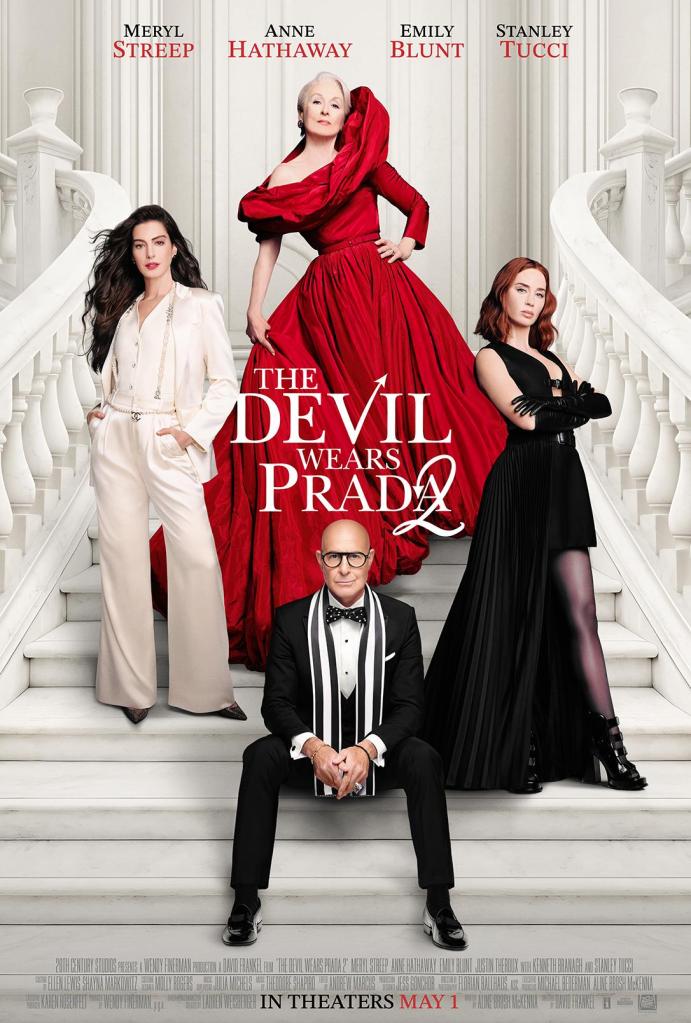
At the end of 2025, The Rewatchables podcast dropped their instantly iconic episode “Bill’s 50 Most Rewatchable Movies of the 21st Century”. An incredible episode for many reasons. But number one on Bill’s list? The Devil Wears Prada. Probably one of his best takes. Because it just might be the most rewatchable movie of all time. I know I have personally seen it more times than I can count. Which made me all the more nervous about this 20-years-later follow up. I’ve been very vocal about my anti-sequel/prequel/remake feelings before, and this was no different. The first film doesn’t leave anything hanging, it’s a closed loop. There’s no need for a continuation of the story. And I will always hold these, let’s just call a spade a spade, money grab projects to a higher standard because of my skepticism of them. Prove to me why this should even exist. That being said, The Devil Wears Prada 2 actually has more of a plot and point of view than I would have expected for a sequel film, especially one in this universe. Instead of just going for full-blown nostalgia bait (which, granted, it does some of that too), the movie attempts to bring the world of the first film into the modern day and infuse it with relevant themes and ideas. Is it successful? Not always, but I’m glad it tries. I had some nitpicky issues with it but, overall, I had an enjoyable time watching the movie, even though it could still never come close to touching the original.
The Devil Wears Prada was based on the 2003 bestselling roman à clef (another new term I learned from researching this!) by Lauren Weisberger. Weisberger famously drew inspiration for the novel from her time working as the assistant to Vogue editor-in-chief, Anna Wintour. The 2006 film is not an Oscar-worthy masterpiece (although I’d argue Meryl Streep at least deserved a nomination for her performance), but it did hit the right notes at the right time to create a lasting cultural staying power. In addition to Meryl’s pitch-perfect characterization of Miranda Priestly (the Anna Wintour stand-in), a classic fish-out-of-water plot, and a fashion-forward makeover sequence straight out of every girl’s dreams, the movie also captured a moment in media. At this time in 2006, Twitter was three months old, Facebook was still only available for college students, and blogs and newsletters were starting to build some buzz but were not mainstream. It was physical magazines (and newspapers) that still ruled the media world. Maybe because of that, working as a journalist, specifically at a magazine, seemed to be a particular fascination as an archetype for leading female characters in 1990s – 2000s romcoms and dramadies. How to Lose a Guy in 10 Days (2003), 13 Going on 30 (2004), Never Been Kissed (1999), Sleepless in Seattle (1993), Sex and the City (1998 – 2004), and, of course, The Devil Wears Prada (2006). These movies (and shows) made it seem like working at a magazine was the coolest, most glamorous, most exciting profession out there. And for those (mostly) women who were raised on these movies or entering the job market at this same time, the story of a young ingénue fighting for her place in this elusive world played as both a fairytale and cautionary tale. I was only 10 when the movie was first released and, while I can’t remember seeing it at that time or even the first time I watched it, I can’t remember a time when the entire film wasn’t completely etched into my brain. Every line, every outfit, every song, every frame of New York City has had an untold influence on me as a person.
20 years later, the main cast is back, along with director David Frankel and screenwriter Aline Brosh McKenna, for round two. The Devil Wears Prada 2 finds our protagonist, Andy Sachs (Anne Hathaway), living out her career goals as an investigative journalist for a news outlet called The Vanguard. Just as her entire team is fired after the paper is bought and gutted, her former boss, Miranda Priestly (Meryl Streep), is faced with a crisis at Runway, the magazine where she is still editor-in-chief. Runway is under fire after endorsing a fast-fashion brand that uses sweatshop labor, so owner of Runway’s parent company Elias-Clarke, Irv Ravitz, hires Andy to be the new features editor at the magazine and restore some integrity to the reputation of the department. Andy is reunited with Miranda and Nigel (Stanley Tucci) as she attempts to make her own mark on the magazine while still constantly trying to gain the approval of the woman at the top. At the same time, there’s an ongoing battle for ownership of Elias-Clarke and therefore Runway. On one side is Irv Ravitz’s son, Jay (B.J. Novack), whose main concern is cutting expenses by restructuring and stripping down the company, potentially selling off the parts. On the other side is tech billionaire Benji Barnes (Justin Theroux) who wants to buy the magazine for his new girlfriend and make her editor-in-chief… welcome back, Emily Charlton (Emily Blunt). The same way the original film was based on real-world figures and events, the sequel also pulls heavily from true-to-life characters and media gossip. Benji Barnes is a clear Jeff Bezos stand-in, coming complete with a sympathetic, charitable ex-wife (Lucy Liu) and a new girlfriend who transformed his look and wants to make a name for herself, like Lauren Sánchez Bezos. More specifically, the Benji and Emily plot is a direct reference to a rumor that the Bezoses were once trying to acquire Condé Nast, the media company that owns Vogue in addition to The New Yorker, GQ, Vanity Fair, and others. The movie came out at an incredibly interesting time because it coincided with the 2026 Met Gala, Anna Wintour’s annual fundraising event often referred to as “fashion’s biggest night”. Two of this years’ Gala co-chairs? Jeff Bezos and Lauren Sánchez Bezos. On the one hand, it made total sense for movie marketing since the film is ostensibly about fashion and is inextricable from Wintour herself. But, on the other, the movie isn’t shy about its distaste for figures like the Bezoses, portraying them as villains (and sometimes idiots). A spokesperson for Emily Blunt told Variety it was “absolutely not true” that her character was based on Sánchez Bezos and Anna Wintour kept a foot in both camps, both publicly supporting the film and participating in the marketing while still hosting the Gala with the Bezoses. It’s really hard to believe the similarities between the characters and the real people were purely coincidental but, whether or not the character of Benji (and Jay) is based on one actual person or is a composite of a few, it’s not subtle how the movie feels about billionaires and their place in the media landscape.
It’s no secret that journalism feels like a dying art these days. Traditional news media, fashion magazines, and legacy brands in the space don’t have nearly the power, influence, or credibility they used to back in 2006 when the original film came out. The first film presents a Runway with seemingly unlimited reach and budgets. The sequel shows a version that’s struggling to hold onto the cultural currency the Runway name once carried. The first film used Runway as a lens to explore the world of fashion but also corporate America. The sequel uses Runway as a lens to mourn the state of print media, like Runway. Instead of giving us a follow-up film that lives in the frozen-in-amber world of the original, to its credit, The Devil Wears Prada 2 not only acknowledges the passage of time, but uses the changed state of the world as a feature, not a bug. Magazines are no longer esteemed institutions. Instead they’re being stripped for parts by bored billionaires who only care about profit and not culture or art. TikTok and influencers are the prevailing locus of cultural influence now. This film has much larger ideas on its mind than the original, but it’s not always the right vehicle for these ideas, sometimes unclear about what it’s critiquing versus endorsing. Like satirizing and condemning the billionaire businessmen in the story, but then also glamorizing the wealth within the fashion industry and wanting the audience to side with the employees of Runway when their access to private cars and planes is so unfairly taken from them. Or when Andy meets Peter (Patrick Brammall), her completely irrelevant love interest. He’s a property developer who flips classic old buildings into sleek, modern apartments. Andy gives a long, outraged monologue about desecrating history like that, but then still moves into the apartment. And dates the man responsible for the act. If the apartment is a metaphor for the magazine, or for all media, are we supposed to glean that it’s a shame to be losing the old ways or that re-invention is a good thing?
The mixed messaging isn’t the only place the movie stumbled for me. While the film wants to be different, bringing the Devil Wears Prada story into modern times with new ideas, it also falls victim to the trap of sequels replaying all the hits of the original, to diminishing returns. The overarching plot beats stay the same from film to film: Miranda (and Emily) being mean to Andy, Nigel as the tough love confidant, Andy gets a makeover, the production travels to Europe for a fashion montage abroad, a backdoor deal is concocted. USA Today’s Brian Truitt wrote, “What this Devil doesn’t need, though, is to run back so many plot points and so much narrative direction from the first film. It’s enjoyable seeing Streep and Hathaway vamp off each other, but Andy having to work this hard to win Miranda over again just feels repetitive.” There are also tons of Easter Eggs, which I really feel mixed about. I loved that the score was the same as the original film and that the last word of both movies is “Go”, spoken by Miranda, little touches that are connective and subtle. But I didn’t need the return of Andy’s cerulean sweater or someone holding up two nearly identical belts in the side of a frame. Even worse were direct, spoken callbacks to the first film, like Andy mentioning the Chanel boots or when she accidentally went upstairs in Miranda’s house. To me that just reads as the movie going, “Hey, remember this iconic moment from the first film? You all know and love that, right?” as if making us think about those scenes will trick us into mistaking our nostalgia for genuine enjoyment. It’s coasting on the goodwill of the past instead of giving us something new to love. I get that a sequel has to include some fan service, especially one in a franchise that is so beloved, and I also do think a sequel should have reverence for the original, respecting and acknowledging its legacy. But if you’re going to go through the effort of making a brand new movie, then make a brand new movie! One that can stand on its own. When pushing back against the Jay Ravitz-hired consultants’ plan to strip down Runway, Andy laments the trend of corporations taking media and turning it into “a smaller, cheaper, more efficient version of something that used to matter.” As a biting comment on the state of news media, it’s an effective sentiment. But, if we look in the mirror, is that not just exactly what this sequel is?
The Devil Wears Prada would be nothing without Meryl Streep’s defining performance as HBIC (Head Bitch In Charge) Miranda Priestly. Similarly, in the world of the film, Runway would be nothing without Miranda. She is the magazine. And in a meta way, her character is quite literally the physical embodiment of the magazine, or magazines as a concept. Back in 2006, Miranda (and print media) was at the height of her power, idolized and feared, esteemed and respected, endowed with prestige. In 2026, we find Miranda trying to maintain composure and keep up appearances while often being on her back foot. Runway’s struggling through a PR crisis, the future of the magazine is in jeopardy, and she is also leashed by 2026 HR standards, some of which is amusing and necessary (I mean the body image stuff from the first film has aged horrendously), but it’s a symptom of a larger issue for me. The appeal of Miranda Priestly is her mystique. In the original film, we only see her through Andy’s eyes, never in scenes on her own. She’s intentionally kept at a distance from both Andy and the audience. She’s more frightening because she’s so unknowable. But from the start, the sequel breaks that down. We get a Miranda that’s more human, more open with her feelings, and more vulnerable. When asked on the press tour whether she felt she had softened the character for the sequel, Meryl said, “I think we tend to Marvel-ize the movies now. We got the villains and we got the good guys, and it’s so boring. What’s really interesting about life is that some of the heroes are flawed and some of the villains are human and interesting and have their own strengths. So that’s what I like about this [film]. It’s messier.” I’d never doubt Meryl Streep, but I would argue that while I don’t entirely disagree with the sentiment, I don’t think that’s always the case. Most of the time, it’s more interesting when characters have dimension, but I’m not looking for nuance in Miranda, I’m looking for cold, fun villainy. Movies these days have gone too far with overexplaining every character’s past trauma and inner turmoil and all of their psychology that made them the people we’re seeing. And I always love some psychoanalysis (I was a Psych major afterall!), but it’s becoming overdone. We just went through a phase of movies that made famous villains the protagonists as a way to make them more dynamic and more relatable (Cruella, Joker, Maleficent).Sometimes villains can just be villains without a tragic backstory that makes us sympathetic towards them. Miranda Priestly is iconic and cool because she was ruthless and cutting. We don’t love her because she seems human, we love her because she doesn’t. Maybe that’s just not the kind of character that can exist in a 2026 world. And if she’s the personification of the magazine, I get why we’re seeing her knocked down a few pegs this time. But it just doesn’t hit the same for me.
Whether I’m on board with the characterization or not, Meryl Streep is Meryl Streep. Aside from some voice work and television roles, this is the 21-time Oscar nominee’s return to the big screen after 2019’s Little Women. And she hasn’t had a starring film role since Steven Spielberg’s The Post in 2017. I hope for all of our sakes she continues making movies. I was shocked to discover Anne Hathaway was only 23 in the first film (and also that they wanted us to believe she was ugly and fat… she’s literally Anne Hathaway). 20 years later, she looks almost exactly the same. The problem is she also plays Andy exactly the same. I need to first and foremost state that I am not an Anne Hathaway hater, of which I know there are many. Just one review ago I praised her performance in Mother Mary! But her choice to play Andy as the same plucky, frazzled, overeager person as the original movie didn’t work for me. (Am I just being super inconsistent with my criticisms that I want Miranda to be the same and Andy to be different? Maybe, but this is my review and these are my opinions!) That characterization made sense for a girl starting her first job out of college, but now Andy is in her 40s and is a well-established writer and adult with authority. I found her over-the-top performance to be slightly annoying. (But I’ll repeat again how incredible she looks.) Emily Blunt is perfect in the part of Emily. I could listen to her talk all day and she gets some of the funniest lines in the movie. Her chemistry with Anne Hathaway is one of the best relationships in the film. Stanley Tucci slips back into Nigel with ease, I found Justin Theroux’s Jeff Bezos knockoff to be grating (maybe intentionally so but I still didn’t like it), and Simone Ashley was sassy and chic as “the new Emily” (aka Miranda’s assistant). The film also pulls that sequel move of cashing in on the cachet of the movie’s popularity and really overdoes it on the celebrity cameos. We see people like Tina Brown, Marc Jacobs, Naomi Campbell, Law Roach, Kara Swisher, Jon Batiste, Brunello Cuccinelli, Jenna Bush Hager, Heidi Klum, Karl-Anthony Towns, and more. I personally find this totally unnecessary and uninteresting, save for a funny scene with Emily and Donatella Versace and another with Lady Gaga.
Another returning member of the original film crew? Cinematographer Florian Ballhaus. Yet, puzzlingly, the sequel’s lighting doesn’t remotely resemble that of the first. Even from the first teaser for the film, fans called out the look and color grading, noting the shift in studio-movie lighting in recent years. Bustle recently posted on Instagram highlighting exactly this trend. Movie lighting has become flat, shallow, and either too bright (with the result looking like a commercial) or too dark (with the result looking bland and bleak). I’m not sure when cinematographers became afraid of color and richness in the frame, maybe it has to do with the transition from film to digital cameras, but it needs to stop. I don’t want my movies to be indistinguishable from T.J. Maxx ads. Bring back film grain and color palettes and shadows. Lighting and composition that’s not only aesthetically pleasing but also elevates the story.
Once again, I feel like this ended up skewing way more negative than I actually feel about the movie. It’s a fun, light, entertaining movie. It’s really not that serious. But it also is to me. The original The Devil Wears Prada is one of the sacred texts of my lifetime and I wouldn’t be me if I didn’t regard it as such. There are definitely things to like about the sequel and it’s seen great success at the box office. Once again, Hollywood is learning a lesson they never seem to remember, even after massive hits like Barbie and Wicked: if you make movies for women, women will go see them. I also love that these are great New York movies. They romanticize the city in a way that I love as Andy does her best Carrie Bradshaw prance down the street. And, on that note, let me do my best Carrie Bradshaw and say… The Devil Wears Prada is a classic millennial comfort watch. And while I mostly enjoyed The Devil Wears Prada 2, I can’t really see myself revisiting it, let alone it reaching popular comfort watch status. So I couldn’t help but wonder, does a movie need an air of nostalgia to be a comfort watch? Does the comfort come from the reminder of a different era, one that takes you out of the troubles of the present? Or is it just the familiarity that comes with having seen a film countless times, an achievement only possible once it’s been out in the universe for many years? Who knows what the legacy of The Devil Wears Prada 2 will be as time passes. The first film unintentionally captured a moment at the peak of the media landscape while the second film purposefully mourns the current day slow death of journalism. Will the state of magazines in the next 10 – 20 years impact the way we think about The Devil Wears Prada 2 in the future? Possibly, and it’s to the film’s credit that it has enough real thematic weight to be so relevant. It makes the sequel a little more solemn in tone than the original, but perhaps smarter in its ideas. It could never and would never be on nearly the same level as the first film, but The Devil Wears Prada 2 is a totally serviceable, more complete than it needs to be sequel that more casual fans of this world will have plenty of fun with.
2026 Count: 33 movies, 15 seasons of television, 1 special
 I Think I've Seen This Film Before