**This review contains spoilers**
Because I’m a super nerd and listen to a ton of podcasts and read articles and social media posts, etc., etc., etc. about Hollywood and the film industry, I usually have an awareness of the upcoming movies for the year that are going to make some noise. Critically, culturally, financially, during awards season, all of the above. But, for some reason, The Invite wasn’t really on my radar. Not until a few weeks before its release when I began to see rave early reviews and reactions online. The Invite is the third directorial effort from Olivia Wilde, following 2019’s Booksmart and 2022’s Don’t Worry Darling. One was a critically acclaimed comedy and the other was overshadowed by controversy (and also wasn’t a very good movie). The Invite is her bounceback. And is also a bounceback to a lost genre of film. I feel like I’ve said this a lot this year (about movies like Tuner and Disclosure Day, to name a few), but The Invite is a return to a type of movie we don’t get as much anymore, giving it a throwback feeling I love. It’s an adult comedy, made about adults for adults, in the mold of a late 60s or 70s style film, staged like a play. A claustrophobic, pressure cooker of a chamber piece that follows just four people talking about sex and love and marriage in one apartment for two hours. The Invite is both sharp and witty and broad and cringey with its comedy while also occasionally surprising with moments of real insight and emotional gut punches. I was absolutely delighted and entertained by the film and beyond impressed by the directorial showing from Olivia Wilde.
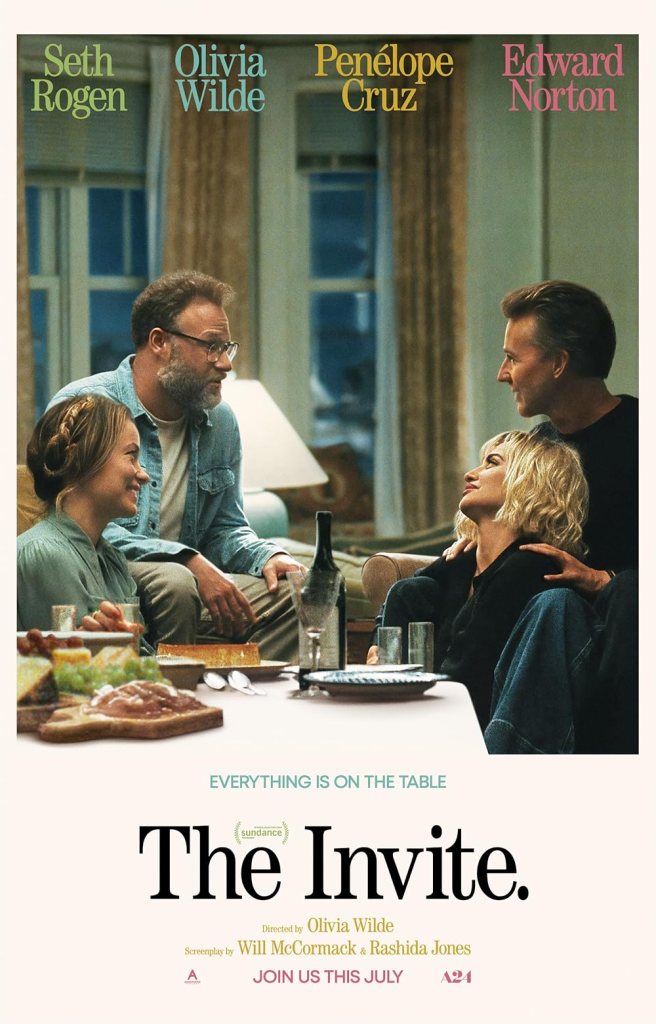
At its core, The Invite is We Saw You From Across the Bar and Really Dig Your Vibe: The Movie. A remake of the Spanish language movie The People Upstairs by Cesc Gay (known as Sentimental in Spanish), a film that has already spawned versions in French, Italian, Swiss, Russian, Czech, and South Korean, this adaptation has a script from Will McCormack and Rashida Jones. It centers on couple Angela and Joe (Olivia Wilde and Seth Rogen) whose marriage is on its last legs. They’re both unhappy and constantly at each other’s throats. Their love lost becomes even more apparent when Angela invites their new neighbors over for dinner. Pína and Hawk (Penélope Cruz and Edward Norton) are the opposite of Angela and Joe: zen, loving, oozing confidence and sex appeal. As the evening progresses, more and more is revealed about all members of the quartet. The neighbors provide both an opportunity for Angela and Joe to escape their current state of stagnation but also hold up a mirror to their relationship that forces them to reckon with the reality of their unhappiness. It turns out swinging won’t save your marriage… or maybe it will?
Olivia Wilde told The Hollywood Reporter, “The reason that I wanted to make this film is because it was a chance to have real conversations about relationships and love.” The entire movie is just one conversation that ends up becoming more like a therapy session, allowing these characters to really get to the root of their issues. This is helped along on screen by Pína who is a psychotherapist and sexologist and behind-the-scenes by bestselling author and relationship expert, Esther Perel, who acted as a consultant on the film. Maybe that’s why I enjoyed the movie so much because I love psychoanalyzing people (I was a psychology major in college after all) and The Invite really wants to pick these characters apart in interesting and insightful ways. The idea I kept coming back to was Tolstoy’s famous quote from Anna Karenina, “…every unhappy family is unhappy in its own way.” Angela and Joe see Pína and Hawk as everything they’re not. Angela wants to be them, viewing them as the perfect couple. Joe is irritated by their happiness, preferring to wallow in his own depression. “Why can’t you just let me be unhappy?” he tells Angela, a frustrating sentiment I unfortunately understand too well. But Angela doesn’t want to just settle for apathetic, she wants to fix things, taking to redoing the entire apartment as a way to feel like she’s rebuilding some part of her life, making it look shiny and new if only on the outside. She wants to feel seen and heard. Her shirt being the same color as the walls in the apartment reflects how she’s lost herself and her identity to this home, having given up her ambitions to raise a family and be a homemaker, but also how invisible she feels in her own life and marriage. Pína and Hawk’s presence only emphasizes the many faults of Angela and Joe. But the longer they stay, the more their cracks show too. Is Angela and Joe’s toxicity as a couple infectious? Or are Pína and Hawk maybe not as perfect as they seem? No one really has it all figured out. You always want what you don’t have. Every unhappy family is unhappy in its own way.
The film’s ending is more of a Rorschach test than a conclusive statement on relationships; how you view it says more about you as the viewer than the intention of the filmmakers. Is the ending hopeful or melancholy? And what does that really mean in this situation? I’ll admit, on first viewing I felt like the film left us with a note of hope, that there was still a chance for reconciliation between Angela and Joe. But the more I’ve thought about it, I’m not sure that would even be the positive outcome. These two people might be happier apart at this point. Would staying together just keep them bound to the resentment they’ve developed towards each other? What version of events would constitute a happy ending? It’s all up for interpretation. Also up for interpretation, the existence of Pína and Hawk. There’s a very legitimate reading of the film where they never existed. Personally, I don’t subscribe to that theory but it did cross my mind because of the way the ending is edited. Olivia Wilde commented on this in conversation with Variety, “Let’s talk about the ending, because I have a theory. The way it’s cut, the abrupt stop and start, I read it that the other couple was never actually there. Am I correct? [Hands raised to celebrate] That is my interpretation, and that was the intention. Do you know which scene breaks the rule? There’s a moment where Hawk goes into the bathroom, and he’s alone at the medicine cabinet. Otherwise, you never experience those characters without the presence of Joe and Angela. I love that you felt it, because to me, it works both ways. This couple reaches a point of combustion in an early argument, when they finally say the word that triggers the projection of the other two: ‘miserable.’ There’s something about admitting unhappiness that is a game-changer. We can go a long time with dissatisfaction expressed only through passive aggression and barbs, but when someone looks you in the face and says, ‘I am miserable in this relationship,’ that is often the point at which you either fix it or fail. We project these people who teach us a lesson. They are, in many ways, the ideal partners we could imagine for ourselves. But imagining the ideal other is part of understanding what you actually want and deserve. There are little clues if you look back. Should people appear in mirrors when they don’t? Are there wine glasses? Tiny things. It also works if you don’t buy that at all.” I like the story more if Pína and Hawk are real, but I do like the slightly magical air about them, showing up to give this fractured couple the wake up call they need.
The Invite lives and dies by its filmmaking. You really need to nail the staging and camera work when filming in a single location so it doesn’t get boring and the work here is masterful. My first note upon leaving the theater was, “Olivia Wilde directed the shit out of this.” In all interviews I’ve read and listened to with her, she speaks about the movie with such passion and excitement. Her care and affection for the material really comes through in her work. Olivia told Variety, “I wanted to approach this like a play. Rehearse, shoot it sequentially, because we were only on one set, and shoot it on film, which was the third dream.” Her clear vision paid off. The rehearsal time allowed for the pitch-perfect cadence and flow of the dialogue. The script also has to be strong enough to hold attention for a talky movie that is predicated on conversation, and the actors bring it to life so naturally. So much of the dialogue is overlapping in a way that feels so real to life. Things real people would say said how real people would say them. It gives the effect of being in the room with them, an invisible member of this dinner party, rather than watching a performance through a screen. The staging of the apartment also works to bring you into the space. Production designer Jade Healy created a set, “where you feel the danger of proximity to your partner, but also the privacy to have secret conversations,” Wilde told Variety. A labyrinth of sorts that allowed for cinematographer Adam Newport-Berra’s framing choices: shots through windows, doors, and hallways, sometimes intentionally divided by beams or window frames, sometimes intentionally grouped together in a tight corner. It’s a beautiful apartment that becomes increasingly claustrophobic as the night wears on. The score from Devonté Hynes (also known as Blood Orange) is ominous from the start to a humorous degree. Something as seemingly innocuous as a small dinner party having music worthy of a horror film or murder mystery lets us know off the bat something is coming.
Each one of the performances in this movie is great. Every single thing Seth Rogen says is funny, but he adds more of an adult darkness to his comedy this time as opposed to his typical brand of juvenile humor. Penélope Cruz is sexy and cool as Pína. Edward Norton plays the perfect smooth, level-headed guy until a moment towards the end of the film where he delivers an emotional monologue that is so incredibly good it took my breath away. You don’t expect a moment that sincere in The Invite, but then suddenly the whole movie turns on it. Olivia Wilde didn’t originally plan to star in the film, she just wanted to direct. But when the actress cast as the fourth lead dropped out, the rest of the cast convinced her to step in. And now, many are calling it her best performance yet. For most of her career she’s played the hot, desirable girl. In The Invite, she plays against type as an insecure, people pleasing, ball of constant anxiety. The actors have such a wide range of emotions to portray on their arcs throughout the film. All parties nail the comedic timing. Wilde and Rogen give some of the best reaction faces I’ve seen in a while and we also feel the tension when their banter turns too real or too cutting. Cruz and Norton are ideal free-flowing open books in response. But it’s also totally believable when the farce becomes a tragedy. The heartbreak and sentimentality are completely earned and well-acted.
The movie premiered at the Sundance Film Festival back in January, seeking a distributor. Wilde told Variety, “Every distributor wanted to take this movie to theaters, and I was adamant that we didn’t go to a streamer.” As a huge fan of the theater experience, I always think that’s the right choice. But especially in the case of The Invite, this is a movie that needs to be seen with a crowd. Similarly to The Drama from earlier this year, the whole audience was just buzzing throughout the movie and squirming in their seats in the best possible way. A raucous crowd really helps to heighten a comedy. I really loved this movie. My only minor complaint was that it felt a tad long towards the end but never got boring. Is it bad that it kind of made me want to have more dinner parties? Because this was entertaining as hell. Although it’s probably not as fun if you’re actually in the room. I think I truly would’ve died from the awkwardness and tension. Best to just enjoy it through the screen, I guess! The Invite is smart, sophisticated, hilarious, and heartbreaking. I have a feeling we’ll be talking about this movie all the way through awards season. Go see it in a packed theater!
2026 Count: 52 movies, 31 seasons of television, 1 special
 I Think I've Seen This Film Before
you keep getting better.
LikeLike
That’s so kind 🙂
LikeLike