**This review contains spoilers**
I’ve been a Christopher Nolan fan for a long time now. The Dark Knight is one of my favorite movies ever, Inception is a perpetual re-watch, and Memento is a technical achievement that continues to impress me. But after years of box office success, it was his last film, 2023’s Oppenheimer, that gave him his first Best Director Oscar and a Best Picture victory (in addition to winning five other awards that night) and catapulted Nolan to a brand-name filmmaker: someone who could sell movies off his own name alone, rather than the stars or the story. What a person, actor or creative, does next after an Academy Award win is always a big question. Can you continue to top yourself or do you just pivot into something entirely different? With The Odyssey, Nolan attempts both. As Variety said, “it’s highly unusual for a centuries-old poem that everyone was forced to read in school to be the basis of a popcorn movie”, especially since “Nolan has become synonymous with blockbuster entertainment” (Variety). I was already in on Nolan, but I really loved Oppenheimer. It blew me away and showed me a new facet of his filmmaking, so I was entirely ready for whatever he wanted to do next. More than ready, I was excited. Actually more than excited, I was quite literally buzzing with anticipation for months leading up to the release. And, once again, Nolan has proven he’s not capable of delivering anything less than a full-blown spectacle of a film. The Odyssey is both a complete sensory experience and a story with thought-provoking themes that have evolved past the “trippier” ideas of some of his previous work.
For anyone who didn’t take a high school English class, “The Odyssey” is an epic Greek poem attributed to Homer from the 8th century BC. The story follows Odysseus, the king of Ithaca. After a victory in the Trojan War, he and his men set sail for home, a journey that turns treacherous and lengthy as the crew faces gods, monsters, mythological creatures, trials, and the elements. No, I did not revisit the text prior to seeing the film. I know it’s unlike me to not fully do my homework, but this felt especially daunting (although after seeing this movie I do have the urge to get really into Greek mythology). I remembered the general gist of the story and some vague things like the name “Circe” or that there’s a giant whirlpool, but mostly I was happy to be surprised by the details like they were new. And in some ways they are. Because while this film is a literal adaptation of the text, it’s still Christopher Nolan’s unique take on it. And it turns out that Nolan sees “The Odyssey” as a much more grounded story than the original text depicts. Although the opening title card of the film reads, “A time of apparent magic…”, there isn’t much magic to be seen. Of course we see mythological creatures like the Cyclops Polyphemus, the giant Laestrygonians, Sirens, the living dead in the Underworld, and a scene straight out of a horror movie where Circe turns Odysseus’s men into pigs. But all of this is depicted in a tone that goes more for realism than fantasy. Nolan, who is known for striving to create as much of his films as possible with practical effects instead of CGI, wanted to downplay this “apparent magic”. Matt Damon told Variety, “The word that Chris kept using was ‘grounded’. He wanted things that were real and tactile. He wanted layers of dirt on the wardrobe. He wanted the sets to feel like real places where people lived and worked, so that it would seem relatable and not some distant world.” As for the gods, the real driving forces of the story in the poem, they appear only in name (except maybe Athena? More on that later…). Some people seem to have responded to this removal of the gods from the narrative as a sacrilegious act, but I honestly don’t mind it as an adaptive decision. What I personally bumped on in the modernization of this movie was the dialogue. This was discourse that started from the first trailers but I didn’t engage with at the time. However, after seeing the film, I have landed on the side that I do not like characters saying “mom” and “dad”. I don’t need the dialogue to be in the dactylic hexameter cadence of the original poem (don’t worry, I obviously Googled that) or even in any kind of overly flowery language. Most of the dialogue is very simple and direct, as is typical for Nolan, with some great, powerful lines throughout. But “mom” and “dad” took me out of the story a little bit. Was it so hard to just say “mother” and “father”?
In addition to being one of the oldest surviving works of literature, the poem has become a foundational influence on Western storytelling. It originated the idea of the “Hero’s Journey” and our conception of character, adventure, and conflict in a complex narrative. And while so many works of art have been directly inspired by “The Odyssey” (including some of Nolan’s previous work), there have been virtually no literal adaptations. There was 1954’s Ulysses, an Italian film adaptation starring Kirk Douglas, Silvana Mangano, and Anthony Quinn as well as some animated movies, some TV miniseries, and more foreign films, but Nolan’s version is the first major film adaptation. It’s interesting to think about why that is. Is it that the text is so foundational for so much of our modern storytelling that filmmakers worry a direct take would feel stale or worn-out? Or does it just feel like too daunting a task to take on such an epic tale? Recently I wrote about the latest version of Wuthering Heights and how a book that is considered nearly un-adaptable has been attempted in film countless times. I posited that maybe filmmakers took the un-adaptability of that text as a challenge. But why isn’t “The Odyssey” viewed the same way? Well, for everyone except Christopher Nolan. Nolan told Empire, “As a filmmaker, you’re looking for gaps in cinematic culture, things that haven’t been done before. And what I saw is that all of this great mythological cinematic work that I had grown up with – Ray Harryhausen movies and other things – I’d never seen that done with the sort of weight and credibility that an A-budget and a big Hollywood, IMAX production could do.” I noted in my Nolan Month series on Instagram that, across his films, Nolan is always telling stories about people trying to go home. That is the main plot of both Inception and Interstellar. “The Odyssey” is the ultimate, original tale of a man doing whatever it takes to return home. Almost as if this story was Nolan’s inspiration all along and now he’s actually just making the classical version of it instead of riffing on it in different mind-bending journeys. He’s going back to the root of it all.
I remember when it was first announced that Nolan’s next project after winning the Oscar for Oppenheimer was going to be The Odyssey. I had full faith in his ability to make a compelling adaptation and would have followed him anywhere at that point, but I did wonder, just out of sheer curiosity, why “The Odyssey”? It just didn’t really seem like his thing. I still think of him as the guy who likes trippy, high-concept, reality-distorting material, so why go all the way back to ancient Greece? How could he make that in his style? To be fair, he did make Dunkirk based on a real historical event and most recently made Oppenheimer and did both in a way that was stylistic with competing timelines. But, still, I wondered about The Odyssey. Then, as more trailers and images of the upcoming film came out, I thought maybe the draw was the enormous scale and spectacle and that’s fully in Nolan’s wheelhouse. But, now, after finally seeing the film, I totally get it. The Odyssey is, by nature, a narratively complex story. Nolan told Stephen Colbert that it is the original nonlinear story. The film plays with time and timelines and is as episodic as the source material, which starts in media res. Most of the action we see is shown in flashbacks as different people tell tales of the Trojan War or Odysseus tells Calypso the story of his journey as he tries to remember it himself. And not only are there flashbacks that disrupt a continuous timeline, the flashbacks aren’t even in chronological order. And we sometimes see different versions of the same scene twice. We go back to some moments over and over again. That’s what makes this a Christopher Nolan movie: in addition to the scale, it’s the jumbled timeline. It’s all there in the original text, the stories within stories, but the task of piecing it all together and dramatizing the emotional arc takes skill. Nolan not only brings his own visual style, but also his own modern ideas to this classic story.
The film does touch on some of the signature themes of the text like the aftermath of war. Soldiers, particularly Odysseus, grapple with, in modern parlance, PTSD and what that does to your faith and your view of the world. When Odysseus begins his journey home, he’s shaken by the human cost of the war and the lives lost. He no longer, if he ever did, has much faith in the gods… which contributes to his constant defiance of them throughout the story. But the main theme of the movie, the idea the entire film hinges on, is Zeus’s Law. Also known as Xenia, Zeus’s Law is an ancient Greek concept of hospitality that essentially means people should welcome strangers into their home, feed them, and treat them with kindness as anyone could be a god in disguise. It’s like guest rights on Game of Thrones. The phrase “Zeus’s Law” is uttered probably a hundred times in the film. At first, it seems like it might just be a very important principle in their culture. Until we get to the climax of the film. Odysseus, concealing his identity after having returned home, delivers a monologue to his wife Penelope about why her husband may not be ready to come back yet. He recounts the story of the Trojan Horse again. We’ve already seen this iconic tale play out earlier in the film when Menelaus, king of Sparta, tells it to Telemachus, Odysseus and Penelope’s son. Menelaus’s version is the rousing triumph we’re all familiar with: the genius of Odysseus’s plan and the victory that followed to end the war. These scenes are incredible and gripping. We’re rooting for the men to take the city. They’re the heroes of our story! But Odysseus paints a much darker picture. His version shows the full scope that the tale of victory leaves out: the Greek soldiers raping women, looting houses, causing destruction, and inflicting violence on innocent civilians. Odysseus tells Penelope that in creating the Trojan Horse, falsely presenting it as a gift to the Trojans, and then using it to sneak into the city uninvented, they broke Zeus’s Law. “We violated all that’s sacred between people and turned a fight into a hunt,” Odysseus says. Another reveal of Odysseus’s flashback is the full version of a recurring shot we see haunting Odysseus throughout the film. During his difficult journey home, Odysseus is often seen talking to the goddess Athena, played by Zendaya, who no one else can see. In a harrowing memory from the battle in Troy, Odysseus watches as a young girl, played by Zendaya, is beheaded in front of him. We don’t actually see the moment she is killed, instead cutting to a shot of a large statue of Athena being beheaded at the same time and the stone head rolling to the ground. This scene has created some interesting discourse as there are a few interpretations of its meaning. Some read it as a literalization of Zeus’s Law; because the practice says anyone could be a deity in disguise, this could actually be Athena in human form becoming a casualty of the war. The soldiers have lost all regard for humanity, not stopping to consider who they might be hurting, and end up killing a god in the process. Others believe that the girl is just a girl, not a god. An average citizen of Troy swept up in the chaos of the battle. Because she is an innocent victim taken right before his eyes, Odysseus is plagued by her face and he therefore imagines Athena in her image. She is the representation of innocence lost at the Trojan War. A point of no return. To borrow again from Greek mythology, this original sin of the Trojan Horse opened a Pandora’s Box of warfare.
By using trickery, the Greek soldiers broke codes of civility, respect, and honor and that boiled over into their savage siege of the town. They couldn’t come back from that. Odysseus quite literally could not come back. Humanity could not come back. They broke something that night, more than Zeus’s Law. Odysseus knew it and felt responsibility because it was his idea. He was afraid to go home and see what the consequences of his actions were. And there were consequences at home. I kept coming back to the concept of men creating the monsters they’re trying to fight. I was reminded of a quote from Ultron in Avengers: Age of Ultron (not a very good movie) where he says, “Everyone creates the thing they dread. Men of peace create engines of war. Invaders create Avengers.” In that film, Tony Stark creates Ultron as a defense system because he’s afraid of another alien invasion after the events of the first Avengers movie. But then Ultron becomes the enemy the team has to defeat. Fear drives people to create the very thing that becomes their undoing. Odysseus’s one idea for the Trojan Horse creates the precedent for the suitors after his long-abandoned wife to abuse Zeus’s Law and hold court in his home for 20 years. He then has to fight the enemy he created when he eventually returns home. Nolan also adds a recurring mythos to the story of the “people from the sea”: mysterious raiders who come from the sea to attack and destroy different cities. The threat of these rumored bandits looms over cities like Sparta and Ithaca. Until Odysseus’s monologue reveals that they, the Greek soldiers, are the people from the sea. Accounts of their brutal invasion of Troy snowballed into this mythological tale of destroyers who don’t respect Zeus’s Law. Troy was the first domino to fall in the path that led to the erosion and downfall of civilization. In this retelling, Nolan deconstructs the myth and legend of Odysseus and the Trojan War, turning it from victory to tragedy. If Zeus’s Law is the foundation of all that is good and respectful in a civilized world, seeing men who are high on power and bloodlust break it is an idea that reflects our modern times.
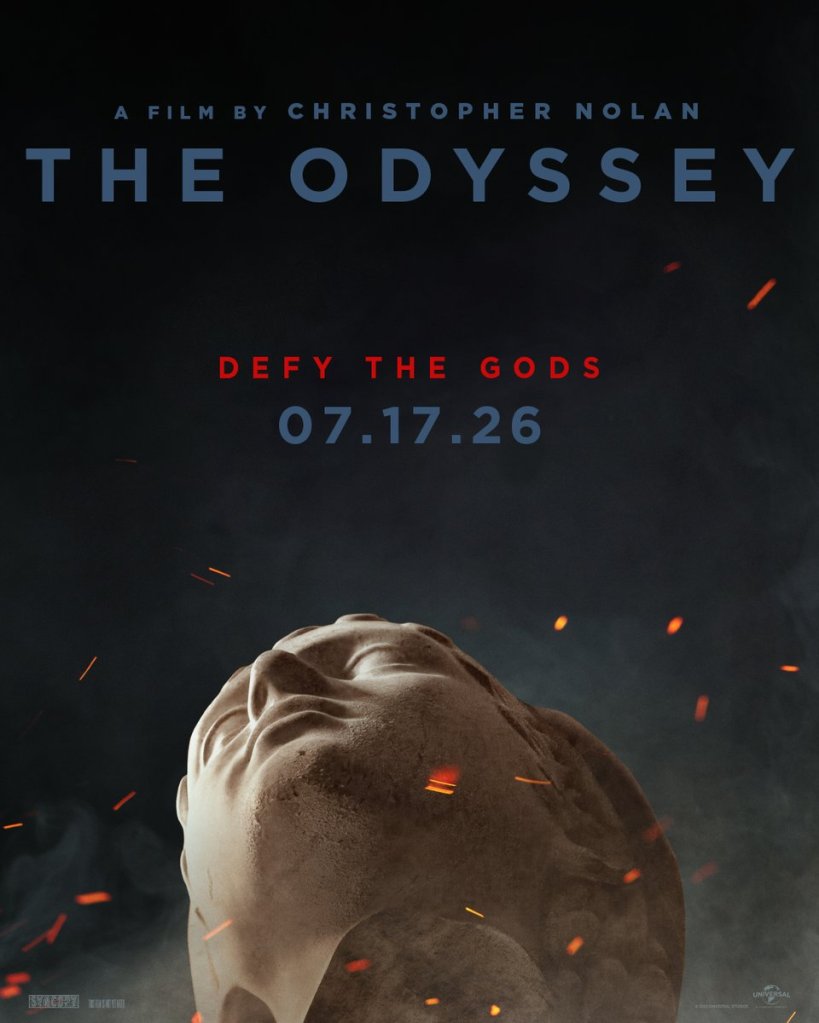
In my Nolan Month series on Instagram, I talked about how many similar themes run through Nolan’s films. I chose Inception and Interstellar as my perfect primers for The Odyssey because they are both takes on the original tale of a man trying to return home to his family. I was surprised to find out that while narratively these choices made sense, thematically the closest comparison to a previous Nolan film is actually Oppenheimer. The tagline for The Odyssey is “Defy the Gods”. Oppenheimer opens with text that reads, “Prometheus stole fire from the gods and gave it to man. For this, he was chained to a rock and tortured for eternity.” Both Odysseus and J. Robert Oppenheimer defied the gods, broke basic human decency, and irreparably changed the world on their paths to glory. Both films fall into an oft-used Nolan trope of “the great man”, painting both men as god-like figures. Odysseus because of the legendary status that forms around him and Oppenheimer in his comparison to Prometheus. The story of “The Odyssey” comes from oral tradition, the practice of passing stories down through spoken performance rather than written word. As we all know from playing telephone, it’s easy for these stories to change and morph over time as they’re passed along, making it hard to know what is actually true. In myth, Odysseus is a legendary warrior: smart, strong, idolized. But when we see him in reality, he’s impulsive, stubborn, headstrong, and arrogant. He’s not a god, he’s a man with faults like anyone else. But his reputation becomes outsized and immortalized through the stories about him and his stature grows far beyond what any real person could measure up to. In Oppenheimer, someone directly tells Oppenheimer, “You are an American Prometheus. The man that gave them the power to destroy themselves. And they’ll respect that.” Once again, the people are equating him with someone with the power to rival the gods. No man is impervious from the effect that has on the ego. These men begin their journeys with a great deal of something that originated in ancient Greece: hubris. Today, we know that to mean excessive pride or arrogance, but, in ancient Greece, it meant emulation of divinity or transgression against a god. Both meanings apply to Odysseus and Oppenheimer. Athena, a true god, even goes so far as to question Odysseus saying, “Why do you put yourself above the gods?”
The thing about “great men” having so much pride is that, when something goes wrong, they feel immense guilt and sole responsibility because they still see themselves as the center of everything. And Odysseus and Oppenheimer both made decisions that hurt and killed people. When Odysseus reveals the truth of Troy to Penelope, in his retelling he says of Odysseus, “What he has done…” “What all of you had done,” Penelope tries to correct. “One man’s idea,” Odysseus replies, shifting the blame for the destruction of the city, the innocents killed, and the ripple effect it all caused back onto himself for having the idea for the Horse in the first place. Athena tries to assuage him of this guilt as well, posing the question about the members of his crew that have perished, “What if their deaths aren’t your failure, but theirs?” Odysseus’s immense guilt leads to the treacherous journey that delays his homecoming; he sees it as the penance he deserves because of what he has done. Oppenheimer also participates in self-flagellation, taking the punishment of being grilled by a board to have his security clearance revoked. Einstein tells Oppenheimer at the end of the film, “It’s your turn to deal with the consequences of your achievement. And one day, when they’ve punished you enough… they’ll pat you on the back and tell you all is forgiven.” But for now, it’s the trial he accepts he must endure because of his actions. In this way, the men are architects of their own downfalls. Not only because they conceived of and created the very engines of destruction that led to the guilt they now carry, but also because of what their inventions may have inspired in others who still view them as leaders and gods. They are eternally haunted. Both films convey this stylistically through unexplained flashes to the climatic moments of the film. In The Odyssey, it’s the head of the Athena statue hitting the ground in Troy. In Oppenheimer, it’s the sound of feet stomping on the bleachers during the celebratory assembly following the bomb being “successfully” deployed in Japan. Early on, we don’t know what we’re seeing/hearing, but when we get the full context, we understand why these are the scenes that play on repeat in these men’s heads. Those are the moments where everything changed for them and their greatest achievements became their greatest burdens. By the end of The Odyssey, Odysseus has changed his tune on his own idea of himself, telling Telemachus, “Don’t look for gods in men. You’ll just be disappointed.”
As for these men’s achievements, it’s fascinating the way Nolan sees the Trojan Horse as the atomic bomb of its time. These ideas that are often recognized as works of genius, led to mass destruction and carnage. They were effective in ending their respective wars, but cost their inventors their humanity and left the world worse off. Odysseus says, “To burn the walls of Troy was to burn the world entire,” while Oppenheimer tells Einstein in the final line of the film, “We thought we might start a chain reaction that would destroy the entire world… I believe we did.” Of the parallels, Matt Damon told Variety, “You see echoes of Odysseus’ ingenuity in Oppenheimer’s, and the tragic consequences of their discoveries. Both men are tortured by what they’ve done.” The Odyssey ends with the classic adage that those who do not learn from history are doomed to repeat it, with a final shot of the Horse engulfed in flames. There’s both hope and caution in the final moments of the film. Nolan told Variety, “That’s my job. And if I’ve done it right, there will always be a correspondence between what’s going on in the world and what’s happening on-screen,” then adding, “I don’t like to be too self-conscious or didactic about that. I really want to entertain people. That’s still what’s most precious about films.” I’d argue that while his films are always entertaining, the subtext of his worldview is coming through more strongly and clearly in his recent films. And after the undeniable parallels between his last two movies, I’m very curious what ideas his next film will impart.
Because Nolan has always remained very true to the themes and motifs that interest him most, much of his work is self-referential. Doing my Nolan Month series and revisiting his past films while also watching some for the first time deepened my understanding of his entire filmography as a connected universe. I’ve already spoken how Nolan is always telling stories about people trying to go home, with Inception and Interstellar being the two clearest examples. We also see this in other Nolan films like with Alfred Borden in The Prestige or with the Allied soldiers in Dunkirk. But Inception, Interstellar, and The Odyssey aren’t just about finding your way home. They’re about men who have been away from home, and therefore their families, for a long stretch of time because of their work and the mistakes they made in the process. Cobb in Inception, Coop in Interstellar, and Odysseus in The Odyssey all feel guilty about their time away. Twitter user @tylerllewtaing summarized the overarching idea across these films perfectly, saying “thinking about how Nolan’s movies all are about how the most tragic thing in the universe is the act of losing precious time to be with the people you love…” In a review I found to be particularly brilliant, Gregory Nussen wrote in Deadline about how the connection between The Odyssey and Inception also encompasses Nolan’s obsession with memory (explored in incredible style in his film Memento, as well): “His Odyssey is about the immutability of time, and it is also about the disastrous effects of being plunged, for too long, inside a memory, like Cobb (Leonardo DiCaprio) in Inception. Two men whose desperation to go home clouds their judgment and risks throwing them into the eternal depths of purgatory. Both films reflect a filmmaker interested in the sacrifices necessitated by artistry, even when that artistry is combat, and especially when that life consistently defies logic.” Even minor moments throughout The Odyssey pinged Nolan’s previous work in my mind: the men inside the Trojan Horse felt like the soldiers in the sinking ship in Dunkirk, Odysseus not letting Telemachus dishonor himself by killing suitors in their home reminded me of Will Dormer telling young cop Ellie Burr not to lose her way like he did by burying evidence in Insomnia, and the previously mentioned repeated, unexplained flashbacks that occur in The Odyssey and Oppenheimer also show up in Insomnia and Inception. There have been traces of The Odyssey all throughout Nolan’s films to date, and now traces of his previous films bleed through The Odyssey in turn.
For better or for worse, trying to see The Odyssey has become an odyssey unto itself. This is the first feature film ever to be entirely shot on IMAX, a feat Nolan has called his “longest-held ambition.” IMAX cameras are loud, expensive, and cumbersome so most movies only use them for certain action sequences. But Nolan has always dreamed bigger and the 70mm IMAX frame has image quality up to three times higher than digital. Somehow this technology has become a draw of the film, equal to that of the story or cast or director. Posters advertising showings in this special format highlighted “Every frame in IMAX” in text larger than the title of the film itself. Selling the film partially on its PLF (Premium Large Format, a term I learned because of this movie) has created a full-blown frenzy amongst moviegoers. Mostly because there aren’t really that many IMAX theaters across America (less than 400), let alone 70mm IMAX screens (only 24). In an unprecedented move, Universal, the distributor of The Odyssey, put IMAX tickets on sale a year in advance. They sold out almost instantaneously. Then when a second batch of tickets went on sale in June, ticketing apps crashed and fans had to deal with hours-long waits and queues. (Guess who was at the scene of the crime in both of those sales? Yes, ‘twas I. And one of those times I was on a plane! That’s how serious I was about this.) To deal with the insane demand for tickets, IMAX has been scheduling showtimes ‘round the clock, with screenings at 2, 3, and 7 a.m. for a nearly three-hour film. And still most locations are fully booked through August. Some cinephiles want to see the full capabilities of the IMAX cameras displayed on screen. IMAX CEO Richard Gelfond remarked to Variety, “If you don’t see The Odyssey in IMAX, you aren’t seeing it in the way that Chris Nolan intended.” A sentiment I’ve seen echoed by many fans and one that paints Nolan as the god in this scenario (fitting for the subject matter). Others just want to be a part of the cultural moment. This happened in a different way with Oppenheimer and the “Barbenheimer” phenomenon. One fan told Variety, “This is the biggest movie of the year from the biggest director of our lifetime. We grew up with Nolan’s work. He’s a household name for my generation like Spielberg or Scorsese were for my parents.” Whatever reason people have for going to see the film, it’s an undeniable success. Universal spent a staggering $250 million to produce the film and it made that back and more at the global box office on opening weekend. It is now the biggest global debut of Nolan’s career surpassing 2012’s The Dark Knight Rises, not adjusted for inflation. It also passed Oppenheimer’s $330 million lifetime gross in just 13 days, a sum that took the Oscar winner 595 days and IMAX re-releases to achieve. I am all for box office success and a thriving film industry. And I love when the general public gets interested in and excited about going to the movies. But the eventization of film in this way does worry me a bit. I don’t want the theater-going experience to go the way of concert-going, where I constantly have to fight for my life in a Ticketmaster queue. As thrilling as it is for me personally when movies are at the forefront of culture, I don’t want it to come at the cost of accessibility for fans. People should be able to decide on a Tuesday afternoon that they want to see a movie without having to plan it a year in advance. And, more than that, I want people to see movies because of the movies and experiences themselves, not because scoring a ticket feels like winning a prize or because it’s some kind of social cache to say you were there.
Nolan’s IMAX gambit paid off, and not just financially. The movie is a true full-sensory experience. Nolan’s fifth consecutive collaboration with cinematographer Hoyte van Hoytema (Interstellar, Dunkirk, Tenet, Oppenheimer) has produced insanely gorgeous visuals made for the biggest screens possible. The landscapes of sand and sea were most striking to me. But the sense the movie played on the most for me was hearing. This movie is so, so loud. So loud. You hear every sword whipping and clanging and every arrow whistling right in your ear. Two scenes in particular, when Odysseus’s crew pokes the Cyclops in the eye and he screams and a thunderstorm the men experience on their ship (complete with shaky camera and flashing lights), are both earsplitting to the point of uncomfortability (complimentary, I think?). It’s all so visceral, you really feel right there with them. Truly, if you see this movie in 4DX, you have a death wish. But the sound design isn’t just going for volume all the time. In the scene where the men put wax in their eyes to block out the Sirens’ song, the film’s sound becomes muted. And we, like all of the crew members except for Odysseus, do not get to hear the song. It’s a cool stylistic choice that then pays off thematically when Odysseus delivers some of the film’s best dialogue in describing what he heard: “All the things you wanted to be and then all the things you wished you never wished for. It was a delicious itch you want to scratch but you find it under the skin and can’t reach it. So the delicious itch becomes unbearable. It told you what you most want is what you most can’t have and what you most can’t have is what you already had and lost. It was a song of all the promises I failed to keep. And it told me I don’t really want to go home.” Also on the sound front, Ludwig Göransson (Oppenheimer, Sinners) delivers another banger of a score. In the first version we see of the Battle of Troy, the tension builds and builds through the drumbeat of the score while the soldiers try to open the doors of the city. My heart was pounding along with it. Then, in a visually stunning moment on a black sand beach portraying Hades the underworld, the score almost goes a bit techno in a way that doesn’t seem like it would make sense yet still fits the eerie vibe. I can’t talk about the look and feel of the movie without mentioning the amazing costume design by Ellen Mirojnick. All of the women looked gorgeous in goddess gowns (and also looked incredibly gorgeous throughout the entire press tour… it had to be said!) and Agamemnon’s black armor with gold accents is badass.
Nolan is a director who likes to work with the same people. Cinematographer Hoyte van Hoytema and composer Ludwig Göransson are just two behind-the-camera examples. But actors Matt Damon, Anne Hathaway, Himesh Patel, Elliot Page, Robert Pattinson, Bill Irwin, Benny Safdie, and James Remar have also all made appearances in Nolan movies before this one. Matt Damon has followed in the Cillian Murphy Oppenheimer path where someone who has had bit parts in previous Nolan films (the Batman trilogy and Dunkirk for Cillian and Interstellar and Oppenheimer for Damon) is now called up for the starring role. Odysseus is an extremely demanding part that involves physical challenges as well as emotional monologues. I thought Damon absolutely delivered. He brings a likability and an everyman quality to the role that keeps the audience rooting for him, even at his worst. Is this the year he finally wins an Oscar for acting? Tom Holland, as Odysseus’s son, is getting more mixed reviews. I’m a big fan of Tom as a person and was happy for him to get this opportunity to have a large role in a non-MCU movie. But for most of the film, he’s kind of just doing the Peter Parker/Iron Man dynamic of “I’m ready to be in the big leagues!” when he’s really not. The American accent also doesn’t help separate his Telemachus from Spider-Man. And it’s not that he’s bad at that, he’s actually really good! We’ve just seen it before and I was ready to see some range. It’s also not totally on him, that’s how the part is written. The second half of the movie does give him more emotional moments and a chance to display some maturity. But I’d like to see him playing real adults moving forward, not just always boys figuring out how to be men. Robert Pattinson as the main antagonist of the suitors might be my favorite performance in the film. He’s so good at playing a conniving, sniveling asshole. He leans all the way into the villainy but, particularly on my second watch, I laughed at literally everything he did and said. I always say Robert Pattinson loves playing a little freak and I love to watch him do it. Anne Hathaway brings her consistently impressive emotional range to Penelope, making her hardened and cold, only slipping occasionally to reveal her true vulnerability. Zendaya is literally a goddess (she plays Athena), but she does have very little screen time. The press tour would have you believe otherwise, but you have to have Zendaya front and center for your press tour. She sells the movie! But this was basically her role in the first Dune movie all over again; she has less than five minutes of screen time, appearing just in visions, but the emotional crux of the movie does hinge on her. Himesh Patel and John Leguizamo are both fantastic in surprisingly large roles considering their near absence from the press tour. Samantha Morton as well, whose one scene as Circe leaves a lasting impression. There are so many good performances in small moments from Lupita Nyong’o, Elliot Page, Corey Hawkins, and more. Oppenheimer was similarly a large ensemble cast that was kind of a who’s who of Hollywood. Christopher Nolan always has a deep bench to pull from.
The Odyssey is an undeniably incredible achievement. Some of the action sequences had me wondering how in the world they possibly did this while the more thematically-rich moments left me thinking about them non-stop and just itching to write this review. The movie warrants repeat viewings for multiple reasons and I think I may have liked it even more the second time. The highest compliment you can give a movie this long is that it absolutely does not feel like three hours. But for all the praise I can lay on it, I can’t say it’s my favorite movie Nolan’s ever made. But, then again, I don’t think I could say I have just one favorite. Because as similar as his films are in some ways, they’re also very different and suit different moods or stimulate different parts of your brain. Everyone should go see this movie. Don’t be intimidated by the hunt for a 70mm IMAX ticket. Just get any ticket and go. I do think there’s something in there for everyone to enjoy. And we most definitely will be talking about this movie come Oscars season. The last time a swords and sandals epic won Best Picture was Gladiator in 2001. Will The Odyssey be the next?
2026 Count: 55 movies, 36 seasons of television, 1 special


what an “epic” review!!!! I loved your thoroughness.
LikeLike
Thank you ❤️
LikeLike