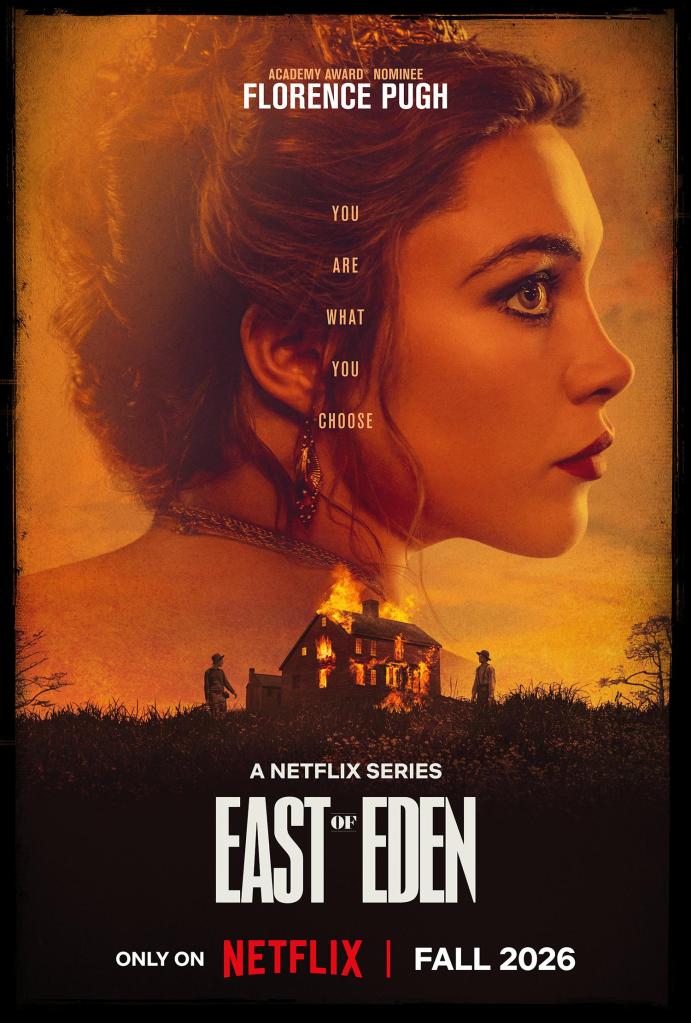
About a year ago, I started reading “Wuthering Heights”. “Read a classic novel” was on my 30 before 30 list and I had always wanted to read “Wuthering Heights”. It turned out to be perfect timing because I was able to finish it before Emerald Fennell’s film adaptation came out a few months later (it’s also more relevant here than I realized because East of Eden has young Cathy Ames reading “Wuthering Heights” in an early scene… from one crazy Cathy to another). It was definitely a tough read but I really loved the experience and decided I wanted to add more classics to my TBR (to be read) list. When Netflix announced it would be releasing a limited series adaptation of John Steinbeck’s “East of Eden”, my next read was chosen for me. The only problem was I wrongly assumed the book would be no more than 300 pages. So when I finally got around to buying a copy, I realized I had about a month and a half to read 600 pages in order to finish in time for the series release. Nothing motivates me like a deadline! I sped-read the novel and, again, really loved the experience (in spite of the haste). The book is fascinating, extraordinarily well-written, and really ahead of its time. It made me even more excited to see how it would be adapted into a seven-episode miniseries. Up to this point, the most well-known adaptation of the novel was the 1955 film starring James Dean and directed by Elia Kazan (I have not seen this film but now I think I might need to). 70 years later, Elia’s granddaughter, Zoe, is the creator behind the miniseries. While Elia’s film only focuses on the final act of the novel, Zoe’s series tackles the entire epic in a show that’s beautiful, emotional, and mostly faithful to its source material.
“East of Eden” is an allegory for the Book of Genesis. It follows two families, the Hamiltons and the Trasks, plus one femme fatale, during the time of American Western expansion in the late 1800s and early 1900s. We see these families through multiple generations as they repeat cycles of trauma and tragedy. Particularly the Trasks whose two sets of brothers are seemingly doomed to the fates of Cain and Abel, the biblical story from which Steinbeck drew the book’s title (“And Cain went out from the presence of the Lord, and dwelt in the Land of Nod, on the east of Eden”, Genesis, Chapter 4, verse 16). The series follows the text of the novel pretty closely, even including much of the exact dialogue. But even seven episodes isn’t enough to cover all of this expansive tale. Much of the Hamilton family is cut out in an adaptive change I don’t mind that much. I enjoyed all of the Hamiltons in the book, but the Trasks are the central plot and the two family’s storylines don’t always have much interaction. Zoe Kazan has said the series was originally intended to be eight episodes but was shortened due to budgetary restrictions. I think that’s felt the most with teenage Cal and Aron. Their individual stories and character development is much more limited here than in the book and I would have liked to see them get a little more time to come into their own. But the general vibe and intentions of the story remain intact despite the cuts and changes. And the ultimate thesis of the novel hits just as hard. The idea of breaking the cycles of generational trauma isn’t new, we just have new language to describe it now. In “East of Eden” it’s “timshel”. The impact that one tiny word, “timshel” (thou mayest), has on a person’s future, their freedom to decide their own path instead of succumbing to one they believe they were fated to, the ability to choose the goodness inside of them over the darkness, understanding that humans are not just one thing and have the capacity to change. It’s an incredibly powerful assertion by Steinbeck that is rendered beautifully in the show.
Probably the most controversial decision and most significant change from the book comes in the characterization of Cathy Ames. Before the series even came out, I saw some interviews with Florence Pugh where she had mentioned that this adaptation attempts to make Cathy more humanized. That really worried me. Steinbeck introduces Cathy in the novel by saying, “I believe there are monsters born in the world to human parents.” In a story that’s an allegory of the Bible, of the Book of Genesis, Cathy is the devil. She’s the original sin, evil incarnate. That’s exactly why I loved her character and found her fascinating. She’s a true-born sociopath. The change is evident from the second the show begins. Variety astutely noted in their review, “‘East of Eden,’ the John Steinbeck novel, opens with a place: the author’s native Salinas Valley, the fertile terrain transitioning from the nation’s frontier to its bread basket at the turn of the 20th century. East of Eden, the Netflix limited series created by actor and screenwriter Zoe Kazan, opens with a person: Cathy Ames (Florence Pugh), the Eve and Satanic temptress of Steinbeck’s explicit Biblical allegory. ‘I believe there are monsters born to human parents,’ Cathy intones — transplanting Steinbeck’s introduction of his most iconic villain into the mouth of the woman it describes.” Where Steinbeck’s sprawling tale follows generations of families growing and changing with the land they’ve settled on, Kazan’s adaptation zeroes in on Cathy as the centerpiece of the story. She’s the narrator, the catalyst, and the anti-hero. I’m not saying this characterization doesn’t make sense. It definitely tracks with the rest of the story, especially when viewing everything through a modern lens in which we’re all overly therapized and “trauma” is a buzzword. This 2026 version of Cathy is a woman who was sexualized and taken advantage of as a young girl and decides her independence and autonomy is the only thing that matters in the entire world. Every choice she makes is in service of her own self-preservation. She’s still a master manipulator and does some incredibly selfish and heinous things, but we understand more of how and why she got to be this way. And we can also see how a woman acting in service of herself instead of the patriarchy in the early 1900s would have been considered sociopathic. (“Fuck the patriarchy,” – Cathy Ames (2026) – Taylor Swift (2021)).
Zoe Kazan told Variety, “Part of what the book is deeply about is: What do we do with the terrible things that have happened to us, or that we have done, or that have come before us? I was really interested in including Cathy in that narrative… One of the things that’s really clear to me is that [Steinbeck’s] viewpoint of her changed as he wrote. He goes from saying, ‘Oh, I’m going to write a monster unlike any you’ve ever seen,’ to saying, ‘I think we all have a little monster blood in us, and people will hate her not because she is foreign, but because she is familiar.’” I understand the adaptive change but I personally don’t agree with it. I’m way more interested in the Cathy who’s a pure evil villain, the monster Steinbeck initially describes. I don’t need her to be empathetic to be invested in her story. I felt like Cathy’s arc in the series started out shaky but then she became more of the book version of the character before falling apart again at the end. I should have known that when the show cast fairly well-known actor Mike Faist to play Charles AND really tried to sell the series as a Adam/Cathy/Charles love triangle in the marketing (this is most definitely NOT The Summer I Turned Pretty) that they would find a way to bring Charles back into the story despite his early departure from the book. Cathy’s final days of hallucinating Charles as if he was her long lost love when I don’t believe she was capable or even interested in loving anyone did not work for me. If you never read the book and this series is your first introduction to Cathy Ames, I think the character comes off as complex and layered and works within the framework of the story. But for my personal tastes and opinions, I would’ve liked to see her as more of the Biblical devil I understood her to be.
All of that said about Cathy’s characterization, I thought Florence Pugh was incredible at portraying her. She does evil and cold, she does empathetic, she does everything and she does it all extremely well. I have always loved her and don’t think she’s ever given a bad performance in her life, but you can just tell how committed she is to this character and to telling this story. The acting is honestly phenomenal across the board. Hoon Lee as Lee is the beating heart of the show and he absolutely stole mine. I know the next Emmys are basically one full year from now, but I can’t imagine a performance more deserving than this one. Mike Faist is fantastic as always, so much so that I understand the impulse to want to bring him back for more despite it not being book-accurate. I have only ever seen Christopher Abbott in Girls so it was definitely a big departure to see him play such a different role in Adam Trask [author’s note: I realized after writing this that he was also in The Testament of Ann Lee which is another a period piece but what does it say that I forgot about that performance…?]. I think it’s a difficult part and he handles it well. Maybe not the best performance in the show but the one that excited me the most was Joseph Zada as Cal. The only thing I knew about him was that he was cast as Haymitch (the lead part) in the upcoming Hunger Games prequel movie as basically an unknown. Seeing him act so well as Cal in this series gives me so much hope for that film and makes me even more excited than I already was. I’m calling my shot: he’s about to break really, really big.
It’s an extremely hard task to adapt a novel for the screen. Even harder when it’s a beloved classic. And even harder when it’s as dense and complex and sprawling as “East of Eden”. With any adaptation, you lose details and internal monologues and sometimes entire characters and plotlines. But despite the changes, both ones I accept and ones I disagree with, I think East of Eden is an incredible achievement as a miniseries. Cinematographer Stuart Dryburgh makes New Zealand a breathtakingly gorgeous stand-in for the Salinas Valley, Laura Karpman’s score swells with your emotions, and the story moves and flows through decades with ease. The talent involved in all aspects of bringing this book to life is overflowing. I loved spending time with this story, in this world, I most definitely cried at the end, and absolutely recommend everyone watch it.
2026 Count: 79 movies, 48 seasons of television, 1 special

