I don’t want to start yet another review this year bemoaning the current state of sequel culture in Hollywood. So can they just make my life easier and stop making them? Recently, I feel like this trend has mostly been around the rom-com/”girl movie” space with 20-years-later sequels or remakes either in production or already released for Freaky Friday, The Devil Wears Prada, Practical Magic, How to Lose a Guy in 10 Days, Serendipity, and I’m sure plenty more that I’m forgetting. The Social Network is an entirely different kind of movie. And yet still falls into the category of movies that did not need a sequel. I am definitely not alone in considering The Social Network a perfect movie. It’s sharp, it’s thrilling, it’s funny, it’s heartbreaking, it catches so much talent at the right time, and it’s endlessly rewatchable, never losing its impact on repeat viewings. At the time of the film’s release in 2010, Facebook, the “social network” at the center of the story, was only 6 years old. While The Social Network was incisive and depicted some darkness within the man behind the site, Mark Zuckerberg, I don’t think anyone, not the filmmakers, not the public, not even the founders of Facebook themselves, knew just how powerful a tool they had created and the true evil that lay at the core. 16 years later, the force that is Facebook is undeniable and Aaron Sorkin, who won an Oscar for his adapted screenplay for The Social Network, is back to write and direct this follow-up story about where we find the social media site now. I found The Social Reckoning to be fine, but completely unnecessary in terms of why this is a story we need to be telling in 2026 or at least told in this way. The movie is not thrilling or provocative enough to justify its existence.
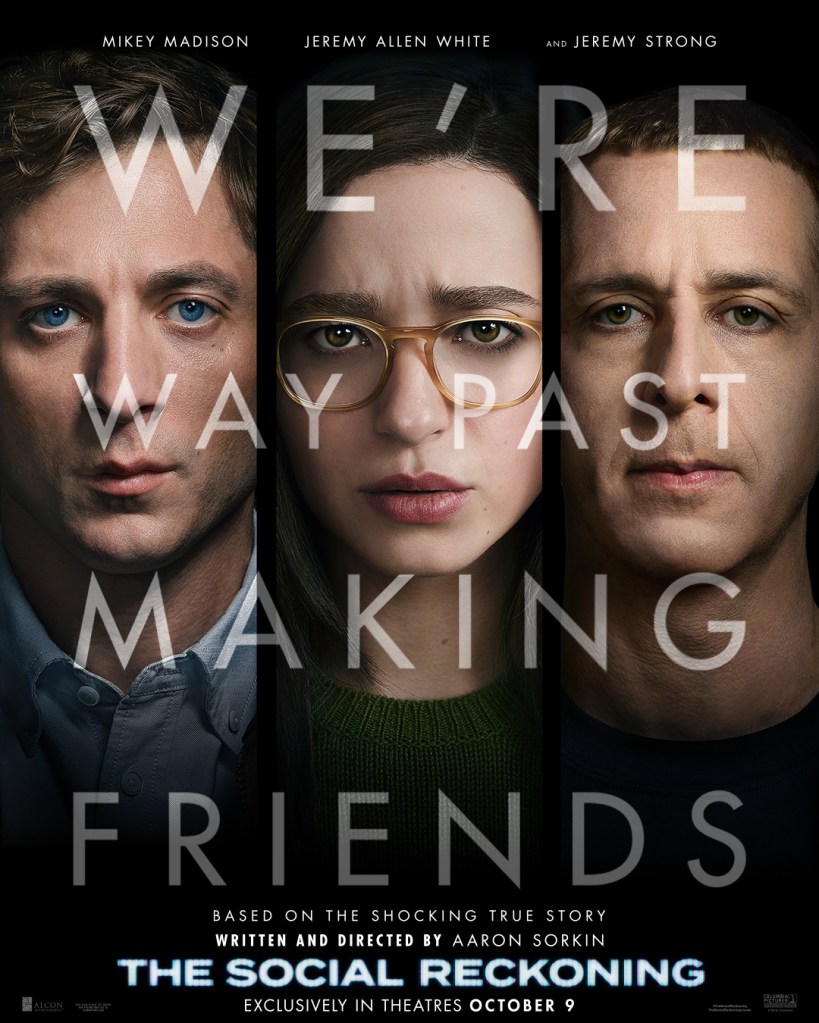
Where The Social Network was a character study of Mark Zuckerberg, The Social Reckoning is a journalism/investigative drama à la All the President’s Men (which they even reference in the film). “À la” as in trying to be but doesn’t come even close to the realm of. The movie starts in 2019 (made clear by timeline graphics on the screen that I thought looked cheap). Mikey Madison plays Frances Haugen, a data engineer at Facebook on the Civic Integrity team. She loves her job and believes the company’s mission of creating connection is important and meaningful. Until she finds proof that Facebook chose to intentionally value profit over public safety. After failing to find anyone at work who will listen to her concerns, Frances reaches out to Wall Street Journal tech reporter Jeff Horwitz (Jeremy Allen White). The two begin a series of clandestine meetings as Frances is worried about violating the terms of her NDA while she increasingly gives him more and more inside information to break the story. What they discover is that Facebook intentionally programmed its algorithm to prioritize reshares over likes because rage bait gets more engagement and leads to more time spent on the platform than posts with positive sentiment. This shift was proven by studies to push users on the platform towards radical extremist groups while Facebook-owned Instagram was having a detrimental effect on the mental health of teenagers. All the while, Facebook execs, including Mark Zuckerberg himself, were fully aware of the harmful side-effects of these updates but chose to ignore them and to deny any responsibility for the outcome. Their findings were eventually published in a series of articles informally titled “The Facebook Files” and Haugen ended up testifying before Congress. Shown intercut with that storyline but taking place in 2021 is Jeremy Strong as Mark Zuckerberg going through a mock congressional hearing with a PR team led by crisis management specialist Raya (Wunmi Mosaku). Mark’s ex-colleague Charlie Garrigan (Bill Burr) is also there as seemingly the only person willing to push back on Mark and stand up to him. Eventually the former timeline catches up to the later as “The Facebook Files” are about to be published. But not before we get to see the best of what 2019 – 2021 had to offer! That’s right, this movie shows us both COVID and January 6. As soon as that started to happen on screen I thought, “No wonder no one wanted to see this.”
The Social Reckoning definitely had potential as a journalism movie but it never totally got there. For one thing, it never feels high stakes or thrilling. Maybe because the reveal of the information that blows the story open doesn’t really seem that shocking at all in 2026. Facebook (and social media in general) is a toxic place that breeds extremist thinking and spreads misinformation to billions of people. Don’t we all know this? Variety wrote in their review, “Where the 2010 film about the founding of Facebook was almost unnervingly timely, this procedural drama about the 2021 ‘Facebook Files’ leak already feels behind the curve.” But maybe most jarring about watching this 2021-set film in the year 2026 was the ending. After Frances testifies before Congress about the dangers of Facebook, she sees Jeff in the hallway and gives him a little fist pump of victory. And then, on screen text reveals that Facebook largely escaped punishment for any wrongdoing, has done next to nothing to fix the problems that were brought forward, maintain their policy not to fact check anything, and, shortly after “The Facebook Files” were released, changed the company name to Meta. So why does the movie try to give us an optimistic ending? They celebrate like they did something but then the movie tells us nothing changed and we know from living in 2026 that nothing has changed. Even the title, “The Social Reckoning”… what reckoning? That was the most bleak and terrifying part of the film for me, to know that they published all this incendiary information, she testified in front of Congress, he won the Pulitzer Prize for the articles, and still there were no consequences for Facebook. That’s not uplifting, that’s horrifying.
Whether it’s an intentional attempt to differentiate itself from the original film or just a complete misunderstanding of what makes that one interesting, The Social Reckoning’s deployment of Mark Zuckerberg as a character is totally ineffective. The Social Network isn’t a great movie because it’s about the invention of a website. It’s a great movie because it’s a look inside the psyche of an angry introvert who is too smart for his own good and is suddenly given an enormous amount of power and influence. If The Social Reckoning is going to be a journalism movie and not a deep dive into Mark Zuckerberg, I don’t really see why he needs to be in it at all. Just to be the connective tissue between the movies? Or to explain Facebook’s reasoning for maintaining a harmful atmosphere under the guise of free speech with quotes like, “We’re a corkboard. We don’t control what people pin on it,”? You don’t need him for that. Especially if the movie isn’t going to do any real work to get inside his mind. Unlike the original, this movie isn’t really about him. And the timeline switching to shoehorn him into the story is overly complicated. But, as many have pointed out, The Social Reckoning is just one of many films coming out at this exact same time that examine the dark side of the tech world and the controversial figures at the top. Alex Gibney’s Elon Musk documentary is about to come out, Nathan Fielder’s Elizabeth Holmes documentary is already breaking records, and Luca Guadagnino’s Artificial, a portrait of OpenAI founder Sam Altman, is set to release Christmas Day. The Hollywood Reporter wrote of the trend, “What all three films have in common [The Social Reckoning, Musk, Artificial], aside from various intersections and overlaps in their stories, is their repositioning of tech billionaires as the new screen villains. Lawyers and finance traders must feel so relieved. Zuckerberg, Musk and Altman to some extent are all exceedingly skilled, ethically dubious con men, all of them able to sell their insatiable hunger for astronomical wealth as a service to humanity, while also selling themselves, not as technocrats so much as creative visionaries.” I guess in that sense The Social Reckoning is a little more timely, but it doesn’t center the technocrat as villain nearly as much as the other films it’s being compared to.
I’m an Aaron Sorkin fan but I do feel like over time he’s started to become somewhat of a parody of himself. If you’ve seen his work, you know the “Sorkin-isms”: rapid-fire dialogue, long monologues, liberal idealism, etc. All of those are present here but what’s lacking is the connection. The movie reminded me in many ways of The West Wing, one of my favorite shows of all time. It has the same dense dialogue full of statistics and technical jargon that will likely go right over your head. The difference is that, in The West Wing, it doesn’t matter that much what they’re actually saying. If you don’t understand every detail, you can still follow the show because it’s really about the human interactions and the characters. That’s what we care about. In The Social Reckoning, we don’t care about these characters. They have no personal lives or emotionality. The story is the statistics and it’s too much to process, at least in a way that penetrates. Aside from the data dump dialogue, some of the lines on the idealist side of the spectrum go way over the edge into corny territory. Some moments show the best of what Sorkin can be, giving some good patter and laughs. But many have said that David Fincher, director of the first film, helped to mitigate some of Sorkin’s worst tendencies with that script. I think that’s really apparent here.
The performances are fine but the actors weren’t given a ton to work with. Jeremy Allen White is going to need to work a little harder or pick some better roles to prove that he can be a film actor. He’s not bad in the movie, just not memorable. This is Mikey Madison’s first starring role since winning an Oscar for Anora and she’s also just fine. Although I did find out that the story detail of Frances dressing like she’s going on a date when she goes to meet up with Jeff so she wouldn’t look suspicious if anyone she knew saw her was a pure movie invention. So was that just an excuse to put Mikey in revealing outfits? I don’t love that. The most performative performance in the movie is Jeremy Strong as Mark Zuckerberg. It’s a strange one but does track with the cold, emotionless villain the movie’s trying to tell us he is. My favorite performance is from Betty Gilpin who is always fantastic and brings the movie some much-needed energy.
Technically The Social Reckoning is the sequel to The Social Network. Aaron Sorkin wrote both scripts and DP Jeff Cronenweth returned as well. And, of course, they’re both about Facebook and Mark Zuckerberg. But I actually think calling this movie a Social Network sequel is working against it because that just reminds us of everything The Social Reckoning is lacking. It doesn’t have the super tight filmmaking and editing, it doesn’t have the now iconic, groundbreaking score from Trent Reznor and Atticus Ross, the story isn’t nearly as interesting, and the performances don’t compare. Why intentionally put yourself in the shadow of a superior film? I think maybe if they had just called this “The Facebook Files” it would have been slightly better received. I don’t think this movie is as terrible as some of the reviews I’ve seen out there. But saying a movie “isn’t terrible” is not exactly high praise. My question for most of the decisions made in this movie and the decision to make it at all is just “why?”
2026 Count: 81 movies, 49 seasons of television, 1 special

