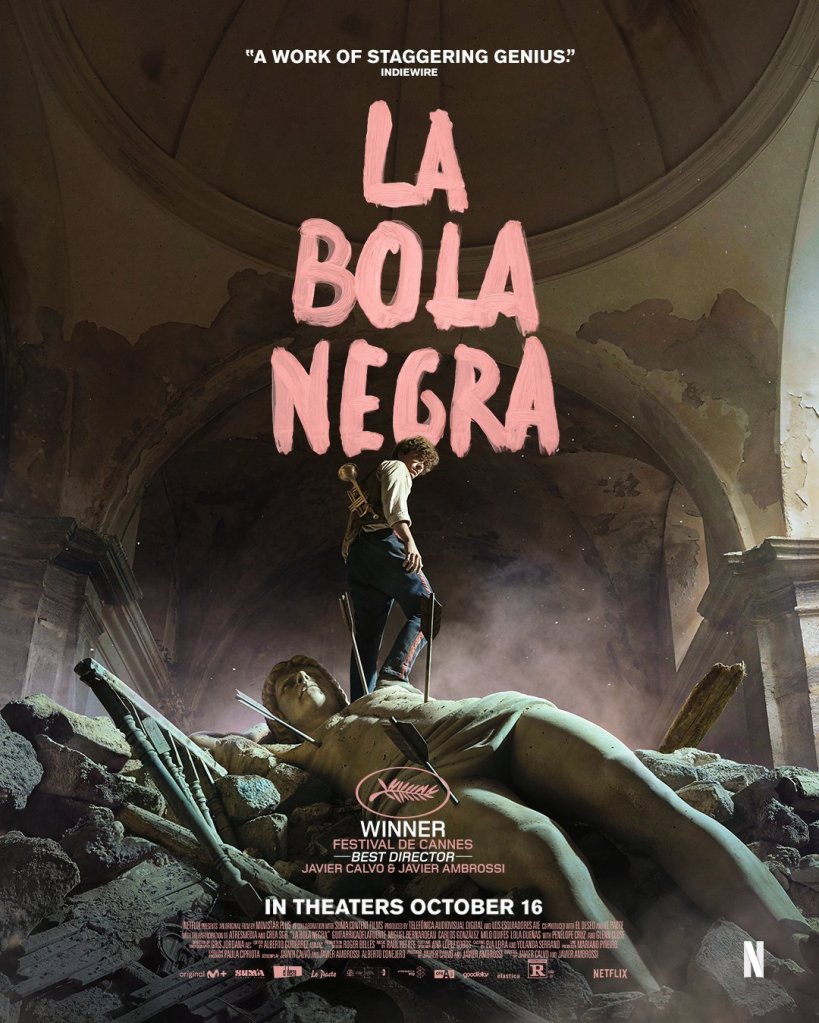
I truly had no idea what to expect from La Bola Negra and it surprised me at every turn. A maximalist production on every level, the film covers the story of three different gay men across decades in Spain. The triptych tale is complex and layered but never hard to follow. I walked out of the theater with my head spinning a little bit from the sheer amount I had just taken in. There aren’t enough adjectives to properly describe the experience: ambitious, sweeping, funny, heartbreaking. But the word I came back to the most was beautiful. From the story, to the performances, to the visuals, to the writing, everything was so achingly beautiful. La Bola Negra is about breaking rules, both within the story and in its filmmaking. The end result is sometimes a little slow in pace, but almost always made up for by the beautiful tableau on screen.
La Bola Negra comes from writing/directing duo Javier Ambrossi and Javier Calvo, known professionally as Los Javis. They’ve worked together on notable Spanish film, theater, and television as well as being famous as judges on Drag Race España. The two were also in a romantic relationship but broke up during the making of this movie (that has nothing to do with the film but that’s just good tea). One thing the movie proved to me was how little I know about Spanish history and literature. If you’re an expert on the subjects, I’m sure this movie will be much easier to follow. For me, it took a little effort (and research after the fact… the tab next to my Google doc for this is the Wikipedia page for the Spanish Civil War) to understand (to the degree that I was able to) but it never hindered my enjoyment. You don’t need to discern every detail of the warring factions to appreciate the human story. Our three timelines follow Carlos (Milo Quifes) in 1932, Sebastián (Guitarricadelafuente) in 1937, and Alberto (Carlos González) in 2017. Carlos is dealing with being blackballed (where the film gets its title) from his father’s social club due to rumors about his sexuality. Alberto is a writer and historian who suddenly learns that a grandfather he didn’t know he had has left him something in his will. When he goes to explore it, he uncovers a world of secrets. Sebastián’s story is the heart of the film. He is living during the height of the Spanish Civil War when his small village is attacked and he is forced to join the fascist army. During his time there, he is charged with trying to extract information from leftist prisoner of war, Rafael (Miguel Bernardeau). Sebastián tries to befriend Rafael but ends up developing much stronger feelings towards him. How all of the stories intersect is the central mystery of the movie, the one you’re trying to piece together the whole time you’re watching. The multi-timeline storytelling in this way actually reminded me a lot of books I’ve read where you’re constantly trying to figure out how the past and present are connected.
So… spoilers! Alberto’s grandfather was Sebastián and what he left Alberto in his will is the original completed copy of the unfinished play “La Bola Negra” by Federico García Lorca. Sebastián came to possess it through his relationship with Rafael. Carlos’s story is that play. I learned after the movie (again, not an expert in the subject) that Federico García Lorca was a real person, a Spanish poet, playwright, and theatre director who was assassinated in 1936 at the start of the war for being gay or a socialist or both. And the unfinished “La Bola Negra” is real as well. The writer was apparently working on it at the time of his death. In writing Carlos’s storyline, Los Javis complete Lorca’s play as if it had been a full story all along. Calvo told Deadline upon their initial investigation of the play, “We realized it was the first play he was going to portray a gay character, so it was going to be revolutionary. But he was murdered. He couldn’t do it, and we were like, ‘What a loss!’” Ambrossi added, “The beautiful thing about the four pages that exist of the unfinished work by Federico Garcia Lorca is that the first page is a list of characters he was going to use. It was like a challenge, you know. I was like, oh my god, if we reimagine this world, it could be something very beautiful.” It’s a bold choice to write your own version of a famously unfinished play by a renowned writer. Maybe my opinion as someone with no history with Lorca’s work doesn’t count for much, but Los Javis’ version worked for me.
Also a real person, Rafael Rodríguez Rapún, the prison of war character in Sebastián’s story. An activist, actor, and former soccer player, Rodríguez Rapún was Lorca’s romantic partner before his assassination. It was Lorca’s murder that inspired him to join the army and fight against the fascist regime. Rodríguez Rapún’s inclusion in the film was actually based on Alberto Conejero’s 2013 one-act play “La Piedra Oscura” (also the inspiration for the character Alberto in the film). It’s a cycle of inspiration: Lorca’s play “La Bola Negra” inspired Conejero’s play “La Piedra Oscura” and both plays inspired the film La Bola Negra. Still with me? “La Piedra Oscura” tells the story of Rafael and Sebastián. You need the whole triptych to paint a full picture but Rafael and Sebastián are the emotional gut punch that make the entire movie. We hear a lot of talk about “yearning” in romances these days from The Summer I Turned Pretty to Heated Rivalry to Wuthering Heights. It’s become one of the biggest indicators of love and attraction in these kinds of stories. I don’t know if I’ve ever seen yearning like what Sebastián does in this movie. In some ways, their love story is one of the least obvious romances ever. They never say their feelings for one another out loud or even kiss. The most physical contact they have is holding each other. But the tension between them says more than most love stories ever do. The way they look at each other so deeply and longingly. The way they never say much with their words during conversations but so much is still communicated. In one scene, Sebastián reaches out to touch Rafael while he sleeps and cannot even bring himself to make contact with his body. He ends up tracing his shaking hand inches above Rafael’s body as if actually touching him would burn them both. And Sebastián’s feelings do seem to cause him immense pain. The more chaste, the more repressed their love is, the more it screams through the silence and pierces the hearts of the audience. Yearning is, by nature, sad and this romance is doomed from the start. (I was trying to be poetic to match the tone of the film but also really wanted to say yearning final boss. Inside you there are two wolves…)
La Bola Negra is definitely a unique film in its portrayal of gay men over the backdrop of war. Javier Ambrossi told Deadline it’s “a war movie” about a bleak time in Spanish history, with Calvo adding it’s “about understanding and seeing the other as a human being. Which is, I think, important.” We never see battle but we do see violence and the effects of a war-torn nation. But in the same interview, Ambrossi also said it’s “a gay movie… I want people to have an experience that is universal. But I don’t want them to miss that it’s gay.” The movie doesn’t shy away from depictions of desire, sensuality, and the male body. Calvo summed it up as, ”Like, a big movie and an intimate movie at the same time. You have the fragility and the war, so it’s about contrast. And it was so nice to create that, because sometimes it’s more difficult to create the relationship of Rafael and Sebastián, with all the tension, than a bombing scene,” (Deadline). Meanwhile Sebastián himself, actor Guitarricadelafuente, contends, “It’s not a film about civil war, it’s not a film about Lorca. It’s a film about life,” (Deadline). I think more specifically it’s about not hiding or waiting to live your life because tomorrow isn’t promised. The unfinished play “La Bola Negra” and the stories of Carlos and Rafael and Sebastián are representative of so much gay history and art and love that has been lost or hidden because of the physical and societal danger that came with being publicly open and out. But La Bola Negra does argue that though some things may have been repressed, they could never be destroyed.
La Bola Negra is a big movie in every sense of the word. The plot is stuffed to the brim, the visual aesthetic takes maximalism to the max, and the sound is all-encompassing. Every shot of this movie is pure art, thanks to cinematographer Gris Jordana. The framing and production design are composed so stunningly in rich, bold color and period detail. The Carlos storyline is significantly more visually surrealistic and artistic, which makes even more sense after it is revealed that it is actually the text of the play being brought to life. It begins to dive deep into magical realism, evoking the poetry of Lorca, the play’s “author”. One particularly affecting scene involving snow is directly based on a line from Lorca’s 1918 poem “Autumn Song”: “Will the snow melt when Death carries us off?” Calvo told Deadline, “This is a movie about poetry and there’s also a poetry in images. You don’t have to show everything. You can give something, and the viewer will leave it to their imagination.” I’ve seen some more negative reviews calling the aesthetic overdone or ostentatious but it worked for me. I was awed by every frame and the skill it takes on every level of craft to create something like this. I was also fascinated by the way music operates within the movie. It’s relevant to the story in every timeline: Carlos participates in essentially a full musical number with a live band and choreography, Sebastián is a musician himself and dreams of doing it professionally, and Alberto is a historian researching music from the 1920s when we first meet him. Music is always around and always prevalent. Beyond the narrative, though, the score or background music from one timeline often bleeds into the visuals of the next timeline in an interesting, anachronistic way. Another stylistic choice that adds to the maximalist feel of the movie.
The peak of the film’s musicality comes in the final climactic stretch when the original song, “La nieve“, starts playing. It’s one of those songs where just hearing the opening chords makes you immediately emotional. I barely understood any of the words but I felt it in my soul. That song comes to us courtesy of Guitarricadelafuente, the actor who plays Sebastián and co-wrote and performed the original track. A musician first, Guitarricadelafuente hasn’t crossed over stateside but sells out arenas in Spain and is making his acting debut in La Bola Negra. And what a debut. Calvo told Deadline of casting him that the directors were drawn to the “magnetism, the sadness” in his eyes. “He had to be the eyes of the viewer and he has eyes that you can rely on, and he had this shyness, but also this bravery, this strength, but then this subtleness. We just knew it was for him.” He really does play Sebastián like an open wound in an impressively gutting performance. He could be up for two Oscars this year with Supporting Actor as a maybe and Best Original Song feeling like a lock (sorry to my close, personal friend, Taylor Swift, that race might be getting tight). Miguel Bernardeau as Sebastián’s counterpart, Rafael, is a more established screen presence and brings some of that steadiness to balance Guitarricadelafuente’s anxious energy. Bernardeau manages to be charming while also haunted by his past and both resigned to and fearful of his future. Milo Quifes as Carlos plays timid and crestfallen while Carlos González as Alberto gets much of the film’s comedic moments and emotional outbursts. Two giant cameos come in the form of Penélope Cruz and Glenn Close. Penélope Cruz plays a “cupletista”, a Spanish singer whose bawdy, openly sexual acts were inspired by the the Moulin Rouge. She performs for Sebastián and his fellow soldiers on a night out and provides mega-watt star-power from the second she shows up. You can’t take your eyes off her. Glenn Close plays an American historian and expert on Lorca and I was shocked (and minorly impressed) to see her acting in Spanish. Definitely an interesting casting choice for this movie but one that does bring gravitas to the entire project.
Aside from winning a shared best director award at Cannes, the movie became the first non-English-language film since 2011 to win the People’s Choice Award at the Toronto International Film Festival, known to be a huge Oscars precursor. Right now it is being considered as the only film with a chance to win Best Picture over The Odyssey. As Variety noted, “The Odyssey is a technically dazzling, timeline-toggling examination of the power of love set against the madness of war, while La Bola Negra is … also all of those things…” But it’s still way early in the season so who knows what could happen? And the response so far to La Bola Negra has been much more divisive than I expected after the film festival accolades it’s received. I get some of the criticism, but definitely not all of it. Unfortunately, I worry that the audience response will only get worse because the movie came out in theaters in a very limited release before it’s scheduled to be released on Netflix in December. I’ve said a million times that I think all movies are better in theaters and, anecdotally, when I see a movie in theaters I always like it better than people who watched it at home. When I went to see this movie in theaters, I spent the last 30 minutes crying because of the emotional swell of the ending, received a free poster on the way out while trying to hide my tears in the bright lobby, and then went home and hung the poster on my fridge (still there!) while still processing what I just saw. That experience cannot be replicated on your couch while you’re staring at your phone. Ambrossi said to Variety, “We made this movie for the screen. We shot it in 35mm. So that was good news, that people can experience the movie as we thought they would. But Netflix, you can rewatch — you can see all of Penélope Cruz’s numbers again and again.” This is such a beautiful spectacle of a movie that’s both intimate and grand and I will be thinking about it for a long time. I’m sad more people won’t get to see it in theaters but I really hope they will watch it on Netflix and put their phones down!
2026 Count: 82 movies, 49 seasons of television, 1 special

