**This review contains spoilers… that’s the only real way to talk about it**
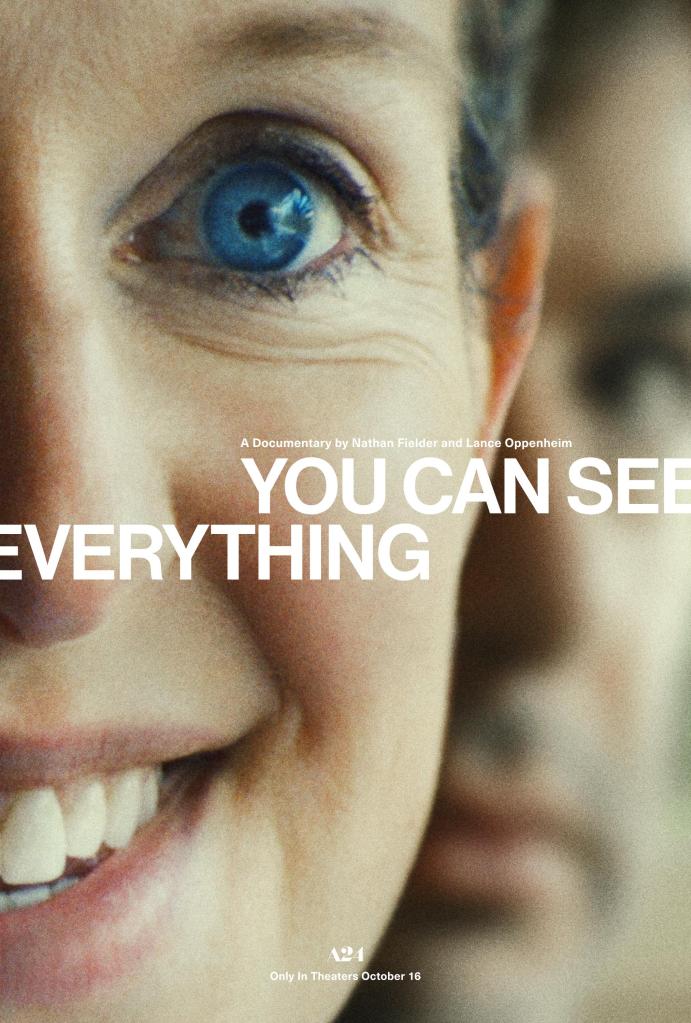
There’s no other way to start this review than by saying “what the fuck”. I’m pretty confident that has been the reaction of every single person walking out of the theater after seeing this movie and also probably multiple times during it. You Can See Everything is becoming one of the most talked about movies of the year and yet, three months ago, barely anyone knew it existed. The announcement of a mystery movie screening at the Telluride Film Festival over Labor Day weekend set the internet abuzz. When that mystery movie was revealed to be a previously unannounced Nathan Fielder/Elizabeth Holmes documentary, the intrigue and excitement only intensified. For me, however, I wasn’t moved. I am absolutely not a Nathan Fielder fan. I can’t handle even the most minor of cringe comedy due to a severe case of second-hand embarrassment, but Nathan’s particular brand involves real people which makes it all about a hundred times worse. I had no intention of seeing this movie. But those are always the ones that get me. As soon as it was released, every single post about it online gave it 5 stars and called it “the movie of the year”. So how could I not go see what it was all about? Well, I’m so glad I did because I have truly never seen anything like this before. Some of the many adjectives I wrote down to describe the film were: genuinely insane, baffling, unsettling, absurd, fascinating. Director BenDavid Grabinski wrote on Letterboxd, “I’m not exaggerating when I say at one point I felt like I was losing my grip on reality.” I think that’s why this movie is as powerful as it is. Because it makes you question everything. Weeks later, I feel like I’m still processing what I watched and changing my opinions on it every day. So I’m going to do my best to talk about You Can See Everything in a coherent way and not just say “what the fuck” over and over.
To start from the beginning, Elizabeth Holmes is the former CEO of Theranos. In 2003, she founded the healthcare technology start-up at age 19 and became America’s youngest self-made female billionaire. The company purported to revolutionize blood testing by only requiring a very small amount of blood to run tests and received money from top investors including Rupert Murdoch and Larry Ellison. The only problem was, the technology didn’t work. Holmes and her business and romantic partner, Ramesh “Sunny” Balwani, were accused of knowing what they were selling was a scam but continuing on anyway. In 2022, Holmes was found guilty on four counts of defrauding investors (but was acquitted of defrauding patients) and sentenced to 11 years in prison for her crimes. After the downfall of the company but before the trial officially began, Elizabeth began a relationship with Billy Evans. They are not married but have two children together, the youngest being born six months before she was set to report to prison. Enter Nathan Fielder. Best known for his Comedy Central show Nathan For You and HBO’s The Rehearsal, Fielder was looking for a project he could collaborate on with his friend, director and documentarian Lance Oppenheim (most recently known for directing Primetime with Robert Pattinson). The thought came up of doing something about Elizabeth Holmes while, at the same time, Elizabeth and Billy were also shopping around the idea of having someone make a doc about them. Fielder told Variety, “When I met her, I remember having this weird experience where she seems so genuine at times. But then I’m like, ‘no,’ and clocking and tracking my thoughts and being like, ‘Okay, I know she’s a liar.’ It was a weird mental thing. From there, we were like, ‘Can we roll the dice on something if they were open to having cameras in?’” Elizabeth and Billy were on board and the studio, A24, agreed to fund the project while also giving the directors full rights to stop and scrap the film at any time if they felt like it wasn’t working. They had no idea what they might find.
The documentary starts in 2023 and follows Nathan Fielder as he moves into Elizabeth and Billy’s California home with them and their two children 34 days before she is set to report to prison. Holmes hadn’t given an interview in a decade before inviting a full camera crew inside of her house. “Why would anyone want a stranger living in their home in their final moments as a family for 11 years?” you might ask. Great question. We see Fielder both observe the family’s “natural” life and then also interview his subjects multiple times, trying to understand their psychology. I was intrigued by the very strange portrait of a person that was being painted, but not sold on this movie being as absurd as had been promised. Then, halfway through the movie, Elizabeth says goodbye to her family and heads to prison in Texas. The prison won’t allow any interviews or cameras so that’s essentially the last time we see her. With over an hour of runtime left, I wondered what else the movie could possibly have to offer. The cameras pick up again two years later in 2025. Not only does the second half of the film provide an increasingly disturbing depiction of Billy, but also introduces a new character in the form of actress Amanda Seyfried. Amanda Seyfried who played Elizabeth Holmes in the 2022 Hulu series The Dropout which she won an Emmy for. (Not only is The Dropout a great show, but I kind of feel like it’s required viewing for this movie because of Amanda’s connection to the story and because the movie doesn’t go deep on Elizabeth’s backstory and the story of Theranos. Pretty much everything I know about that I know from the show… another issue that comes up later.) Amanda’s role is two-fold. In some moments she joins Nathan in his investigative journey in scenes that play like a buddy cop movie and in other moments she reprises her role of Elizabeth Holmes in recreations of scenes that were not captured on camera for which Nathan himself wrote the transcripts from memory (with Christopher Abbott making a surprising cameo in the role of Billy Evans). The movie starts as one thing and then becomes this entire other wild, complex, mulit-layered thing. The second half is the part that blew me away and had my jaw hanging open at every new turn.
The movie starts out as, and was likely intended to be, a character study of Elizabeth Holmes. It’s not another investigation of Theranos, it’s a deep dive into the person at the center of it. And it’s not trying to litigate whether she’s guilty of the crimes she was convicted of but, more broadly, can we believe anything she says about anything? What is real, what is true, in the world and mind of Elizabeth Holmes? The fun of the movie is that you will likely be less able to answer that question after watching it than you were before. Elizabeth herself seems to believe that everything she’s saying is the truth. She even tells Nathan in one moment that she’s never lied about anything in her whole life. Seems a little like someone overcompensating. But the more Nathan talks to her and pushes back against her, the more she comes across as someone neurodivergent. Even Billy tells us that she just doesn’t think the same way as other people. Is that an excuse for committing fraud on the level that she did? Not really. And is it even possible that no one realized that everything that happened with Theranos could have been based on a misunderstanding about word choice? Seems highly unlikely. Some former Theranos employees have even come out and said the way she acts in this movie is not the Elizabeth they knew back in the day. But, yet, it’s equally hard to believe that Elizabeth Holmes is the greatest actress of all time by constantly keeping up this innocent, too-smart-to-have-social-skills front. Could she just actually be someone whose brain works differently than most and therefore can’t understand how what she says and does could be interpreted in ways other than how she meant them? Whoever she is or whoever she’s purporting to be, she never feels like a real person.
Once Billy’s role in the film kicks into high gear in the second half of the doc I thought, “Oh, Nathan went to profile one potential sociopath in Elizabeth and found a different one in Billy.” He comes across as narcissistic, paranoid, psychotic, and plain evil. And because of that, by comparison, Elizabeth looks a lot better. Maybe she’s just a blindly unaware girl who keeps falling in with these controlling men (Holmes blames Sunny Balwani for much of what went wrong with Theranos). Does her neurodivergence just make her easier to take advantage of? Or is she intentionally seeking out these men to make herself look better and give herself some cover?
Amanda Seyfried’s involvement adds another interesting wrinkle. Co-director Lance Oppenheim told The Hollywood Reporter, “The Amanda piece — she maybe knew who Nathan was, but they’d never met each other before. That first moment when we’re in her apartment, that’s the very first time any of us had really spoken with her in person, when she’s watching the footage. She even says in the scene, ‘I have no interest in doing this again.’ Then she started imitating her, and that suddenly led to us being like, ‘OK, well, this is interesting.’ It almost felt like she had this unfinished business, this desire to do it again. That led us down a whole different path. She brought her own baggage into the process too. It was amazing. It’s a testament to the way we made the film.” It’s exactly that baggage that Amanda brings to the film that I find most fascinating. Playing Holmes in The Dropout may be one of her most recognizable screen roles (and her most awarded) but Seyfried’s portrayal of Holmes in The Dropout is also the one that shapes Holmes’s public persona the most. Many consider that characterization to be entirely accurate to who Elizabeth Holmes is and multiple extras throughout the doc bring up having seen the show. Elizabeth herself is not thrilled by this and expresses feeling hurt by it. She even mentions to Nathan (in a moment off camera that we learn about through reenactment) that she doesn’t understand how a woman, or team of women who created the show, could do that to another woman, could portray her so “inaccurately” and make entertainment out of her real life. Amanda for most of the movie is her kooky, open self but is also reasonable and logical. She’s always trying to be understanding and absorb and process the information she’s getting. And she even defends Elizabeth against Billy when she sees how awful he is saying that they need to get her away from him because has to stand up for another woman dealing with a terrible man (which earned applause in my theater). But when Elizabeth comes for Amanda directly, she acts like any human being would and gets defensive. I thought it was really brave of Amanda to participate in this and to sign off the final product because she doesn’t always come off as perfect. Sometimes she loses her cool or doesn’t say the right thing or inserts herself too much. I really liked that she’s not trying to be the polished, media-trained celebrity and that she’s okay with looking bad sometimes if that’s the real version of her. She might be the most honest person in the entire movie.
Which brings us to our guide through this bizarro world, Nathan Fielder. Nathan is often known for blurring the lines between reality and fiction in his work and You Can See Everything might be the perfect summation of that. His inclusion onscreen throughout the doc often lends itself to moments of humor, like shots of him lurking in corners watching his subjects or being so dead-pan in his tone when speaking to them, but also pushes the story forward with his probing questions and looks of skepticism. But, at the same time, it eliminates any real sense of objectivity as Nathan himself gets pulled into this warped reality. He said during a Q&A following the first public screening at Telluride, “What I am really excited about is for you to see the movie and tell me what I experienced. I don’t know why they wanted me there. Why am I there?” (Deadline). And why him of all people? He added later to The Hollywood Reporter, “This is an interesting time because there are a lot of reactions to this, and I have time to look at some stuff. There is this phenomenon that happens that is related to proximity. When you’re in their bubble, you’re in a different mindset than when you step out of it and you’re in the world of everyone else. We weren’t talking to anyone about this project; no one had seen it, we were just talking amongst ourselves for so long. And now the conversation is so all over the world, I’m gleaning new things from just hearing what other people are saying. Also, it does feel like people bring to this a lot that’s inside them. It’s not just what’s on the screen, or else everyone would have a consensus. There’s something coming from people, individuals, and it’s hard sometimes for me to separate that from what we’re objectively looking at.” Another movie this year, this month actually, that functions as a Rorschach test for audiences.
A running theme throughout the film for me was the way everyone gets sucked into the orbit of Elizabeth Holmes. Billy, for everything that he is, is completely consumed by her and builds his life around her. Amanda Seyfried becomes overly involved and invested, going from bystander to full participant. And Nathan gets kind of attached to Elizabeth, to the point where Amanda even asks him if he’s trying to protect her in his depiction because he cares about her. He never gives a clear answer to that. So is she neurodivergent or a master manipulator? I think maybe both can be true. Maybe she does think differently and doesn’t always know how to communicate exactly what she means. Maybe she is truly delusional and believes 100% that she didn’t do anything wrong. But I also think she knows how to emotionally manipulate people (maybe through prolonged eye contact with her giant eyes) to gain sympathy. I think that’s part of how Theranos became what it did in the first place. Or maybe she just is that good at playing the part and convincing everyone she’s someone else.
It’s impossible to really know. Oppenheim told The Hollywood Reporter, “We’re dealing with a real-life human optical illusion. That’s who she is.” In the infamous first teaser for the movie, Nathan asks Elizabeth, “You’re being real right now?” and she replies, “I’m always being real.” In another recurring thread throughout the movie, Billy and Elizabeth push back on a quote attributed to Elizabeth in an New York Times profile of her where she’s quoted as saying regarding actors portraying her in movies and TV: “They’re not playing me. They’re playing a character I created.” Billy posits that Elizabeth more likely said, “They’re playing a character they created.” (The importance of minor word choice completely changing the meaning of a sentence also comes up again and again.) In a thorny twist, both Billy and Elizabeth and the New York Times reporter behind the article claim to have recordings of the interview that prove their version, but neither side actually produces that evidence. The idea of “playing a character” is the basis of the entire movie. There’s the central question of whether or not Elizabeth is playing a character the whole time, but there’s also a character that has been created by her public image that is out of her control and makes Billy, Amanda, and Nathan all complicit. Billy posts from Elizabeth’s Twitter account posing as her and uses her image and likeness for AI holograms and other strange business ideas (without her direct consent). Amanda previously made The Dropout and now impersonates Elizabeth again in You Can See Everything that, on the surface seems accurate, but also brings some of Amanda’s own interpretation to the role, as any actress would. Nathan tests the limitation of memory when he attempts to script reenactments for Amanda based on interactions he had with Elizabeth off camera. Amanda actually stops reading the script at one point towards the end to point out that if Elizabeth said, “I knew he was talking to you about it,” that would prove she knew about secret dealings between Billy and the documentary team. Nathan considers this before saying that, during his conversation with Elizabeth, he didn’t believe that she knew. Because of that, she must have actually said, “I knew he was talking to you about something.” He changes it in the script (this is where she accuses him of trying to protect her by making her look better). Again, a simple word choice that changes the entire meaning. But how do we know if that’s really what she said? How do we know if anything in the reenactments is accurate when they are just based on one person’s biased memories? If the audience’s perception of Elizabeth Holmes comes down to the difference of one singular word, how much stock can we put in the portrayal we’re watching? How much stock can we put in any portrayal of a person in which they don’t have any autonomy? Everyone in the film is playing a character and they’re all playing Elizabeth Holmes in some way, shape, or form. As Letterboxd user @whentheometfilm wrote, “never has a documentary felt so much like everyone was acting.”
It does beg the question, is this a documentary? It definitely pushes the limits of what a documentary can be and questions whether a doc needs to be objective to be authentic. Lance Oppenheim told The Hollywood Reporter that it was Elizabeth and Billy’s idea for Nathan to appear on camera in the film, not the original plan. They didn’t really have a plan. Fielder said to Variety, “It wasn’t until we started shooting that moments would happen — some of them are in the film — and then after Lance and I would talk about what we thought happened there. We’d completely disagree on what something meant to us and what we thought was happening. Then we were like, ‘Oh, this is really interesting. If we can’t agree on what’s happening, there’s something here.’ And our curiosity sort of just like drove us from there.” Oppenheim added, “Every person that worked on this movie was going through a similar feeling of cognitive dissonance… We would unpack the day’s events, and no one could agree on the seemingly mundane moments that would transpire. Everyone had a different point of view. So Nathan and I started thinking, ‘If we can just try and get out of the way of this and capture this and attempt to bring people as close to that experience of being there as possible, then maybe there’s an interesting project to be made out of this… The laws of reality and everything that we thought was going on outside just evaporated, and no one could agree. I feel like our brains were scrambled. We were also unsure for so long if we even had anything that was worthwhile to make and put together.” As for authenticity, the filmmakers argue that the final product was their version of being authentic. “This project’s different than the other ones, but I feel like the process of making it was just a process of including everything that needed to be included to make it as honest as possible. It was not a choice of trying to do anything different — like, we were very stringent about trying to be accurate, trying to portray things authentically. The only reason we started including these other things [such as reenactments] was because it felt dishonest not to. We’d actually be hiding things from the viewer if we didn’t let them in on what we knew or what we observed,” Fielder told The Hollywood Reporter.
Considering everything involved in the process of filming this movie, it’s extremely impressive what they were able to shape it into. 700 hours of footage was cut into a 2-hour and 54-minute movie (that, if I’m being honest, felt more like five hours. Not because it was bad but maybe just because it was like five different movies in one). Cinematographer David Bolen (also the cinematographer on Oppenheim’s Primetime) perfectly places the camera to document the right action, reactions, and smaller details that help paint a full picture. Some shots are extreme, uncomfortable close ups on people’s faces while others emphasize the voyeuristic nature of documentaries by capturing intimate moments through windows or doorways. The movie also looks much more beautiful than it has any right to. Lance Oppenheim’s skill and experience as a documentarian is really felt throughout and I think also helps mitigate the typical Nathan Fielder cringe-tone that I don’t personally like.
You Can See Everything has quickly become a cultural phenomenon. It opened to $15 million at the box office, an insanely high number for a non-fiction film. Trying to get a ticket for myself was a challenge as theaters were fully sold out for days. It also saw a record-setting 99 on Metacritic, 98% on Rotten Tomatoes, 4.7 (out of 5) on Letterboxd, and 9.4 on IMDb the Monday after opening weekend, making it the highest-rated film of all time on both Letterboxd and IMDb (at the time). The movie also led to a 186% viewership spike for The Dropout. And the conversation around the film is just getting started as it gears up for an Academy Awards run where it could, again, make history. No documentary has ever been nominated for Best Picture at the Oscars in 98 ceremonies. And, no actor has ever been nominated for appearing in a documentary in the history of the awards. But it has been confirmed that Amanda Seyfried is eligible for and will campaign in the Best Supporting Actress category for her work in the reenactments. I genuinely thought to myself during the movie that she should be nominated for this because she’s so good in it. It’s conceptually insane to be nominated for an acting award for a documentary but I absolutely support it (and it would be very funny if she won both an Emmy and an Oscar for playing the same part). Nathan Fielder could potentially be recognized for Best Picture, Best Documentary Feature, and/or Best Director. However, the documentary branch of the Academy is known to be very persnickety so there’s a real chance the movie is nominated for Best Picture but not Best Documentary. The doc branch tends to reject films that feature celebrities, get wide releases, have box office success, and are more formally adventurous. You Can See Everything checks all of those boxes. But longtime member of the doc branch, Bar-Lev, said of the movie on a panel at the SCAD Savannah Film Festival, “… a lot of times, they forget — we forget — that it’s an Oscar for a film, not for an issue. We all care about issues, but that’s not what this Academy Award is supposed to be about. It’s supposed to be about technique and craft,” (The Hollywood Reporter). So we’ll just have to see come January!
There are so many ingredients that have made this movie the perfect recipe for success. The secrecy of its origins that turned into buzzy word-of-mouth. The theater experience of audiences laughing, gasping, and cringing and going back for more to try to understand what they just saw. The glowing reviews and rating. The awards chatter. But also the way the movie somehow captures the zeitgeist of our current moment where no one trusts anyone or anything. From “fake news” to misinformation online to AI, it’s impossible these days to know what is real and who to believe. Variety wrote in their review of the film, “You Can See Everything is a true parable for our time. It overlaps reality, performance, greed, deception, and mental illness, bringing you into the head-spinning vortex where they all meet.” But, to me, You Can See Everything has the best possible outcome a movie has to offer: lasting resonance. All I want to do is talk about this movie with everyone I know, listen to podcasts about it, read articles about it, and just keep thinking about it and pulling it apart constantly in an attempt to make sense of it. There are like 10 million more crazy moments and details I didn’t even mention. It’s like an unsolvable puzzle you’re determined to figure out. I don’t think I’ll ever solve it, but I also don’t think I’ll ever stop trying. And that’s what makes the film such an incredible achievement.
2026 Count: 83 movies, 50 seasons of television, 1 special

